Wagner's Rare Wooden Trumpet Resounds in New Met Opera Production
A startling and rarely heard sound emerges from the wings approximately four and a half hours into Wagner's monumental opera "Tristan und Isolde" at the Metropolitan Opera. This distinctive auditory moment is produced by a nearly four-foot wooden horn known as a holztrompete, specially constructed to the composer's somewhat ambiguous specifications.
A Dramatic Signal of Arrival
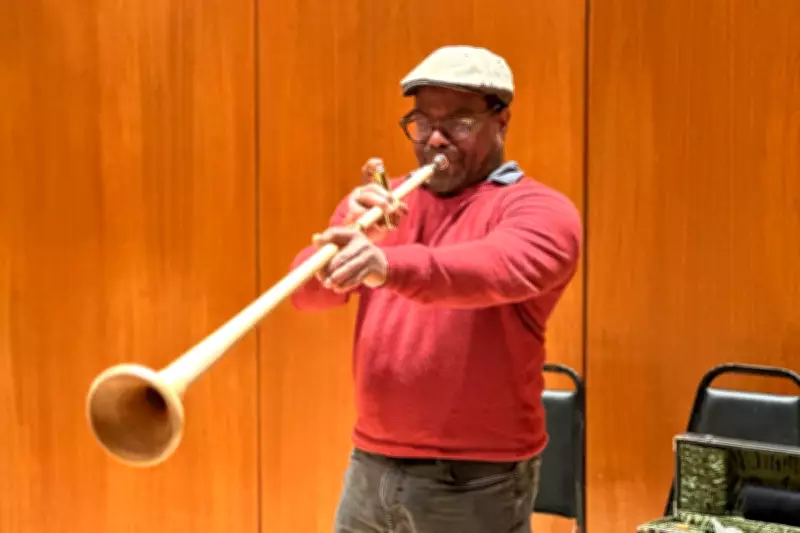
The holztrompete's unique tone signals the arrival of the ship carrying Isolde and King Marke to Brittany in Yuval Sharon's compelling new production. This sound inspires the mortally wounded Tristan to cling to life for a few more precious moments. "Joyous," described Billy R. Hunter Jr., the Metropolitan Opera's principal trumpet, who plays the wooden instrument from stage left.
The production, which opened on Monday to predominantly rave reviews and stars Lise Davidsen, features a specially constructed horn nearly matching Hunter's height. It measures a minimum of 46.5 inches and can lengthen slightly when the tuning slide is adjusted.
A Distinctive Sonic Creation
"You listen to the sound of the holztrompete and the imitation, it's a clear difference," remarked bass-baritone Ryan Speedo Green, who performs as Marke alongside Davidsen's Isolde and Michael Spyres' Tristan. "It blows my mind to think that Wagner created it himself. How many humans have created an instrument? It really sounds like victory."
While Wagner's better-known Wagner Tuba was invented in the 1850s for his Ring Cycle to bridge horn and trombone sounds, the holztrompete's details remain more nebulous. Wagner wrote the notes for an English horn but included a footnote to his score indicating it should produce "the effect of a very powerful natural instrument, such as the alphorn."
Historical Evolution of the Instrument
Research by Daniël Vernooij reveals that Wagner specified in a June 15, 1861, letter to violinist and conductor Heinrich Esser that he wanted the instrument to be "at least three feet long, made of wood, almost trumpet-like, slightly curved downwards so that the bell is open to the side."
Although a wood trumpet was used at the opera's premiere, Wagner's Bayreuth Festival in Germany switched in 1891 to a newly created woodwind called the Heckel-clarina, resembling a soprano saxophone. Conductor Hans Richter replaced that at Bayreuth in 1902 with a tárogató, a woodwind common to Hungarian folk music. The Metropolitan Opera used the tárogató when James Levine conducted "Tristan" from 1981 through 2008.
Mitch Weiss, a Met clarinetist for 38 years, recalled taking over the tárogató in the 1980s from Roger Hiller. "One day he said, 'I'm sick and tired of playing this. You play it.' And he handed me the tárogató," remembered Weiss, now 93. Weiss later auditioned for Levine alongside principal trumpet Mel Broiles, with Levine ultimately selecting the tárogató for the performance.
The Modern Met Introduction
When Daniel Barenboim led the opera at the Met later in 2008, he introduced his own holztrompete. "He pulled out this thing. I'm like: What in the world?" Hunter recalled. Barenboim informed him, "'This is what we use at Bayreuth.'"
After Barenboim's departure with the horn, Thomas Lausmann, hired in 2019 as the Met's director of music administration, commissioned a new holztrompete from Thein Brass in Bremen, Germany. This manufacturer had previously built an initial version for the Hamburg State Opera. "They recreated an instrument that they believed would come very, very close to the instrument Wagner would have had in his time," Lausmann explained.
Technical Characteristics and Performance
Hunter noted that the bells of the Barenboim and current Met versions differ slightly. Martin Wagemann, principal trumpet of the Deutsch Oper Berlin, has played the Holztrompete at Bayreuth since 2018, using different versions at each venue.
"The Deutsche Oper trumpet sounds slightly darker and woodier, but it is softer and therefore harder to articulate," Wagemann wrote in an email. "The Bayreuth instrument has slightly better intonation and a brighter sound, which allows for clearer articulation—something you need in the Bayreuth acoustic."
Hunter compared the holztrompete to a bugle, noting it has only one valve that lowers notes by a step, whereas a standard trumpet features three valves. "On a regular trumpet, there's slides you can adjust with pitch but with this, there is no adjustment," Hunter clarified.
Preparation in Domestic Surroundings
Preparing for the mostly sold-out run through April 4, Hunter practiced for a month in the living room of his Upper West Side apartment. His audience consisted of his wife, a pianist, and their children. "If the kids like it, then I know it's OK," Hunter said. "It's like the food. If they eat the food, it means you did a good job."
Hunter completes the first act six stories above the stage in The Domes at the auditorium's tip, where the banda of trumpets and trombones loudly greets Tristan's ship in Cornwall. The boat's arrival at Monday's production premiere also marked Hunter's temporary departure: he had approximately three hours until the wooden horn was required again.
"I left to put my daughters to sleep, relieve grandpa and wait for my wife to return from work," Hunter recounted, highlighting the intersection of professional dedication and domestic responsibility in bringing this rare musical moment to life.