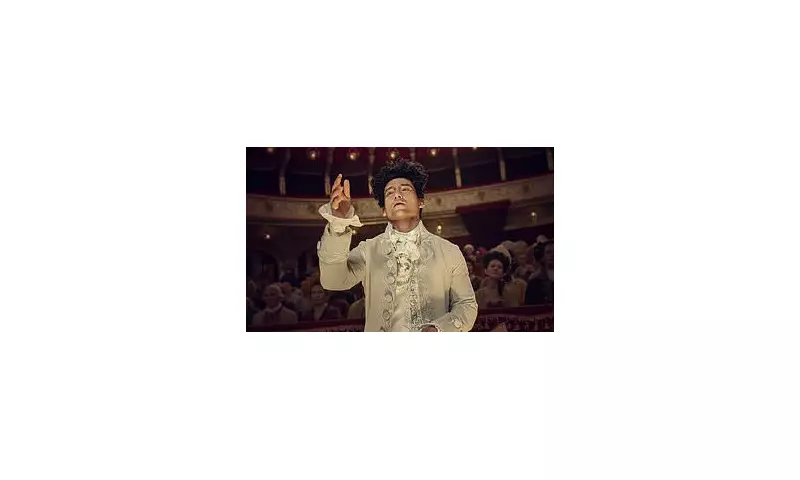
Sky Atlantic has unleashed a new, nightly adaptation of Amadeus in the run-up to Christmas, taking the Oscar-winning 1984 film as a blueprint and cranking every element to its extreme. The result is a version that is louder, cruder, gorier, and significantly raunchier than its predecessor. However, this amplified approach does not automatically translate to a superior piece of television.
A Vulgar Descent into Genius
The series opens with a jarring introduction to Wolfgang Amadeus Mozart, played by Will Sharpe. We first encounter the composer staggering from a carriage and vomiting in front of his horrified landlady and her daughters. This sets the tone for a portrayal that frequently prioritises shock over subtlety. Later scenes include Antonio Salieri, portrayed by Paul Bettany, in a moment of solitary despair at his harpsichord, and an infamous, hygiene-defying incident involving Mozart and a strawberry.
While the original film faced criticism for its coarseness, this adaptation pushes boundaries further. Screenwriter Peter Shaffer, who adapted his own 1979 stage play for the screen, historically defended such portrayals by citing Mozart's notorious scatological humour and prolific sexual appetite. Yet, here, the most vulgar moments risk feeling like a direct affront to the sublime beauty of the composer's own music.

Reimagining Genius for a Modern Audience
The casting of Will Sharpe as Mozart is a deliberate departure from the powdered-wig archetype. With his wild black hair and mixed heritage (his mother is Japanese), he visually breaks from the conventional image of a pale, blue-eyed prodigy. Sharpe, a Bafta-winning actor and writer, brings intensity but sometimes struggles to embody the innate, reckless hedonism of the character. His portrayal of drunkenness or moments of musical inspiration can occasionally feel performed rather than fully inhabited.
The series grapples with a contemporary question: how are we meant to view Mozart today? In an era of decolonising curricula, the composer—a white, male, privileged 'nepo-baby' supported by an emperor—represents much of what modern scrutiny challenges. The show cannot rely on automatic reverence for his centuries-old genius; it must make its case anew.
Salieri: The Patron Saint of Mediocrity
The true emotional core of this Amadeus remains, as in the original, the tortured court composer Antonio Salieri. Paul Bettany delivers a masterful performance, achieving a nuanced feat where F. Murray Abraham's Oscar-winning turn did not: he elicits genuine pity. Salieri's envy, malice, and cruelty propel the narrative from farce to tragedy, beginning with his failed suicide attempt and subsequent confession.
Bettany's Salieri is painfully self-aware of his own mediocrity. Initially in awe of Mozart's brilliance, his turn towards vengeance is sparked by personal mockery, his eyes reflecting more anguish and self-pity than pure wickedness. This complexity makes his machinations strangely forgivable. Shaffer's sparkling dialogue survives intact, with lines like Salieri being 'the patron saint of mediocrity' resonating as powerfully as ever.
In the final analysis, it is Salieri's consuming mediocrity, not Mozart's fleeting genius, that commands attention in this 2020s adaptation. In a decade often preoccupied with re-evaluating historical icons, that focus feels strikingly apt. The series is a flashy, provocative, and sometimes excessive spectacle that asks whether we can still hear the music through the noise.