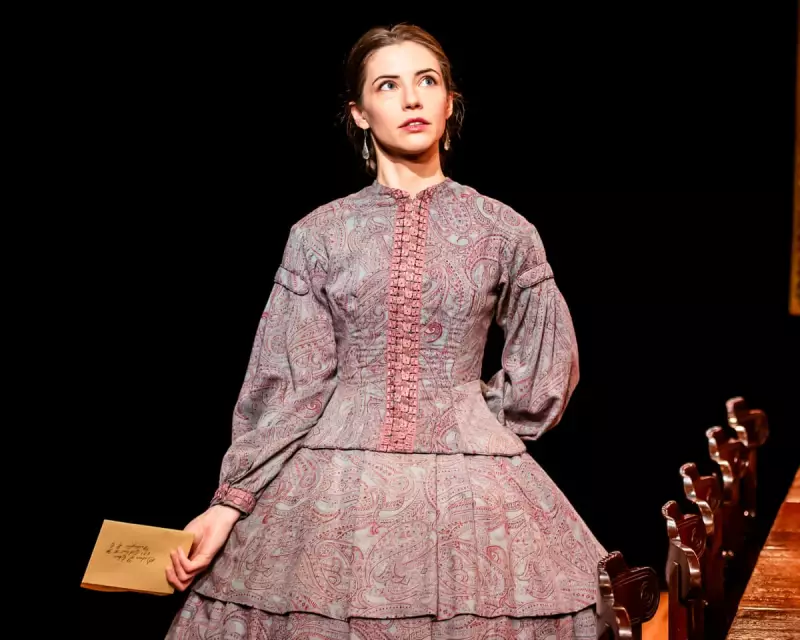
A new theatrical production delving into the high-stakes political world of the American Civil War has arrived in London. 'Our American Queen', playing at the Bridewell theatre until 7 February, dramatises the formidable influence of Kate Chase, daughter of Abraham Lincoln's treasury secretary, Salmon P. Chase.
A Savvy Operator in a Man's World
The play, written by Thomas Klingenstein and directed by Christopher McElroen, focuses on Kate's intricate plotting on the eve of the 1864 US presidential election. Her father, Salmon, is preparing to challenge President Lincoln for the Republican nomination, and Kate is his chief strategist. She masterminds alliances, manages public perception, and even plans a lucrative marriage to fund the campaign, all while navigating a deep connection with Lincoln's secretary, John Hay.
As her father admits, "Sometimes she understands things better than I," acknowledging Kate's superior political acumen. Wallis Currie-Wood takes on the central role, portraying Kate as a steely, intelligent woman operating within the severe constraints of her era.

Ambitious Themes and Theatrical Execution
Produced by the Brooklyn-based company the american vicarious, the play raises compelling questions about female ambition, power, and the psychological impact of a distant father-daughter relationship. However, the production struggles to explore these themes with full depth or satisfying heft.
A significant hurdle is Klingenstein's script, which often becomes mired in expositional detail about the Civil War. The dialogue is dense, with little of the witty badinage that would showcase Kate's famed intellect. Furthermore, the action is confined almost entirely to the Chase household, making Kate's political manoeuvres feel domestic rather than dynamic. We hear of her mining Hay for information and priming military commander George B. McClellan (Haydn Hoskins), but we long to see her prowess in a wider arena.
Staging and Standout Performances
Neal Wilkinson's set design centres on a huge dining table, bedecked for a party, symbolising the era's obsession with appearances and those excluded from power. A gilded frame displays changing images to track the war's progress. A directorial choice to use a live video feed for actors facing upstage proves more distracting than illuminating, robbing scenes of direct connection.
The enormous table also physically separates the cast, though this distance works effectively for the flirtatious intellectual sparring between Kate and John Hay. This relationship forms the play's most successful element. Tom Victor brings a sensitive vulnerability to Hay, which sparks revealing moments in Currie-Wood's otherwise resolute performance, culminating in a powerful release of repressed emotion.
The supporting cast includes Darrell Brockis as the impassive Salmon P. Chase and Christy Meyer as his love interest, Carlotta.
An Unresolved Historical Portrait
The play's central challenge lies in balancing Kate Chase's documented historical actions with imagined personal motivations. In the end, it leaves the audience uncertain about what truly drove this ambitious woman. Was it pure political ambition, a desire for her father's approval, or a complex blend of both?
While 'Our American Queen' shines a light on a fascinating, lesser-known historical figure, its scope feels limited. It offers a glimpse into Kate Chase's confined world of domestic political intrigue but stops short of fully unleashing her formidable character or definitively interpreting her legacy.
'Our American Queen' continues at the Bridewell Theatre, London, until 7 February.