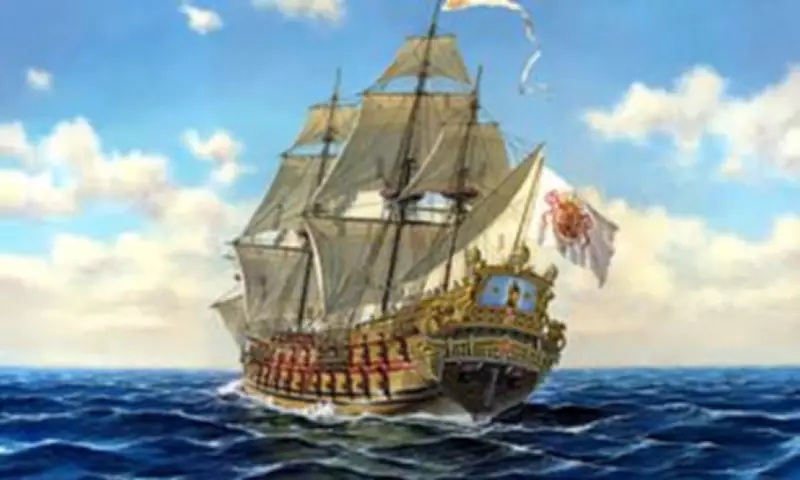
The Allure of Sunken Gold: A Timeless Fascination
For millennia, gold has captivated human imagination with its radiant beauty and immense value. The Inca civilization of South America revered it as divine, believing it descended to Earth as the tears of the sun god, while silver represented the moon goddess's tears. This mystical reverence extended into modern times, exemplified by Cuban President Batista, who owned a solid gold telephone before his overthrow by Fidel Castro in 1959. Against this backdrop of historical obsession, the Spanish galleon San Jose emerges as a legendary maritime treasure, sinking off the coast of modern Colombia in 1708 and gripping public fascination ever since.
The Battle and Sinking of a Treasure-Laden Vessel
Julian Sancton's comprehensive book delves into the intricate saga of the San Jose, weaving together elements of shipbuilding, scuba-diving, maritime law, and even eccentric tales of individuals claiming to communicate with dolphins. The narrative begins with the decisive battle that consigned the galleon to the ocean depths during the War of the Spanish Succession. Britain's involvement aimed to thwart a Spanish alliance with France, which threatened lucrative British trade routes across the Atlantic.
Captain Charles Wager of the Royal Navy, commanding a squadron of four ships, spotted the San Jose laden with Spanish treasure. The Spanish crew harbored confidence in their vessel's resilience, constructed from timber cut under a waning moon—a practice believed to concentrate sap near the roots, thereby enhancing sturdiness. In an era when captains retained most plundered treasure, Wager observed from a distance, allowing the galleon to accumulate precious metals and other valuables before its transatlantic journey to Spain.

Rather than permitting capture by enemy forces, it is widely believed that the San Jose's captain chose to detonate the ship, ensuring its treasure would not fall into British hands. This dramatic act sealed the fate of the vessel and its invaluable cargo, setting the stage for centuries of speculation and salvage attempts.
Eccentric Treasure Hunters and Modern Discoveries
The enduring mystery of the wreck, resting on the seabed, has attracted a colorful cast of characters throughout history. Among them was Roger Dooley, born in the United States in 1944 before relocating to Cuba, where he developed an obsession with shipwrecks inspired by the television series Sea Hunt, starring Lloyd Bridges. Dooley later founded Scuba Cuba, a company dedicated to underwater exploration, fully aware of the eccentric treasure hunters who dominated the 1950s and 1960s.
Figures like Robert Marx, known for his burly physique and unconventional attire, and Mel Fisher, who relied on intuition, dowsing rods, and even mediums purportedly communicating with dolphins, exemplified this era's quirky pursuit of sunken riches. Fisher's methods included redirecting search efforts based on nocturnal dreams, showcasing the blend of superstition and determination that characterized these endeavors.
Dooley, despite his strong Cuban accent and rapid speech, demonstrated meticulous research in locating the San Jose. After studying Spanish archives in Seville, he calculated sunrise times, wind patterns, currents, and departure points relevant to the ship's final voyage. By 2013, he secured financial backing from a British multimillionaire, a move that stirred controversy among Colombians who recalled Britain's role in the original sinking.
Legal Disputes and the Historic Discovery
Dooley's search area overlapped with prior efforts from the 1980s, when another team nearly located the wreck but faced a harrowing incident where their submarine became stuck in the seabed. Through coordinated body swaying, the crew managed to free themselves, avoiding a potential tragedy. Accusations arose that Dooley piggybacked on their work, leading to protracted and inconclusive legal battles, reflecting the complex disputes often surrounding treasure salvage.

Undeterred, Dooley and his team employed advanced equipment from the same oceanographic institute that aided in discovering the Titanic. In 2015, they conducted a systematic seabed search, colloquially known as "mowing the lawn," and successfully identified the San Jose. Key evidence included cannons with dolphin-shaped ends, a distinctive feature documented in historical records.
The wreck remained remarkably intact, possibly due to the forceful impact that "wedged open its own grave." Underwater cameras revealed well-preserved artifacts, such as unbroken blue and white porcelain cups and pewter syringes used for enemas—a fashionable practice in Europe influenced by Louis XIV's endorsement.
The Ongoing Saga of Salvage and Politics
Despite this monumental discovery, the treasure, including gold coins estimated at up to $17 billion, remains submerged. Salvage efforts have been entangled in Colombian political dynamics, with successive presidents reversing decisions made by predecessors. In November of the previous year, initial items were retrieved from the depths: three coins, a cannon, and a porcelain cup, marking a tentative step toward recovery.
As Sancton poignantly notes, "the horizon never gets any closer," encapsulating the enduring challenges and controversies that continue to surround the San Jose. With new issues and arguments inevitably arising, this sunken treasure saga promises to unfold further, blending history, adventure, and human ambition in a tale as deep as the ocean itself.