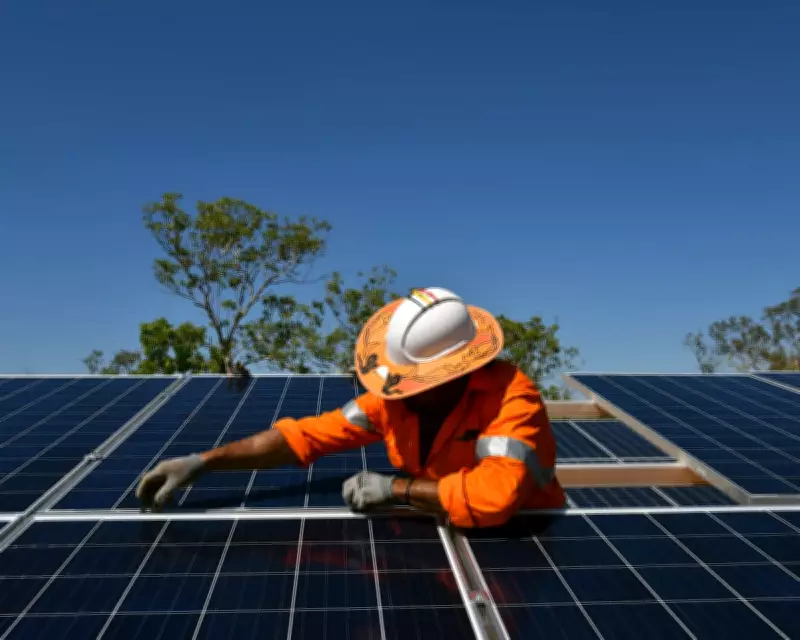
Australia's electricity grid is undergoing a transformation so rapid that it challenges long-held assumptions about energy generation and supply. As climate journalist Adam Morton observes, "Solar energy is incredibly cheap. It costs much more to burn coal." This fundamental economic reality is reshaping the nation's power landscape in profound ways.
Heatwave Reveals New Energy Reality
During a recent oppressive heatwave that rewrote temperature records across southeastern Australia, the country's main electricity grid demonstrated remarkable resilience while revealing a new energy paradigm. As millions cranked air conditioners to combat soaring temperatures, solar power emerged as the dominant daytime energy source, fundamentally altering traditional grid operations.
Solar's Dominant Performance
Over the past seven days, solar energy provided 30% of all electricity in Australia's main grid, which supplies five eastern states and the Australian Capital Territory. This figure becomes even more impressive when examining daylight hours specifically.

Between 9am and 6pm, solar met 59% of electricity demand, with more than half of this coming from approximately 4 million rooftop systems across the country. Large-scale solar farms contributed the remainder, demonstrating how distributed and centralized solar generation work in tandem.
Dylan McConnell, a senior research associate at the University of New South Wales, notes that solar output peaked between 12pm and 1pm at 67% of total consumption. In New South Wales and South Australia, this figure exceeded 70%, showcasing regional variations in solar penetration.
Coal's Diminished Role
Coal-fired power, once supplying nearly 90% of Australia's electricity and long considered the backbone of the national grid, found itself unable to compete economically during peak solar hours. The country's ageing coal fleet was reduced to filling gaps in generation, providing barely a quarter of electricity used during lunchtime periods.
As McConnell explains, "We had a little bit of volatility in the evening, but not much. That's quite extraordinary for a system during peak demand. They are the days when the system is under stress. Things could have gone wrong, but they didn't."
Renewables Reach Parity with Coal
Perhaps the most significant development is that Australia's grid now relies equally on renewable energy and coal. Each source provides nearly half of the electricity powering homes, businesses, and increasingly electric vehicles throughout the year.
The Australian Energy Market Operator recently described the last three months of 2025 as a "landmark moment," with renewable energy's share rising beyond 50% for the first time in a quarter. This milestone coincided with a 44% fall in wholesale electricity prices compared to the same period in 2024.
Rapid Transformation
The speed of this transition is remarkable. Just five years ago, renewables provided about 26% of Australia's electricity generation. A decade ago, the figure was less than 15%, with solar contributing less than 2%. Today's statistics represent a dramatic acceleration in clean energy adoption.
Supporting technologies are also advancing rapidly. Battery output tripled in just one year, indicating growing capacity to store renewable energy for use during non-sunny periods. This storage capability will become increasingly crucial as coal plants continue to retire.
Challenges and Opportunities Ahead
Despite these advances, significant challenges remain. The grid still requires existing coal-fired power plants to function reliably, particularly during evening hours when solar generation declines. These facilities continue to emit substantial climate pollution while operating.
Building sufficient grid infrastructure, including synchronous condensers and other stabilizing devices, represents another hurdle that must be overcome before all coal plants can be safely retired. Some political actors, including the Queensland LNP government, continue to resist aspects of the energy transition.
From one perspective, Australia is embracing renewables at what by any measure is a historic pace. From another, investment in new developments may not be happening fast enough to meet climate targets or ensure adequate replacement capacity as ageing coal plants close.

The reality is that both assessments contain truth. The energy transition being attempted is enormous in scale, more work needs to be done, and difficult moments likely lie ahead during the shift toward a near 100% renewable grid. Yet the fundamental direction is clear, and the progress achieved thus far represents no small accomplishment in reshaping a nation's energy future.