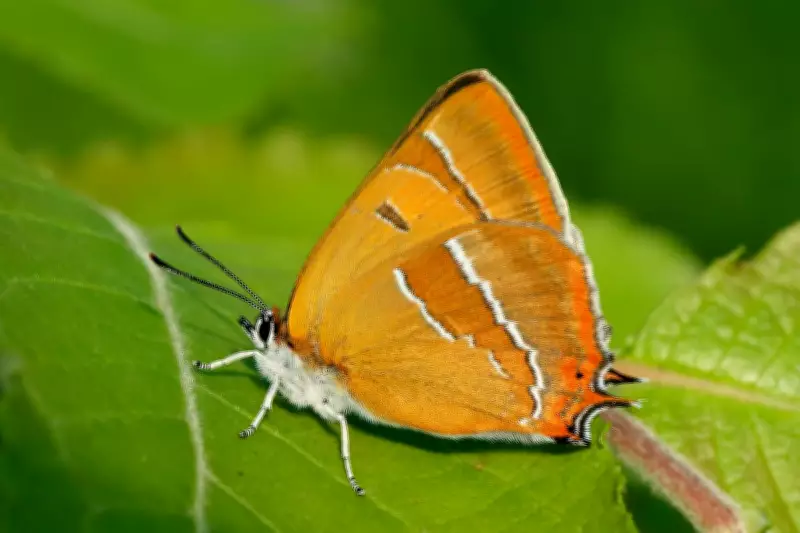
Conservationists in south Wales are celebrating a remarkable wildlife success story, as record numbers of a rare butterfly species have been discovered following a shift in hedgerow management practices. The brown hairstreak butterfly, whose populations had dwindled alarmingly in recent decades, has laid unprecedented quantities of eggs this winter in areas where landowners have allowed hedges to grow wilder.
Hedge Cutting Changes Deliver Dramatic Results
Butterfly Conservation has reported that volunteers armed with magnifying glasses have counted record tallies of the tiny white eggs in Carmarthenshire's Tywi valley this December and January. This significant increase follows collaborative work with partners including the National Trust and the South Wales Trunk Road Agent, who have substantially reduced their annual hedge cutting regimes.
The crucial change involves protecting hedgerows from the mechanical "flailing" that previously destroyed the young blackthorn shoots where brown hairstreaks exclusively lay their eggs. While the species was present throughout most of the Tywi valley as recently as 2010, it had almost completely disappeared within the following decade due to intensified hedge management practices.

Volunteer Excitement Over Population Upturn
Richard Smith, a volunteer with Butterfly Conservation's south Wales branch for over three decades, expressed the team's enthusiasm about these developments. "The volunteer team are really excited to find that, after a decade of heartache for brown hairstreaks in Carmarthenshire's Tywi valley, there is at last signs of an upturn," he stated.
The data reveals particularly striking contrasts between different management approaches. Sites protected from annual flailing have experienced a 50% increase in eggs this winter. Meanwhile, nearby fields that were left unmanaged for four years before being "severely flailed" saw egg counts plummet from sixty to just four.
Balancing Hedge Management with Wildlife Needs
Dan Hoare, Butterfly Conservation's director of nature recovery, emphasised that the organisation isn't seeking to prevent hedge management entirely, but rather to encourage more thoughtful approaches. "We don't want to stop anyone managing their hedgerows, but we would love more landowners to try cutting back on their cutting back," he explained.
Hoare highlighted that simple adjustments could make substantial differences: "If hedgerows are only trimmed once every two years, or even every three years, it could make an enormous difference to the survival of the brown hairstreak and help many other species as well." He described the brown hairstreak as "an indicator of getting that balance right" between agricultural needs and wildlife conservation.
Broader Ecological Benefits of Wilder Hedges
The benefits extend far beyond butterflies alone. Thriving brown hairstreak populations signal healthy hedgerows that provide multiple ecological advantages. These living boundaries serve as essential food sources for diverse wildlife, offer shelter for creatures ranging from dormice to yellowhammers, and create natural pathways through the countryside for bats and birds.
Hoare further explained that grasses and flowers flourishing at hedge bases support amphibians, reptiles, farmland birds, small mammals and numerous insects. Additionally, hedgerow trees increase both the abundance and diversity of larger moth populations. "The simple message for brown hairstreaks is that cutting hedges less often is better," he summarised.
Practical Steps for Landscape-Scale Conservation
Beyond reduced cutting frequency, conservationists advocate several straightforward measures that can significantly enhance wildlife habitats. These include planting hedgerow trees, filling gaps in established hedges, widening field margins adjacent to hedgerows, and coordinating hedgerow management across landscapes with neighbouring landowners.
"There is a wealth of evidence that taking a range of other simple steps can give wildlife a major boost," Hoare emphasised. The south Wales success story demonstrates how relatively minor adjustments to land management practices can yield substantial positive outcomes for threatened species and broader ecosystem health.