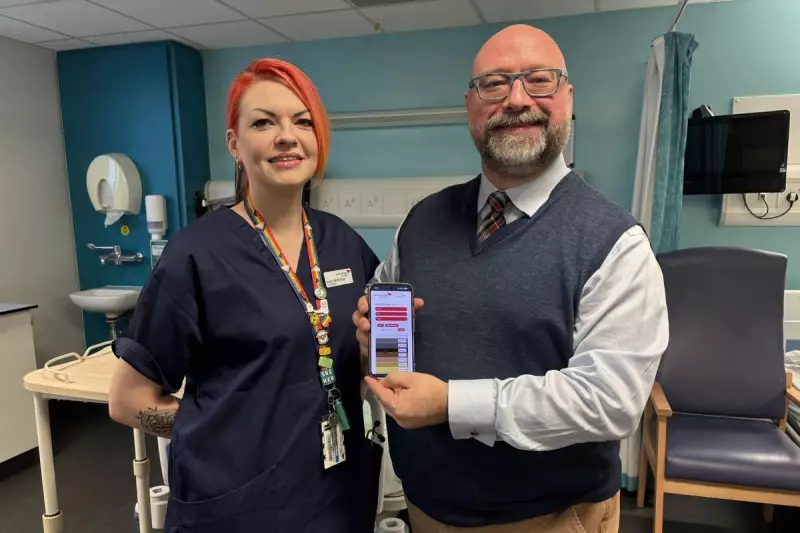
A new, straightforward digital tool that helps patients and clinicians accurately describe the colour of bodily fluids has been launched, with researchers claiming it could have a profound impact on healthcare outcomes.
Standardising a Subjective Science
Developed by a team at Edinburgh Napier University, the free online resource called What Colour Is It? resembles a paint colour card. It provides palettes of 13 or 15 clinically relevant shades for identifying the colour of sputum, urine, and faeces. Each colour has a unique 'hex code' – an international standard for colour identification – which can be recorded in a patient's notes, ensuring all medical staff visualise the exact same hue.
Hazel McPhillips, an advanced nurse practitioner and lecturer at Napier, highlighted the critical problem the tool solves. "We prescribe, we diagnose, we investigate based on the description of that colour, and that's really subjective," she explained. Documentation often relies on vague descriptions like 'greeny-brown', which can be interpreted differently by the next clinician. "This toolkit really standardises that. It takes the subjectivity out of it and makes sure everyone's working from the same colour."

Beyond Embarrassment and Communication Barriers
The researchers assert that the visual chart does more than just improve accuracy; it also helps reduce the embarrassment that can prevent patients from discussing bodily fluids openly. Furthermore, it overcomes significant communication barriers.
Business improvement consultant Stephen Yorkstone, who co-developed the tool, outlined its broad utility. "Kids, for example, might not have the same words for colours that we do, likewise people from different parts of the world, or with different language abilities," he said. He also noted its use with stroke patients suffering from aphasia, a condition that impairs speech. "For them, a conversation that would be a struggle becomes much more seamless and much more easy."
The tool's simplicity is central to its design. It is a mobile-friendly website that clinicians can pull up in seconds during an appointment. "You can pull it out of your pocket, point at a colour so that you can communicate about colours more clearly clinically," Mr Yorkstone added.
Aiming for Widespread NHS Adoption
Launched four weeks ago, the tool is already in use by approximately 225 people across several countries, including the UK, US, Norway, Sweden, and Australia. It is being applied in diverse fields such as nursing, physiotherapy, and dentistry.
Ms McPhillips connected the innovation directly to patient safety, referencing fatal accident inquiries that often conclude communication and documentation could have been better. "This is a very small thing, but if we can standardise that small part, that could have a huge impact on patient care and actually on safety as well," she stated. The team hopes it will become a normalised part of the healthcare system, used across all professions.
The tool is particularly useful for remote consultations, such as those conducted via NHS 111 or NHS24, where visual confirmation is otherwise impossible. The ultimate goal, as Ms McPhillips puts it, is that "It's going to make so many things so much safer and much more simple for patients as well as staff."