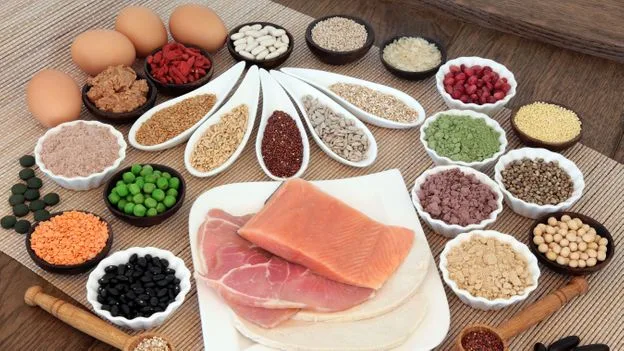
Protein is everywhere. It’s in your morning yoghurt, your mid-afternoon snack bar, your post-gym shake – even in your coffee. Walk down any supermarket aisle and you’ll see it stamped across packaging in bold, confident fonts: high protein, extra protein, 12g per serving. The message is simple, repeated so often it feels like fact: eat more protein and you’ll be healthier, stronger, better.
But what if that message isn’t quite true?
According to new research, the modern obsession with protein may have far less to do with what our bodies actually need – and far more to do with how we’ve been taught to think about food in the first place.
“Protein has gained an outsized stature,” says Samantha King who, with Gavin Weedon, is co-author of Protein: The Making of a Nutritional Superstar. “There seems to be no limit to the problems it can be mobilised to solve. Want to lose weight? Eat more protein. Want to gain weight? Do exactly the same thing! Protein for dull skin, ageing, energy, satiety, recovery, cognition, and so on.”
Once associated primarily with muscle growth and repair, protein is now being marketed as a fix for almost every aspect of modern life. But King and Weedon see protein more as a solution in search of a problem; something that is presented as a fix in the absence of a clear existing need. “We don’t need all this additional protein,” says King, a professor at the School of Kinesiology and Health Studies, Queen’s University.
It’s a striking claim – and one that cuts through the noise of a culture increasingly fixated on macros, meal plans and optimisation. Because if protein is everywhere, the question isn’t just what it does. It’s why we’ve come to believe it can do so much.
Do we actually need more protein?
The short answer is no. “It is not necessary,” says Weedon. “Protein is in nearly everything we eat, from lettuce to potatoes, and in the UK, the average daily intake for adults exceeds recommended levels across all age groups.”
In other words, far from being something most of us lack, protein is already abundant in a typical diet.
That doesn’t mean it isn’t important as part of a balanced diet. But the idea that we need to actively increase our intake is harder to justify. “Protein deficiency is extremely rare in the absence of severe hunger, or serious illness and frailty,” he explains – conditions where people are struggling to get enough food of any kind.
Part of the issue is that the science itself is far less clear-cut than most people assume.
“Nutrition is a notoriously inexact science, and the science of protein is no exception,” explains Weedon. Much of what we know about diet is based on imperfect data – often relying on self-reporting rather than controlled conditions – making it difficult to draw firm conclusions about what people should actually eat.
“We have a good understanding of the fundamental biochemistry of nutrients such as protein, but we don’t have reliable ways to apply that to dietary advice.”
That uncertainty leaves space for interpretation – and for competing interests to step in, says Weedon, describing a landscape where “corporate interests, environmental concerns, and cultural and social identity coalesce and conflict”.
Social media has amplified that noise, but it isn’t the root cause. King points out that anxieties about bodies, ageing and diet have long been shaped – and monetised – by media.
What’s more, protein doesn’t work in isolation. Its much-advertised role in muscle building depends on other factors – something often overlooked in mainstream advice. “Any additional protein one consumes must be combined with resistance training to have a positive impact on muscle growth and utility,” says King.
From waste product to wellness staple
Behind the rise of protein is an industry that has found it remarkably useful. Not just as a nutrient, but as a commodity.
“Protein’s rise is absolutely a product of commercial interests,” says King. “Before there were TikTok influencers, there were 19th-century protein boosters, such as Baron von Liebig, the German biochemist credited with developing not just the first protein supplement … but also one of the first global food companies.” It later became what we now know as Frey Bentos.
“There’s a long history of protein as a magic bullet, stretching back to its founding as a nutritional category in the mid-19th century when it was promoted as a boost to the strength of workers and soldiers.”
Now, its appeal spans almost every demographic: “male fitness enthusiasts … young people of all genders seeking hard, muscular bodies; menopausal women concerned about bone density; wellness warriors seeking immunity; seniors fighting sarcopenia; and even children (or their parents) with elite sport aspirations.”
The story of whey protein, now a staple of the supplement market, is particularly revealing. Its origins can be traced back to the rise of mass industrial agriculture in the US after the Second World War, when an abundance of milk and cheese also meant an abundance of whey waste. This posed a significant problem, because untreated whey is highly toxic – 175 times more toxic than untreated human sewage, in fact.
Rather than reducing production, the industry found a way to repurpose it. Whey was processed into a dry, shelf-stable product – and then marketed as a health supplement. “One industry insider describes this as a journey ‘from gutter to gold’,” says King.
Today, that transformation underpins a booming global market. “The estimated global market for protein supplements reached $24.8bn in 2025,” King notes, a figure expected to increase to $45.7bn by 2035.
In this context, protein becomes more than a dietary component. It becomes a way to add value. “We can only eat so much,” she points out. “So supplementation is a way to add value without adding bulk.”
The illusion of control
Protein’s appeal is also not just commercial – it’s psychological. “What protein consumption often offers is a sense of bodily control at a time when that sense of control is lacking,” says Weedon. “It’s no coincidence that we saw a sharp rise in protein talk during the pandemic, for example. We can’t control chains of food production, the uncertainty of political turmoil or economic austerity, or the climate catastrophe.” Instead, we count grams, track macros, choose “high-protein” options: small measurable actions in an otherwise unpredictable world.
But that sense of control is often misleading. “We say ‘illusion’ because none of us chose to live in a world where it might be deemed necessary to consume a meal replacement shake or to plan dinner around a biochemical formula,” he says. Instead, these behaviours reflect a broader cultural shift that places increasing responsibility on individuals to manage and optimise their own health. “Protein lends itself especially well to a culture of optimisation, where diet becomes a matter of finding the right combination of ‘macros’,” says Weedon, “and the body becomes an engine to be tinkered with.”
This way of thinking – often referred to as nutritionism – reduces food to its component parts, encouraging people to focus on nutrients rather than meals. “There’s no evidence that, as a population, we are eating healthier diets overall,” says Weedon. “We are confused by competing dietary advice, but food is also losing its pleasure and meaning.”
At the same time, protein has become central to competing visions of the future of food. On one side, traditional meat and dairy production is defended as a symbol of self-sufficiency. On the other, laboratory-grown alternatives are promoted as a solution to environmental crisis.
“Neither seems able nor willing to shake the idea that protein is the material and symbolic centre of their visions for feeding future populations,” he says.
So what should we actually be eating?
Protein remains essential to human health, and for some people – elite athletes, or those with specific medical needs – careful attention to intake may be important.
But for most of us, the constant focus on protein is unnecessary.
“Really, only those with medical conditions or high-performance sport aspirations would focus on their protein intake,” says King. “It’s a strange thing that many elite athletes complain about their strict, meticulously measured diets, and yet so many who don’t face the demands of elite athletes, let alone the glory or the riches, are mimicking them!”
Instead, she suggests a simpler approach – one that shifts attention away from numbers and back to food itself. “As Michael Pollan famously put it: ‘Eat food. Not too much. Mostly plants.’”