

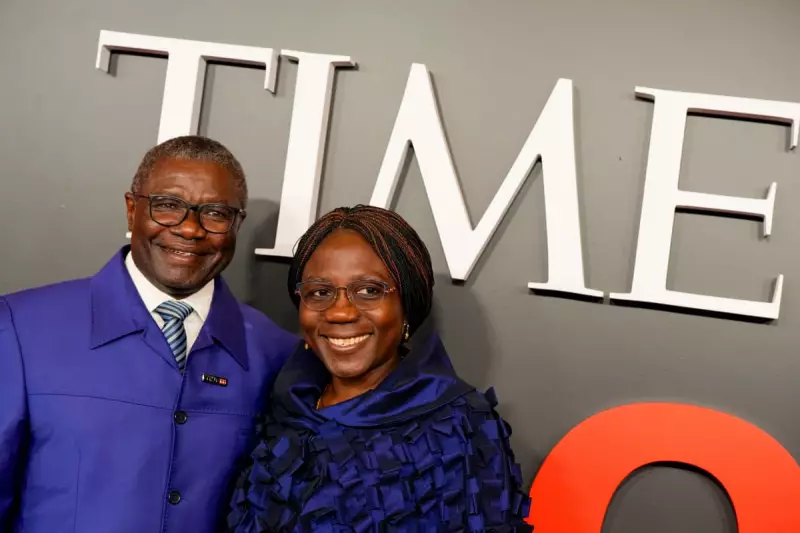
In an era of severe global health funding cuts, a Cameroonian professor's visionary project has just won a monumental $100 million lifeline. Dr Christian Happi, named one of Time magazine's 100 most influential people of 2025, and his co-founder Dr Pardis Sabeti have been awarded the prestigious MacArthur Foundation grant for their groundbreaking work in pandemic prevention.
A Lonely Victory in a Time of Cuts
Dr Happi describes the win with mixed emotions. "It's like being an orphan in a space where there used to be many kids playing – suddenly everybody's gone and you're just there with a ball," says the 57-year-old from his office at Redeemer's University in Ede, Nigeria. The grant arrives as wider aid cuts see development assistance for health estimated to drop to $39.1 billion by the end of 2025, with the US and UK among nations reducing overseas funding.
"It gets very lonely when you have this type of resource, and then around you, your colleagues have nothing to do, don't have resources to work and are closing down labs," Happi admits. The MacArthur grant, awarded every four years for initiatives promising measurable progress on critical problems, will sustain the work of Sentinel, the early warning framework he co-created.

The Sentinel System: Africa's Shield Against Outbreaks
Sentinel is housed within the African Centre of Excellence for Genomics of Infectious Diseases (ACEGID) and was co-created by Nigeria's Institute of Genomics and Global Health and the Broad Institute of MIT and Harvard. Its mission is twofold: to detect pathogenic threats in real-time and to empower African scientists to improve African lives, thereby breaking down long-standing inequities with the global north.
The programme uses genomics, surveillance, and sequencing to identify new pathogens, packaging the science for governments to act on swiftly. Its managing director, Dr Al Ozonoff, calls it "an extraordinarily effective idea." Beyond outbreak response, Ozonoff highlights Happi's core vision: "African scientists working at the cutting edge of their fields to improve life for everyday Africans."
To date, Sentinel has trained over 3,000 health professionals across 53 of Africa's 54 countries in genomics, enabling them to track, identify, and respond to outbreaks independently.
From a Midnight Ebola Call to a Global Mission
The efficacy of Happi's approach was first proven in 2014 with a dreaded midnight call from Nigeria's health ministry. A suspected Ebola case had arrived in Lagos. Working in a rudimentary two-room lab, Happi and an assistant confirmed the diagnosis within hours, knowing they were exposed to the deadly virus. "I did not know if I would see [my wife] Anise or our three children again," he recalls.
That swift confirmation allowed Nigeria to mobilise an unprecedented response. Just 42 days later, Nigeria declared itself Ebola-free. Of 20 confirmed cases, eight people died—a tragedy, but a death toll dramatically lower than what could have been in a nation of 186 million. This event proved Sentinel was "a transformational system."
With infrastructure upgraded by the non-profit Build Health International, the team was ready when Covid-19 hit. They sequenced the full genome within 48 hours of the first case arriving in Nigeria and later detected the Beta and Omicron variants. Jim Ansara of BHI praises Happi's relentless drive: "He's quite unusual because he is very entrepreneurial, very driven and almost impatient for results."
$100m for the Future: Building a Lasting Legacy
The $100 million grant infuses Happi with urgency, but also humility. "We are not going to be judged by just the fact that we got this money but [for] what we do with this money," he states, committing to put "500%" into the work. The funds will expand training for scientists in hard-to-reach areas and embed pandemic preparedness in public health systems across the continent.

However, Happi warns that Sentinel is not immune to the wider aid crisis. "In order to tie a parcel you need many hands," he says, referring to the fight against emerging diseases. The team will seek collaborations to mitigate the impact of funding cuts. Ansara notes Happi is already fostering a new generation of African scientists, helping to "break apart the legacy of colonialism and aid from the global north."
Professor Dyann Wirth of Harvard TH Chan School of Public Health, where Happi is an adjunct professor, believes the grant "will be foundational in sustaining [his] efforts to develop genomics capability on the African continent."
For now, the man described as a "force of nature" has promised his family, including his wife and research partner Dr Anise Happi, a proper break over Christmas—away from what she calls "his second wife," his laptop. With $100 million and a steely determination, Dr Christian Happi's mission to safeguard the world from the next pandemic is just entering a new, critical chapter.





