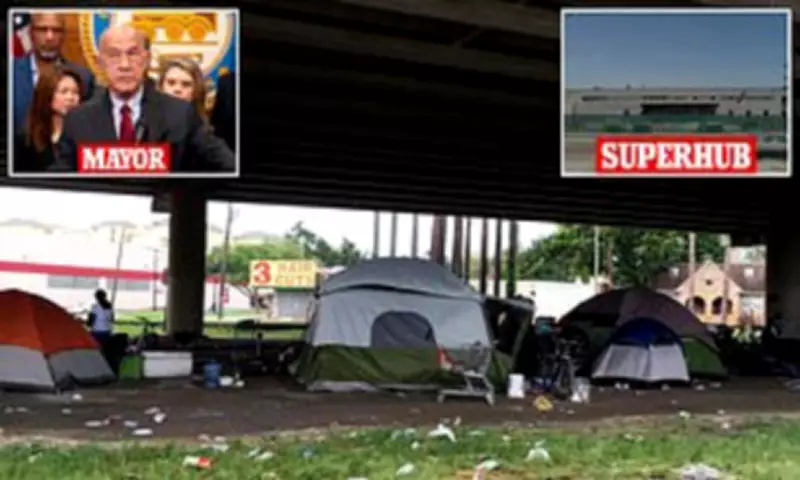
Houston's Controversial $16 Million Homeless Superhub Moves Forward Amid Resident Opposition
Houston city officials are advancing plans to construct a $16 million 'superhub' facility for the homeless population, but the initiative has encountered significant skepticism and resistance from local residents. The Houston City Council approved the project in October, despite vocal pushback from community members who expressed concerns about safety and a perceived lack of involvement in the decision-making process.
Location and Historical Context of the Superhub Site
The superhub has been approved for development at 419 Emancipation Avenue in Houston's East Downtown neighborhood, situated near Shell Stadium. The currently vacant warehouse has a complex history: it was originally purchased by the Star of Hope organization in 1977 and operated as a homeless shelter from 2004 to 2017. In 2017, the property was acquired by 419 Hope Partners. Subsequently, it was leased by the federal government as a shelter for migrant children until last year, after which it has remained empty.
Resident Outcry and Safety Concerns
At a press conference in October, residents voiced their frustrations, with Cassie Batson stating she was 'irate' about the plans. 'We love it here. We have worked hard to invest in the community to clean up the area. We want to live here forever, and this has come as a major shock to me,' Batson added. In an interview with local ABC affiliate KTRK, she further emphasized her safety concerns following the city council's approval, predicting that the facility would 'draw more people loitering out on the streets.'

Another resident, Elizabeth Spivey, criticized the financial aspect, calling it a 'misuse of funds' to allocate millions to the initiative. The controversy attracted attention from Houston-based independent investigative media firm Dolcefino Media, with Wayne Dolcefino warning in a video message, 'We are fighting for a neighborhood that quite frankly could be ruined if council members vote yes.' He accused Mayor John Whitmire's administration of breaking promises of transparency to East Downtown residents.
Scott Singleton, a resident near the superhub location, echoed these sentiments in an interview with local NBC affiliate Click 2 Houston, accusing city officials of failing to notify the community before enacting plans.
Details of the Superhub and Broader Initiative
The superhub is designed as a 'triage point' where homeless individuals can temporarily stay and access resources such as healthcare, psychiatric support, substance use programs, and pathways to permanent housing. The massive building features 75 rooms, with capacity for up to four beds per room, allowing it to accommodate an estimated 150 to 225 people at a time.
This facility is part of a larger three-year Ramp Up plan, with a total estimated cost of $168 million aimed at ending street homelessness in Houston. According to the proposal, $60 million of the funds is expected to come from foundations, with $6 million already donated. In addition to the $16 million purchase price, annual operational costs are projected to range between $10 and $14 million, funded through city and county general funds, state funding, philanthropy, and corporate donations.
Timeline and Implementation Challenges
The plan was made public on October 6, just nine days before the city council voted to purchase the property. Initially, the superhub was scheduled to open in the first quarter of 2026, but delays have pushed the opening to around June, as confirmed by the Houston Housing Authority to KTRK. The city still needs to select a nonprofit organization to manage the program.
Mayor John Whitmire has publicly supported the proposal, praising its mission despite the backlash. However, residents continue to raise issues about transparency and community engagement, with many attending city council meetings last fall to voice their worries about safety and the potential impact on the neighborhood.
The Daily Mail has reached out to the mayor's office for comment, but as of now, the project remains on track, highlighting the ongoing tension between city-led homelessness initiatives and local community concerns.