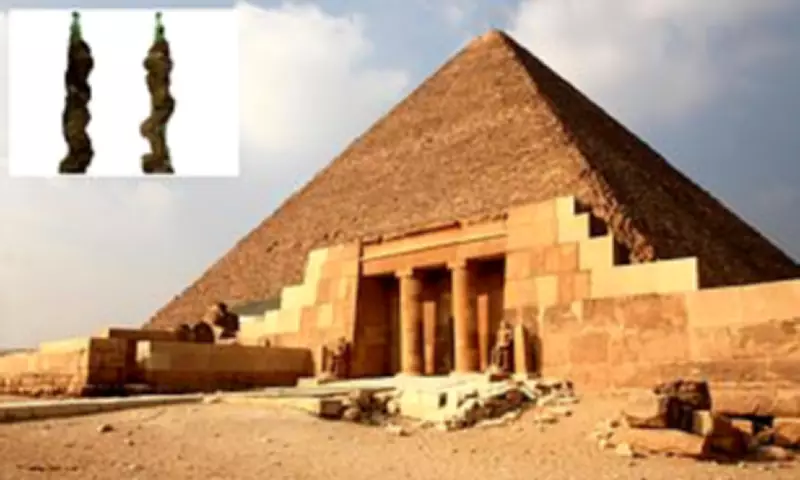
Museum Artefact Rewrites History of Ancient Engineering
A tiny copper-alloy tool, previously overlooked for nearly a century in a museum collection, is fundamentally reshaping what archaeologists understand about the origins of human engineering. Researchers have confirmed that this artefact demonstrates ancient Egyptians were employing a mechanically sophisticated rotary bow drill more than 5,300 years ago. The object, catalogued as 1924.948 A within the University of Cambridge's Museum of Archaeology and Anthropology, has now been definitively identified as the earliest known metal drill ever discovered.
Pushing Back the Technological Timeline
This groundbreaking finding pushes back the established timeline for advanced drilling technology by more than two millennia, compelling scholars to completely reconsider when complex mechanical tools first emerged in human history. First excavated a full century ago from a cemetery at Badari in Upper Egypt, the tool exhibits distinctive wear patterns that are entirely consistent with sustained rotary drilling action.
The tool's composition contained significant traces of arsenic and nickel, alongside notable amounts of lead and silver. This specific metallurgical profile suggests deliberate engineering choices by its creators and points to early material trade networks or shared technical knowledge across the ancient Mediterranean region.

Microscopic Analysis Reveals Critical Evidence
Lead author Dr. Martin Odle from Newcastle University stated: 'This comprehensive re-analysis has provided strong, conclusive evidence that this object was utilised as a bow drill. Such a mechanism would have produced a significantly faster and more controlled drilling action than simply pushing or twisting an awl-like tool by hand. This suggests that Egyptian craftspeople had mastered reliable rotary drilling techniques more than two millennia before some of the best-preserved drill sets from later periods.'
When archaeologist Guy Brunton first documented the object during the 1920s, he described it merely as a small copper awl with leather wrapped around it. This brief, simplistic classification led to the artefact being largely ignored and overlooked for almost a hundred years. However, modern microscopic analysis has revealed wear patterns that are completely inconsistent with simple puncturing or scraping activities.
Fine striations, distinctly rounded edges, and a subtle curve at the tool's tip all indicate the object was repeatedly rotated under pressure, pointing unequivocally to sustained rotary drilling rather than basic piercing work. Researchers made another crucial discovery: six coils of extremely fragile leather thong remain wrapped around the shaft, providing direct, physical evidence of a bow drill system. In such a mechanism, a string wound around the drill shaft is driven back and forth by a bow, rapidly spinning the tool to cut efficiently into material.
Context and Significance of the Discovery
'Behind Egypt's famous stone monuments and exquisite jewelry lay practical, everyday technologies that rarely survive in the archaeological record,' Dr. Odle explained. 'The drill was one of the most fundamentally important tools, enabling sophisticated woodworking, intricate bead production, and detailed furniture making. Bow-powered drills appeared frequently in New Kingdom tomb scenes, and several complete examples from that later era survive. The Badari discovery is far older, dating to the Naqada IID period.'
This suggests Egyptians had perfected fast, controlled rotary drilling nearly two millennia before those later artistic depictions. The Naqada IID period, a late Predynastic era around 3300 to 3200 BC, witnessed the inception of kingship, writing, and organized religion—the very foundations of classical Egyptian civilization.
The discovery of this ancient drill coincides with other recent findings that are altering the historical timeline of Egypt. A separate study released in December revealed evidence that reshapes understanding of Egypt's early dynasties, suggesting the rise of the powerful New Kingdom occurred nearly a century later than previously believed.

The New Kingdom, lasting from approximately 1550 to 1070 BCE, represented Egypt's peak of imperial power, wealth, and territorial expansion—the era of legendary rulers like Tutankhamun. It began with the 18th Dynasty, founded by Pharaoh Ahmose I, who reunified Egypt and expelled the Hyksos invaders. New scientific analysis confirms that the colossal Santorini (Thera) volcanic eruption occurred before Ahmose's reign, meaning the 18th Dynasty, and thus the New Kingdom itself, began later than historians once assumed.
This chronological breakthrough comes from advanced radiocarbon dating of Egyptian artefacts directly linked to the 17th and early 18th Dynasties, including a mudbrick stamped with Ahmose's name, a linen burial cloth, and wooden funerary figures called shabtis. Because these objects are firmly anchored to specific historical contexts and known pharaohs, their ages provide a highly reliable snapshot of the period. The study conclusively shows the eruption predates these artefacts, reshaping how experts comprehend the chronological rise of Egypt's most formidable and influential historical period.