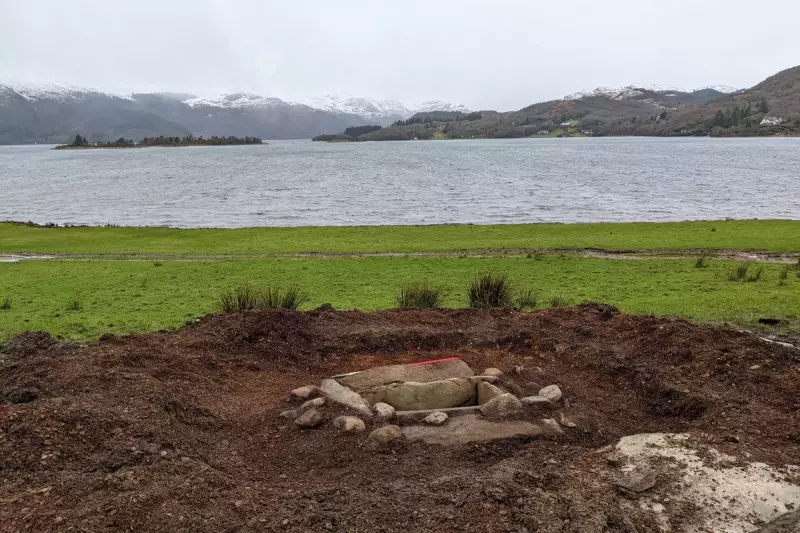
A long-lost Bronze Age burial chamber, accidentally rediscovered by a farmer on a Scottish island, is now yielding profound insights into the lives of two people who died over four millennia ago.
Rediscovery of a Forgotten Tomb
The story begins on the Isle of Bute, where a farmer ploughing a field in 2022 stumbled upon human remains. This was not the first time the site had been disturbed. Archaeologists from the AOC Archaeology Group confirmed the location was a cist – a stone-lined burial box – first excavated before 1863. On that earlier occasion, a skull was removed and sent to the Society of Antiquaries of London, a common practice of the era. The site was then lost to history, its precise location forgotten, until the farmer's chance discovery.
Secrets of the Rhubodach Cist
Detailed analysis following the 2022 excavation has transformed our understanding of the site. Dr Jess Thompson, Scotland's first curator of osteoarchaeology at National Museums Scotland (NMS), examined the remains. She determined that the cist contained two individuals, buried at different times. The person buried uppermost was an adult male, aged 35-50, standing about 5ft 6" tall and in good health. Beneath him lay a female, either an adolescent or very young adult.

Radiocarbon dating places both deaths within the final quarter of the third millennium BC, after 2250 BC. The male was likely buried just after, or within a few generations of, the female. Isotopic analysis of their bones suggests their diet was primarily terrestrial, with little marine protein. The original 19th-century skull, sadly, is now lost.
A New Home for Ancient Lives
The finds, declared through the Treasure Trove Unit, were allocated to National Museums Scotland in September 2025. They now reside in a brand-new, ethically designed facility at the National Museums Collection Centre in Granton, Edinburgh. This centre, operational since autumn 2025, was created as part of the Scotland’s Archaeological Human Remains Collections (SAHRC) project.
The facility provides 70% more storage and houses remains from around 2,500 individuals from roughly 600 sites across Scotland, spanning 8,000 years. Dr Matthew Knight, senior curator of prehistory at NMS, emphasises the project's dual purpose: providing ethical care and enabling research that enriches our understanding of Scotland's ancient inhabitants.
"These are people who were once living, breathing humans," Dr Knight stated, "and we need to ensure that they are treated with the utmost respect." The SAHRC project enhances NMS's capabilities and fosters collaboration across Scotland's heritage sector, ensuring these ancient stories continue to be told.