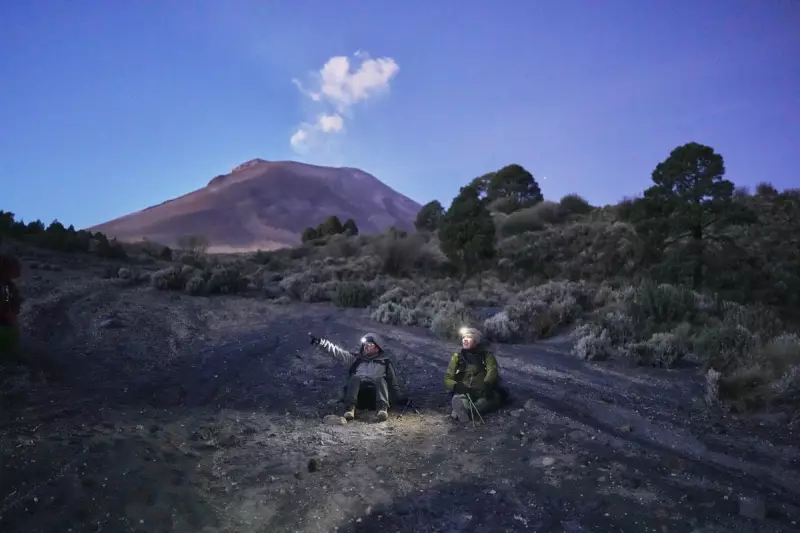
In a groundbreaking scientific achievement, researchers have unveiled the first three-dimensional view inside one of the world's most dangerous and closely watched volcanoes. A dedicated team from Mexico's National Autonomous University (UNAM) has spent five years scaling the slopes of the Popocatépetl volcano, braving extreme conditions to finally produce a detailed internal map.
A Perilous Five-Year Mission
The project, led by Professor Marco Calò from UNAM's Geophysics Institute, involved repeated expeditions up the 5,452-metre (17,883-foot) volcano. Scientists hauled heavy equipment, faced the constant threat of data loss from bad weather or sudden explosions, and meticulously gathered seismic data. Their goal was critical: to understand the subterranean architecture of a volcano that poses a direct threat to approximately 25 million people living within a 100-kilometre radius.
"Most high-risk volcanoes globally have detailed interior maps, but Popocatépetl did not, despite its immense danger," explained Calò. Previous imaging attempts 15 years ago yielded contradictory results and lacked the resolution to show how the volcano was being built or, crucially, where its magma was accumulating.

Harnessing AI to Decode Volcanic Tremors
To achieve their unprecedented scan, the team expanded the volcano's monitoring network, increasing seismographs from 12 to 22 to encircle its entire perimeter. These devices measure ground vibrations 100 times per second, generating vast amounts of data.
Doctoral student and researcher Karina Bernal, 33, turned to artificial intelligence to make sense of it. "I taught the machine about the different types of tremors there are in El Popo," she said, using the volcano's local nickname. By adapting algorithms developed for other volcanoes, the AI helped catalogue distinct seismic signals, allowing the team to infer the types of material below, their state, temperature, and depth.
The resulting 3D cross-sectional image, extending 18 kilometres (11 miles) below the crater, shatters the simplistic textbook model of a single magma chamber. It reveals a complex structure with what appear to be multiple magma pools at varying depths, separated by rock and other materials. These accumulations are more numerous towards the southeast of the crater.
A Majestic and Unpredictable Giant
Popocatépetl, which formed in its current state over 20,000 years ago, has been in a state of near-constant activity since 1994. It emits plumes of smoke, gas, and ash almost daily. Activity periodically forms a dome over the main vent, which can collapse and trigger an eruption, as last occurred in 2023.
Professor Calò speaks of the volcano with reverence, noting its history includes a "little Pompeii"—the burial of the village Tetimpa in ash in the first century. He also highlights that while El Popo emits significant greenhouse gases, its output is a tiny fraction of that produced by human activity in nearby Mexico City.
The final expedition before publication offered a visceral sense of the volcano's power. The team camped at 3,800 metres, navigating landscapes of ash and crossing dry lahar channels—paths for deadly mudflows in the rainy season. Master's student Karina Rodríguez, 26, described hearing small tremors and ash falling like rain, and seeing the crater's rim glow orange on dark nights.
A Natural Laboratory for Future Safety
This research provides authorities with a powerful new tool. "We have a natural laboratory here," said Calò. "It is very important to be able to understand and give residents detailed, trustworthy information about what is happening inside the volcano." The map will help scientists better interpret the volcano's activity, ultimately leading to improved eruption forecasting and emergency response planning.
However, the work also raises new questions. Scientists now seek to understand why tremors are more frequent on the southeast side, where magma is concentrated, and what implications this has for future activity. Despite challenges like failed batteries and damaged equipment, the team's drive persists. Seeing the volcano's interior move in 3D on a screen, said Rodríguez, "is what drives you to start another project and keep climbing."