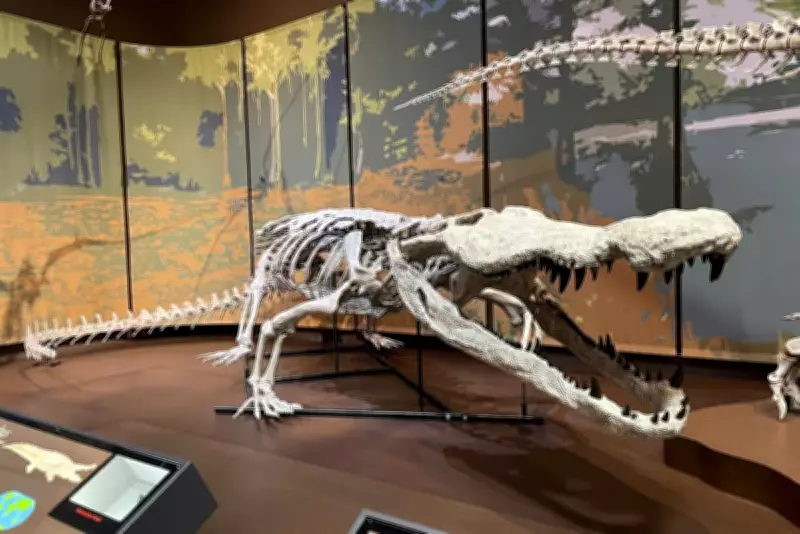
Scientists have achieved a groundbreaking paleontological milestone by reconstructing the most complete skeletal model ever of a monstrous 10-metre-long (32ft) crocodile known as a "dinosaur killer" that dominated prehistoric waters approximately 76 million years ago.
Unveiling the Prehistoric Predator
The species, named Deinosuchus schwimmeri in 2020, represents one of the largest crocodilians to ever inhabit North America. This recognition honours the decades-long contributions of palaeontologist David Schwimmer to understanding giant prehistoric crocodilians, distinct from the actor of the same name who portrayed palaeontologist Ross Geller in the television series Friends.
A Formidable Presence in the Late Cretaceous
Deinosuchus schwimmeri thrived in what is now the eastern United States during the Late Cretaceous epoch, reaching dimensions comparable to a modern school bus. As a relative of contemporary alligators, this apex predator is documented to have preyed extensively on dinosaurs, cementing its fearsome reputation in prehistoric ecosystems.

Despite its significance, a comprehensive skeletal reconstruction of this formidable predator had remained elusive until now. "The sheer scale of dinosaurs and other creatures from the Late Cretaceous period is challenging to convey through words or images alone. While we can state that Deinosuchus measured 30 feet in length, witnessing its physical representation delivers a far more profound impact," explained Rebecca Melsheimer, curatorial coordinator at the Tellus Science Museum.
Museum Installation and Educational Value
Researchers have meticulously completed a life-sized replica of the crocodile, commissioned by the Tellus Science Museum in Cartersville, Georgia, where it has been permanently installed. This installation enhances the museum's portrayal of ancient ecosystems.
"Integrating Deinosuchus schwimmeri into our exhibits enables us to present a more nuanced and detailed depiction of this region's ecosystem during the Cretaceous Period," stated Hannah Eisla, director of education at the museum.
Ms Melsheimer added, "Tellus currently stands as the sole museum worldwide to possess a cast of Deinosuchus schwimmeri, offering visitors an exclusive and unparalleled educational experience that cannot be replicated elsewhere."
Advanced Reconstruction Techniques
To assemble this unprecedented model, scientists employed cutting-edge methodologies to interpret fragmentary fossil evidence. They utilised high-resolution 3D scans of available fossil material to accurately reconstruct the animal's skeletal framework and its distinctive dermal armour, which provided crucial protection.
The resulting model embodies the most current scientific understanding of Deinosuchus anatomy, offering researchers and the public alike a clearer visualisation of one of North America's most colossal prehistoric predators.
Insights into Ancient Survival Strategies
Dr David Schwimmer emphasised the broader scientific implications of such reconstructions. "Deciphering the predatory behaviours of dinosaurs assists us in unlocking some of nature's most effective survival strategies. By examining these ancient apex predators, we essentially peer back through time to observe precisely how life adapted to and dominated an ever-changing world," he elaborated.
"Fully assembled, life-size replicas serve as a blueprint for gaining deeper insights into the dynamic nature of creatures like Deinosuchus, revealing their true biological and ecological characteristics," Dr Schwimmer concluded, highlighting the enduring value of such paleontological endeavours.