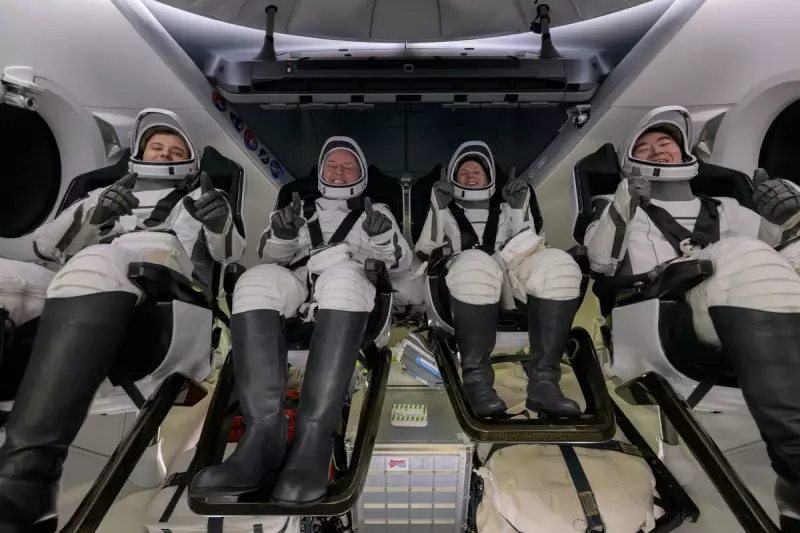
Astronauts from the International Space Station have publicly revealed for the first time how a portable ultrasound machine proved to be an indispensable tool during a serious medical crisis in orbit. The four members of Crew 11 spoke during their first public appearance since being evacuated from the ISS and returning to Earth, marking NASA's first medical evacuation in its 65-year history of human spaceflight.
Medical Emergency Aboard the ISS
The astronauts declined to specify which crew member required medical attention or the exact nature of the health issue during their remarks on Thursday. However, they provided significant details about how the situation unfolded and was managed aboard the orbiting laboratory.
NASA astronaut Mike Fincke explained that the medical problem arose on January 7th, just one day before a planned spacewalk that had to be abruptly cancelled. "Once the medical problem arose, we used the onboard ultrasound machine," Fincke stated. "We had already been using the device extensively for routine monitoring of our body changes while living in weightlessness, so when we had this emergency, the ultrasound machine came in super handy."

Essential Equipment for Space Medicine
Fincke emphasized the machine's critical role, noting that it should become standard equipment on all future space missions. "It really helped," he affirmed. "Of course, we didn't have other big machines that we have here on planet Earth. We do try to make sure that everybody before we fly are really, really not prone to surprises. But sometimes things happen and surprises happen, and the team was ready... preparation was super important."
NASA astronaut Zena Cardman, who commanded the crew's early return flight with SpaceX, confirmed that the space station is equipped as well as possible for medical emergencies. She praised NASA's decision-making process, stating the agency "made all the right decisions" in cancelling the spacewalk—which would have been her first—and prioritising the crew's wellbeing.
Training Proved Its Worth
Japanese astronaut Kimiya Yui expressed surprise at how effectively their extensive preflight training prepared them to handle the health concerns. "We can handle any kind of difficult situation," Yui asserted. "This is actually very, very good experience for the future of human spaceflight."
The mission, which launched from Florida last August, concluded more than a month earlier than planned, lasting approximately five and a half months instead of the scheduled six and a half. The crew splashed down in the Pacific Ocean off the San Diego coast last week, with Russian cosmonaut Oleg Platonov completing the four-person team.
Welcome Back to Earth
Upon their return to Houston, the astronauts were greeted by their replacements, whose launch has been delayed until mid-February. NASA and SpaceX are currently working to expedite that flight. "We were hoping to give them hugs in space, but we gave them hugs on Earth," Fincke remarked, highlighting the unexpected change in their reunion plans.
This incident represents a significant moment in space medicine, demonstrating both the challenges of healthcare in microgravity and the importance of adaptable medical technology for long-duration space missions. The crew's experience is likely to influence future medical protocols and equipment selection for the International Space Station and beyond.