Labour's efforts to forge closer ties with the European Union have descended into further chaos today, as a senior minister insisted the United Kingdom would be 'crazy' not to explore the possibility of a customs union arrangement.
Ministerial Contradictions Emerge
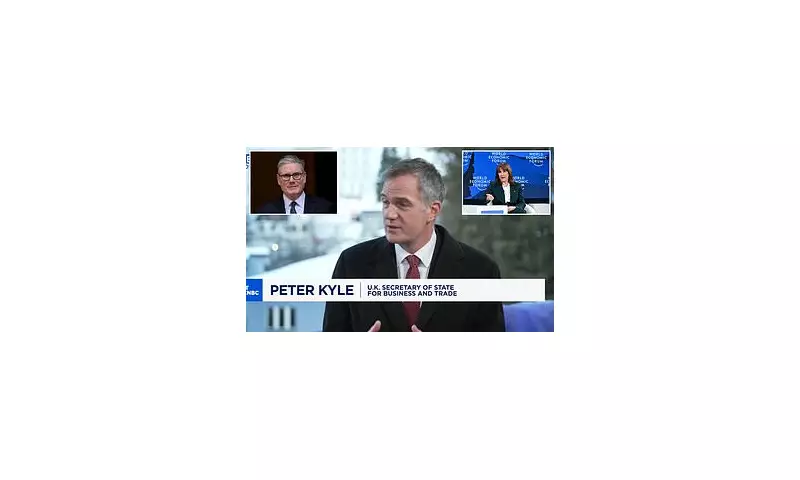
Trade Secretary Peter Kyle declared that Britain must carefully consider where the 'best opportunities' lie for the nation's economy in the longer term. However, this remark arrived just one day after Chancellor Rachel Reeves flatly dismissed the entire concept, pointing out that the Labour manifesto explicitly ruled it out and warning that other valuable trade deals would be jeopardised.
Davos Interviews Reveal Deep Divisions
During an interview at the prestigious World Economic Forum in Davos, Mr Kyle was questioned by CNBC about hints from colleagues, including Wes Streeting and David Lammy, suggesting support for a customs union model. He firmly denied that this internal wrangling indicated Sir Keir Starmer lacked control over his top team.

'When it comes to the customs union, we need to be having these conversations as a country about where is the best anchor, what are the best opportunities for Britain's economy post-Brexit,' Mr Kyle stated emphatically. 'Now, of course, it would be crazy not to engage with the prospect of a customs union.'
Focus on Economic Growth Versus Long-Term Strategy
Mr Kyle clarified his position by emphasising the immediate economic challenges. 'My point is very clear that the challenge we have as an economy is growth in the short term,' he explained. 'We are beating expectations. We have growth predicted this year at 1.5 per cent. It's not enough.'
He outlined that the government is actively pursuing regulatory reforms and investing in methods to ramp up economic activity. 'We're investing, but most of these things will deliver growth a little bit into the longer term,' he added. 'Now, a customs union is something we need to engage with, but let's be clear: it took Turkey 20 years to join the customs union. It took four years for us to leave. I am focusing on what it takes to get growth into the economy now.'
Mr Kyle characterised the current discussion as a 'gentle debate', contrasting it sharply with the divisive Brexit years that 'ripped our country apart'. He noted that Britain is now 'back together as a country' and benefits from 'stable government with a 10-year industrial strategy'.
Chancellor's Firm Rejection
These comments stood in stark contrast to those made by Chancellor Rachel Reeves during her own tour of Davos just yesterday. When asked directly if re-entering a customs union with the EU was being considered, she provided a definitive response to Bloomberg TV.
'No, it was very clear in our manifesto that we wouldn't be re-joining the customs union, the single market, or bringing back free movement of labour,' Ms Reeves stated unequivocally. 'We can't go back in time, and since we've left the EU we have done trade deals with India, with the US, with South Korea. Obviously, you would lose the benefit of some of those trade deals if you were to re-enter a customs union.'
She further argued that rejoining is not necessary to achieve trade benefits. 'I don't think you have to return to the customs union to seize greater benefits of free and fair trade,' Ms Reeves asserted. 'These are times when others are putting up barriers to trade. What Britain is arguing for, and what I believe in strongly, is that those of us who believe in free and fair trade practice what we preach and reduce barriers between ourselves.'

Key Points of Contention
- Trade Secretary Peter Kyle advocates exploring a customs union, calling it 'crazy' not to consider it for long-term economic opportunities.
- Chancellor Rachel Reeves firmly rejects the idea, citing the Labour manifesto and potential damage to existing trade deals.
- The public disagreement highlights potential divisions within Labour's top team regarding post-Brexit strategy.
- Both ministers presented their arguments on the global stage at the World Economic Forum in Davos.
- The debate occurs against a backdrop of Labour's efforts to present a united front on economic and trade policy.
This very public clash between two of Labour's most senior economic ministers throws the party's post-Brexit trade strategy into uncertainty and raises questions about internal coherence on one of the most critical issues facing the UK economy.