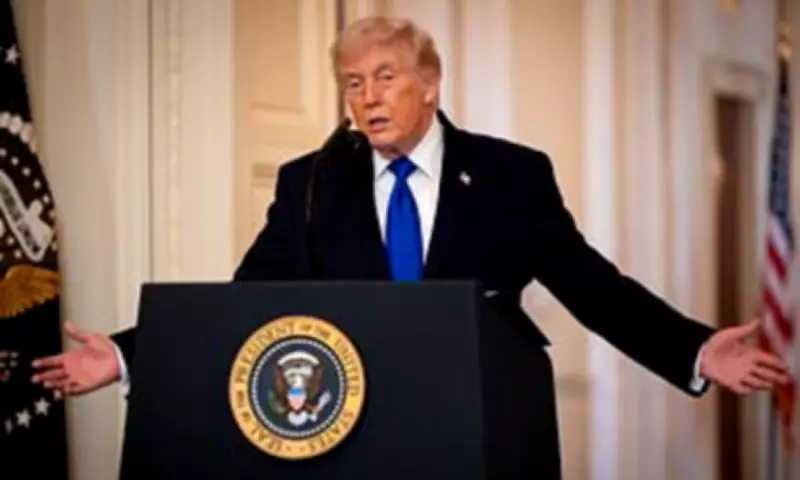
UK Government Considers Countermeasures as Trump Tariff Announcement Creates Confusion
Prime Minister Keir Starmer is actively evaluating trade reprisals against the United States following provocative tariff threats from former President Donald Trump. The situation escalated dramatically when Trump announced a new 10 percent 'global tariff' on Friday, only to increase it to 15 percent the following day, leaving British ministers scrambling for clarification from the White House.
Confusion Over Implementation and Rates
With the new levies scheduled to take effect on Tuesday, significant uncertainty persists regarding the exact rate that will be imposed. Downing Street has emphasized its expectation that the terms of the trade agreement negotiated between Sir Keir and Mr. Trump last year should be respected despite this new tariff blitz. When questioned about potential British retaliation through tariffs on American goods, the Prime Minister's official spokesman stated unequivocally: 'Nothing is off the table.'
While Number 10 expressed strong desire to avoid a full-scale trade war, officials have already prepared an extensive 417-page list of potential US targets. This comprehensive document covers a wide range of products from motorcycles and rollercoasters to beef and whiskey, raising the possibility that iconic American brands such as Harley-Davidson and Jack Daniel's could face significant trade barriers.

Trump's Reaction to Supreme Court Ruling
The tariff announcement came in response to Friday's US Supreme Court decision that ruled Trump had exceeded his authority by imposing 'Liberation Day' tariffs on numerous countries last year. In a characteristically fiery reaction, Trump declared on Monday that the 'ridiculous' court ruling still left him capable of implementing 'terrible' measures against foreign nations.
Writing on social media, the former president elaborated: 'The court has also approved all other tariffs, of which there are many, and they can all be used in a much more powerful and obnoxious way, with legal certainty, than the tariffs as initially used.' He specifically warned that the new tariffs could become 'much more powerful and obnoxious' than previous measures.
Diplomatic Efforts and Economic Implications
Following discussions between Business Secretary Peter Kyle and his US counterpart Jamieson Greer, British officials expressed cautious optimism that the new 'global tariff' would not compound existing levies on British automobiles and steel. A government source indicated that the anticipated 10 percent levy due on Tuesday would likely replace an existing tariff of identical magnitude that had been invalidated by the court. However, ministers remain uncertain whether or when this rate might escalate to 15 percent.
The British Chambers of Commerce has issued a stark warning that the higher tariff rate could impose an additional £3 billion burden on the UK economy. Andy Haldane, president of the organization, highlighted the peculiar situation where countries like Britain that had secured favorable agreements now face disproportionate punishment compared to nations previously subjected to higher levies.
'The perversity of what happened over the weekend was that those who got good deals, the allies, have been most disadvantaged,' Haldane told the BBC.
Long-Term Economic Forecasts and Monetary Policy
Alan Taylor, a member of the Bank of England's Monetary Policy Committee, predicted that US tariffs represent a permanent fixture in international trade, despite the Supreme Court ruling that could trigger compensation claims exceeding £130 billion. 'The fundamental thing to realise is that those tariffs are here to stay at some number that is an order of magnitude bigger than it was two years ago,' Taylor stated.
He further cautioned: 'I think we should expect this shock to play out also over many years. It's not going to be like an immediate shock that passes through.' Taylor, who recently advocated for interest rate reductions, suggested there could be up to three cuts to UK interest rates before stabilization occurs.

Government Strategy and Political Criticism
Downing Street has committed to a 'pragmatic' approach regarding the latest tariffs, emphasizing ongoing engagement 'at all levels' with US administration officials to assess potential impacts. The Prime Minister's spokesman confirmed: 'We continue to have productive conversations with them… and those discussions are happening at all levels, but nothing is off the table at this stage.'
The spokesman added: 'Industry doesn't want to see a trade war where both sides keep escalating the situation, and that's why our focus is on constructive engagement with our US counterparts to retain the UK's competitive advantage.'
Nigel Farage offered sharp criticism of the government's position, warning that the latest tariffs would 'hurt us' significantly. He argued that Sir Keir faces substantial difficulties in negotiating improved terms while continuing to deny US requests to conduct bombing missions against Iran from British military bases.
'I think telling the Americans that they can't use bases on UK soil to attack the appalling Iranian regime now puts us in a very, very bad place,' Farage asserted. 'I would suggest on tariffs right now, we don't have a negotiating position.'