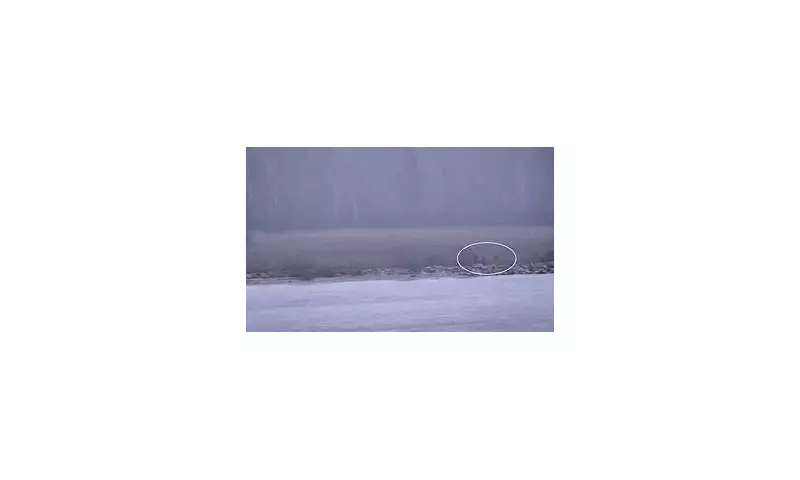
Three Russian border guards from the Federal Security Service (FSB) have illegally crossed into NATO territory in Estonia, remaining there for approximately 20 minutes in what officials suspect is a deliberate provocation. The incident comes just weeks after Russian warplanes violated Estonian airspace, raising tensions on the alliance's eastern flank.
Details of the Border Intrusion
The alleged breach occurred on Wednesday morning along the Narva River, which forms part of the border between Russia and Estonia. According to the Estonian Foreign Ministry in Tallinn, three officers arrived via an FSB security service hovercraft and proceeded on foot along a breakwater, crossing the control line into Estonian territory.
Grainy surveillance footage, released by authorities, shows the figures of the intruders near the village of Vasknarva. After spending roughly 20 minutes on the Estonian side, the trio returned to their hovercraft and crossed back into Russian territory.

Estonian Interior Minister Igor Taro confirmed the event was fully documented. "The illegal border crossing has been documented, and we have it on video from the surveillance camera that detected the crossing," he stated.
Estonian Response and Investigation
Estonian police and border guard units were immediately dispatched to the scene. "Naturally, our units went to investigate, but the illegal border crossers were no longer there," Minister Taro explained. "They had left Estonian territory and returned to their own."
A thorough check of the area was conducted to ensure the Russian guards had not planted any suspicious items. Traces were found, but nothing was left behind. While Taro stated there was no immediate security threat, he confirmed that Estonia has significantly increased its border patrols and police presence in response.
The Estonian government is summoning the Russian chargé d'affaires in Tallinn, and a meeting between the border guard authorities of both states has been scheduled to address the incident.
A Pattern of Provocative Incidents
This border breach follows a pattern of recent Russian incursions. In September, three Russian MiG-31 fighter jets entered Estonian airspace over the Gulf of Finland for about 12 minutes. Estonia condemned that act as a 'brazen' violation, lodged a diplomatic protest, and invoked NATO consultations under Article 4 of the alliance treaty.
Moscow denied any violation, claiming the flight remained in international airspace. That same month, Russian drones briefly breached Polish airspace, prompting NATO fighter jets to scramble.
Regarding the latest land-based incident, Minister Taro suggested the quality of Russian border personnel may be a factor. "What we have observed in recent years is that the quality of border guard personnel on the Russian side varies greatly," he said, implying that the war in Ukraine may have led to more competent officers being redirected to the front lines.
He speculated that the drafted-in guards may have "no understanding of where they are, what they are doing here, or the nuances of the terrain." However, the act is widely seen in Tallinn and among NATO allies as a calculated test of Western defences and resolve.