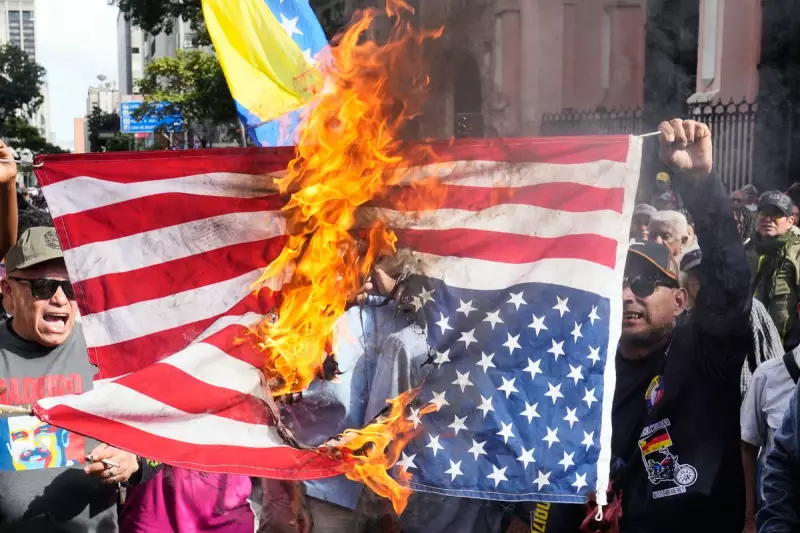
The Trump administration's dramatic seizure of Venezuelan President Nicolás Maduro, spiriting him to New York to face charges, has ignited a fierce debate over the legality of American actions and the precedent it sets for global conflict.
An Unprecedented Escalation in International Relations
In a stunning middle-of-the-night operation that reportedly rocked Caracas with explosions, US forces captured President Nicolás Maduro and his wife. They were transported via a US warship to face narco-terrorism conspiracy charges. Legal scholars have been swift to condemn the move, describing it as an unprecedented escalation beyond even historic interventions in Panama or Iraq.
Jimmy Gurulé, a professor at Notre Dame Law School and former assistant US attorney, stated unequivocally: "This is clearly a blatant, illegal and criminal act." The operation marks a peak in months of aggressive US military posture in the region, which has included the bombing of alleged drug trafficking vessels and seizures of oil tankers. Since September, the administration has conducted 35 known boat strikes, resulting in over 115 fatalities.

The Legal and Constitutional Firestorm
The action has starkly exposed divisions over executive power. Unlike the 1989 invasion of Panama—which had clear national security justifications involving the Panama Canal—Congress has not authorised any military strike or law enforcement action against Venezuela. This places the operation in a contentious legal grey area.
Matthew Waxman, a Columbia University law professor and former Bush administration official, noted the administration will likely cite broad executive power to defend US interests. "Critics will charge that this exceeds the bounds of presidential power without congressional authorisation," he said.
The administration's rationale appears rooted in a memo obtained by The Associated Press in October, which declared drug cartels operating from Venezuela as "unlawful combatants." This frames drug trafficking as an "armed conflict," a novel justification for employing military force. Michael Schmitt, professor emeritus at the US Naval War College, argued this triggers an international armed conflict under law. "Lay people call it war," he said.
Political Repercussions and a Dangerous Precedent
The political fallout in Washington is immediate and starkly partisan. Congressional Democratic leaders, Sen. Chuck Schumer and Rep. Hakeem Jeffries, demanded urgent briefings, having been notified only after the operation began. Schumer warned, "The idea that Trump plans to now run Venezuela should strike fear in the hearts of all Americans."
While Republican lawmakers largely welcomed the removal of a leader they label a dictator, Democrats warned of the dangerous precedent. Sen. Mark Warner of Virginia questioned, "Beyond the legality, what kind of precedent does it send?" He drew parallels to the Iraq War, especially with plans to use Venezuela's oil revenue to fund the operation's costs—a move raising further legal questions over resource ownership.
The Senate is expected to vote next week on a bipartisan war powers resolution to block further use of US forces against Venezuela without congressional authorisation. As the nation grapples with the aftermath, the harder task identified by experts like John Yoo of UC Berkeley—who helped architect Iraq War policy—looms large: ensuring a stable democratic transition. The legality of the initial strike may soon be overshadowed by the immense challenge of what comes next.