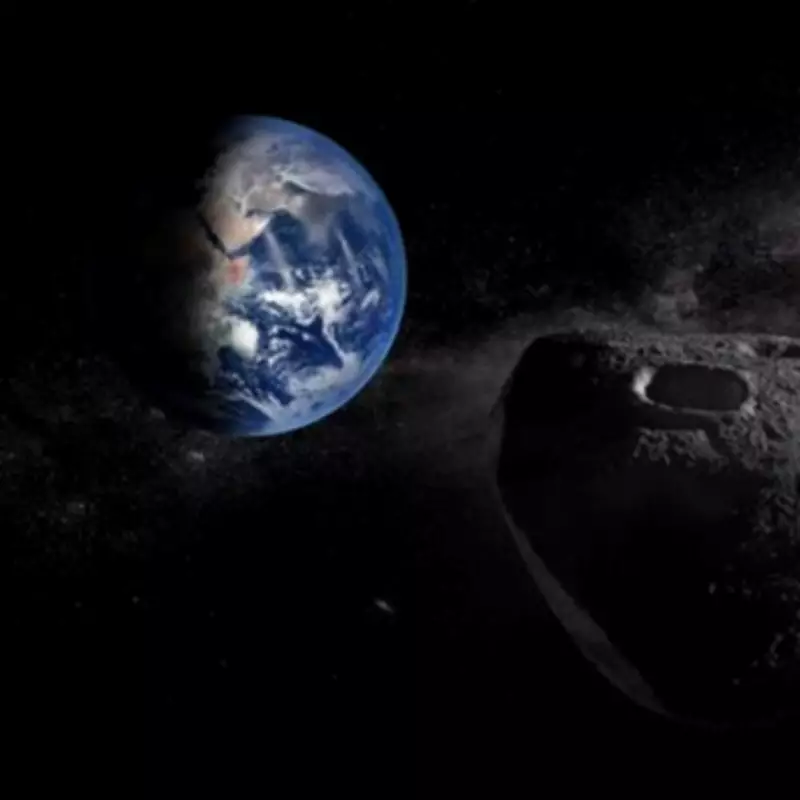
NASA has officially announced the exact date when the colossal asteroid Apophis, often referred to as the 'God of Chaos,' will make its closest approach to Earth in recorded history. The space rock, named after the ancient Egyptian deity of evil and destruction, is set to hurtle past our planet on Friday, April 13, 2029, coming within approximately 20,000 miles of Earth's surface—closer than many orbiting satellites.
Unprecedented Close Encounter
This rare event will mark the nearest approach by an asteroid of this size ever documented. To put it in perspective, Apophis will be nearly 12 times closer to Earth than the Moon's average distance. The asteroid, which spans about 1,230 feet—slightly taller than the Eiffel Tower—will be visible to the naked eye for several hours, offering a spectacular sight and a unique scientific opportunity.
History of Apophis
Discovered in 2004, Apophis initially raised concerns about a potential impact in 2029, 2036, or 2068. However, after years of meticulous tracking using optical telescopes and ground-based radar, NASA has ruled out any risk of collision for at least the next century. In 2021, refined observations eliminated the earlier 2.7% chance of impact, confirming a safe flyby.

During its last flyby in 2021, Apophis passed at a distance of about 10.5 million miles—roughly 43 times the Earth-Moon distance. The upcoming 2029 encounter will be dramatically closer, allowing scientists to study the asteroid's shape, spin, and composition up close. Early observations suggest Apophis resembles a peanut in shape.
Scientific Significance
NASA has emphasized that this close approach is a once-in-a-lifetime event for researchers. The asteroid's passage will be influenced by Earth's gravity, potentially altering its spin state. This provides a natural experiment to understand how tidal forces affect such celestial bodies.
NASA currently tracks approximately 2,000 near-Earth objects, including asteroids and comets. While most pose no threat, the study of Apophis will enhance our ability to predict and mitigate potential future impacts. The last asteroid of apocalyptic scale struck Earth 66 million years ago, leading to the extinction of the dinosaurs.