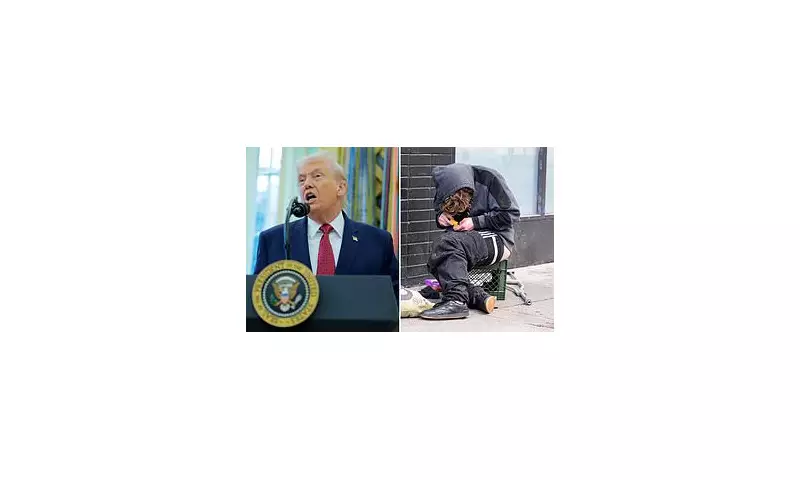
In a dramatic escalation of his administration's campaign against international drug cartels, President Donald Trump has formally classified the synthetic opioid fentanyl as a weapon of mass destruction.
A Decree Linking Drugs to National Security
Signing an executive order on Monday, President Trump placed illicit fentanyl in the same category as nuclear and chemical weapons. He argued the drug's devastating impact on American lives justified the unprecedented move. "No bomb does what this is doing - 200-300,000 people die every year, that we know of," Trump stated during the signing ceremony.
The order itself declared that "illicit fentanyl is closer to a chemical weapon than a narcotic" and that its manufacture and distribution "threatens our national security and fuels lawlessness in our hemisphere and at our borders." However, this fatality figure cited by the President appears significantly inflated compared to official data. The US Centers for Disease Control and Prevention reported an estimated 80,000 total overdose deaths in the country for 2024, with roughly 48,000 of those attributed to synthetic opioids like fentanyl.

Military Buildup and 'Narco-Terrorist' Strikes
This new classification is intrinsically tied to the Trump administration's expanding military operations, which it brands a war against "narco-terrorists." Since early September, a campaign targeting alleged drug-smuggling boats with military strikes has left nearly 90 people dead. Trump has claimed that each vessel destroyed – more than 20 so far – saves 25,000 American lives.
Yet, intelligence suggests these targeted boats are primarily transporting cocaine, not the far deadlier fentanyl, which is mainly smuggled into the United States overland from Mexico rather than by sea from Colombia or Venezuela. The military action has been accompanied by a significant US force deployment in the Caribbean, including the world's largest aircraft carrier and multiple warships, alongside reconnaissance flights along Venezuela's coast.
Heightening Tensions with Venezuela
The Trump administration insists the military focus is solely on drug trafficking, but Venezuela's socialist leader, Nicolás Maduro, accuses Washington of using narcotics as a pretext for regime change. The US has sought to directly link Maduro to the trade, accusing him of leading the "Cartel of the Suns," designated a narco-terrorist organisation last month. A $50 million reward has been offered for information leading to his capture.
Tensions spiked further last week when US forces seized a sanctioned oil tanker off the Venezuelan coast. Attorney General Pam Bondi stated the vessel was part of a network "supporting foreign terrorist organisations." Shortly after, US forces conducted a strike destroying another alleged drug-smuggling boat, killing 11 individuals whom Trump identified as members of the Tren de Aragua narcoterrorist group – a claim for which public evidence has not yet been provided.
Venezuela has denounced this action as "extrajudicial killings," with Interior Minister Diosdado Cabello alleging the victims were innocent citizens. In response to the US pressure, Maduro has threatened to "declare a republic in arms" if attacked and has deployed troops and militias across hundreds of locations. He warned that any US military action would "stain President Donald Trump's hands with blood."
The situation remains volatile, with the US maintaining over 4,000 troops in the region and Venezuela mobilising civilian militias, signalling a dangerous standoff with the opioid crisis at its core.