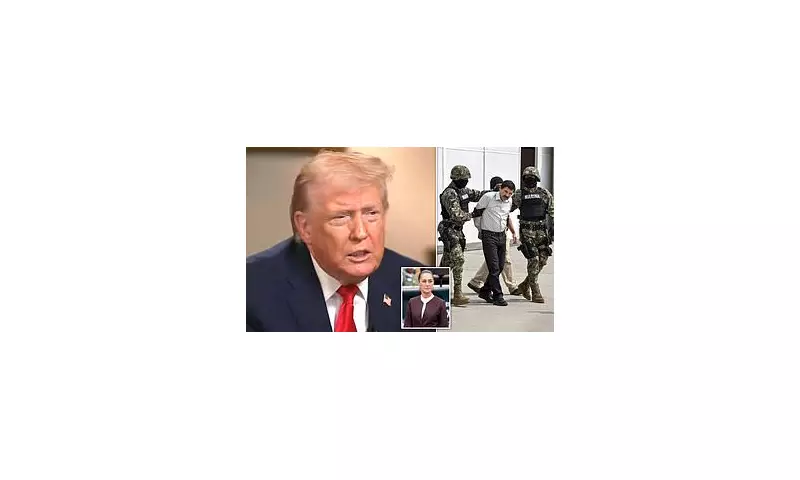
President Donald Trump has declared that the United States military will commence land strikes against drug cartels operating in Mexico, framing the move as a critical step in the battle against narcoterrorism. The announcement, made during a Fox News interview on Thursday night, comes just days after the high-profile capture of Venezuelan leader Nicolas Maduro.
A Stark Warning to Cartels and a Boast of Unchecked Power
"We are gonna start now hitting land with regard to the cartels," Trump stated emphatically. He lamented the cartels' influence, adding, "The cartels are running Mexico, it's very sad to watch and see what's happened to that country." This threat marks a significant escalation in rhetoric and potential action against cross-border criminal organisations.
Earlier, when questioned by The New York Times about the constraints on US military action in the region, Trump offered a revealing response. "My own morality. My own mind. It’s the only thing that can stop me," he asserted, dismissing the traditional limits of international law. He elaborated, "I don’t need international law," while claiming he is "not looking to hurt people."

Regional Fallout and a Contentious Nobel Prize
The president's aggressive foreign policy stance has already caused ripples across the globe. He has suggested that Greenland, Cuba, and Colombia could be next for US operations, a prospect that has angered NATO allies and world leaders including the UK's Keir Starmer and France's Emmanuel Macron.
During his recent interview, Trump even took a call from Colombian President Gustavo Petro, who has previously vowed he would "take up arms" if targeted by the US administration. This tense exchange underscores the diplomatic friction his announcements generate.
The strategy follows what Trump's team views as a successful operation in Venezuela. Following Maduro's capture, the US has secured a deal for 30 to 50 million barrels of Venezuelan oil, potentially worth up to $2 billion. Trump announced the proceeds would be controlled by him "to ensure it is used to benefit the people of Venezuela and the United States."
This manoeuvre has, however, sidelined Venezuelan opposition leader Maria Corina Machado, who recently won the Nobel Peace Prize. Sources indicate Trump's displeasure at not receiving the prize himself has influenced his approach. "If she had turned it down and said, 'I can't accept it because it's Donald Trump's,' she'd be the president of Venezuela today," an insider told the Washington Post, calling her acceptance the "ultimate sin."
Mexican Resistance and Future Implications
Despite Trump's threats, direct military intervention in Mexico faces firm opposition from its government. Mexican President Claudia Sheinbaum confirmed the idea has been raised in conversations with Trump but stated she has consistently rejected it, insisting their relationship is one of "mutual respect."
Analysts believe such threats will remain a hallmark of Trump's negotiation tactics, especially with the US-Mexico-Canada free trade agreement (USMCA) up for revision this year. Trump has long accused Central American drug traffickers of being responsible for 250,000 to 300,000 American deaths annually, blaming the cartels' influence and fentanyl trafficking for devastating families.
As the administration moves forward, placing Energy Secretary Chris Wright in charge of the Venezuelan oil plan, the world watches to see if the threats against Mexican cartels materialise into action, setting a profound precedent for US military power and international sovereignty.