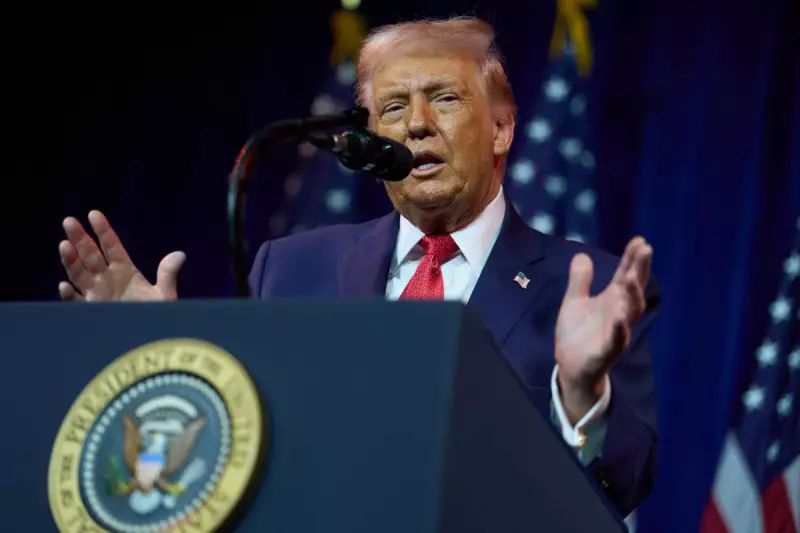
President Donald Trump has unveiled an ambitious proposal to set United States military spending at a staggering $1.5 trillion for the 2027 fiscal year, declaring the nation is living through "troubled and dangerous times." The announcement, made on Wednesday 7 January 2026, signals a dramatic escalation in defence investment.
A Surge in Spending Amidst Military Moves
The call for a massive budgetary surge comes directly on the heels of significant military operations. Just days prior, Trump ordered a mission to capture Venezuelan leader Nicolás Maduro, who was spirited out of the country to face drug trafficking charges in the US. American forces continue to mass in the Caribbean Sea region in the operation's aftermath.
This proposed figure represents a near-doubling of the current defence outlay, with the 2026 military budget set at $901 billion. Trump framed the increase as essential for building a "Dream Military" that would keep the nation "SAFE and SECURE, regardless of foe," in a post on his Truth Social platform.

The geopolitical context appears increasingly volatile. In recent days, Trump has also called for the US to take over the Danish territory of Greenland for national security reasons, suggested openness to military operations in Colombia, and seen his Secretary of State, Marco Rubio, issue ominous warnings about longtime adversary Cuba.
Funding the Vision: Tariffs and Political Battles
President Trump asserted that increased revenue from his administration's aggressive tariff policies enables this military spending surge. According to data from the Bipartisan Policy Center, the US government collected $288.5 billion last year from tariffs and excise taxes, a sharp rise from $98.3 billion in 2024.
However, this revenue stream is unlikely to cover the full cost. Trump has previously claimed tariffs could also fund taxpayer dividends, pay down the national debt, and now finance military expansion. The proposal is almost certain to face fierce resistance. Democrats typically insist on parity between defence and non-defence spending changes, while Republican deficit hawks have historically pushed back against unchecked military budget growth.
The Pentagon recently received a significant boost of roughly $175 billion from a Republican-passed bill of tax breaks and spending reductions signed by Trump last year.
Confronting Defence Contractors: The Raytheon Ultimatum
In a parallel move, Trump directly threatened defence giant Raytheon, warning he would cut off Pentagon purchases if the company did not halt stock buybacks and invest more profits into expanding its weapons manufacturing capacity. He accused defence firms of being "woefully behind on deliveries" while rewarding investors and executives.
"Either Raytheon steps up, and starts investing in more upfront Investment like Plants and Equipment, or they will no longer be doing business with Department of War," Trump stated on social media. He explicitly barred the company from any further stock buybacks if it wants future US government contracts.
Raytheon is a critical supplier, manufacturing iconic weaponry like the Tomahawk cruise missile, Javelin, Stinger, and Sidewinder missiles. It also owns Pratt & Whitney, which produces jet engines for aircraft including the F-35 Joint Strike Fighter. The company did not immediately respond to requests for comment.
The market reacted swiftly, with shares of major defence contractors falling. Northrop Grumman dropped 5.5%, Lockheed Martin declined 4.8%, and RTX Corp., Raytheon's parent company, slipped 2.5%.
This sweeping proposal sets the stage for a major political and fiscal debate in Washington, as the Trump administration seeks to fundamentally reshape US defence posture and industrial policy amidst a landscape it describes as increasingly perilous.