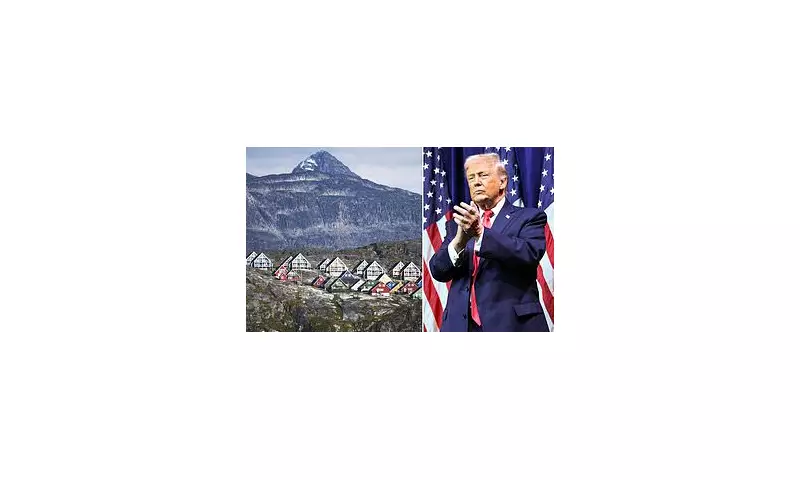
Fresh from the dramatic extradition of Venezuelan leader Nicolas Maduro, President Donald Trump is renewing his controversial campaign to acquire Greenland. However, a new opinion poll suggests the American public's foreign policy gaze remains fixed on the Middle East, with Iran topping the list of desired targets for US intervention.
Greenland Ambition Meets Public Apathy
President Trump has repeatedly signalled his desire to purchase or otherwise obtain the vast, autonomous Danish territory of Greenland, citing its strategic position in the North Atlantic and Arctic. This ambition appears to have been intensified by what the White House hailed as a successful Delta Force operation in Venezuela over the weekend.
Yet, according to a Daily Mail poll conducted by JL Partners on January 5-6, this potential Arctic power play is generating little enthusiasm among voters. The survey of 1,000 respondents found that barely half – 44 percent – were unsure or held no strong opinion on where the US should conduct military strikes or pursue regime change next.

Among those who did express a preference, a mere 5 percent supported a US takeover of Greenland, a territory Denmark has controlled in some form since the 14th century.
Public Opinion Favours Action Against Iran and Russia
Instead of looking north, the poll indicates that American foreign policy concerns are still dominated by traditional adversaries, even after the end of the 20-year war in Afghanistan four years ago.
The data reveals a clear public appetite for confrontation with nations aligned against US interests. One in every four Americans surveyed said they want Iran to be the next target for US intervention. Russia followed closely in second place with 18 percent, and Cuba was third with 17 percent. A further 8 percent advocated for action against China.
These three nations – Iran, Russia, and China – are all noted allies of Venezuela and are considered among Washington's most significant geopolitical rivals. The poll underscores a continuing public focus on these adversarial relationships, despite the administration's Arctic pivot.
White House Doubles Down on Strategic Rationale
Undeterred by the apparent lack of public interest, the Trump administration is actively advancing its case for acquiring Greenland. At a White House briefing on Wednesday, Press Secretary Karoline Leavitt confirmed the president is "actively" discussing the purchase with Denmark.
Leavitt framed the move as a matter of long-standing national security interest, noting, "This is something that presidents dating back to the 1800s have said is advantageous for our national security." She argued it would give the US "more control over the Arctic region" and prevent Chinese and Russian aggression.
This push follows Trump's earth-shattering decision to authorise the abduction and extradition of Maduro and his wife, Cilia Flores. Secretary of State Marco Rubio added that he plans to meet with Danish officials next week, further signalling the administration's serious intent.
However, strategic analysts continue to question the necessity of an outright acquisition. The Arctic island is already protected under NATO alliances, and critics argue the US could achieve its security objectives through enhanced cooperation with European allies rather than a contentious takeover.
A Disconnect Between Policy and Public Priority
The JL Partners poll highlights a potential disconnect between the Trump administration's evolving geopolitical strategy and the enduring concerns of the American electorate. While the White House looks to secure the Arctic frontier against Russian and Chinese influence, a significant portion of the public remains focused on perceived threats from Iran and other longstanding foes.
This divergence raises questions about the public appetite for a new era of territorial expansion and whether the political capital exists to pursue such a historically significant, and diplomatically sensitive, acquisition as Greenland.