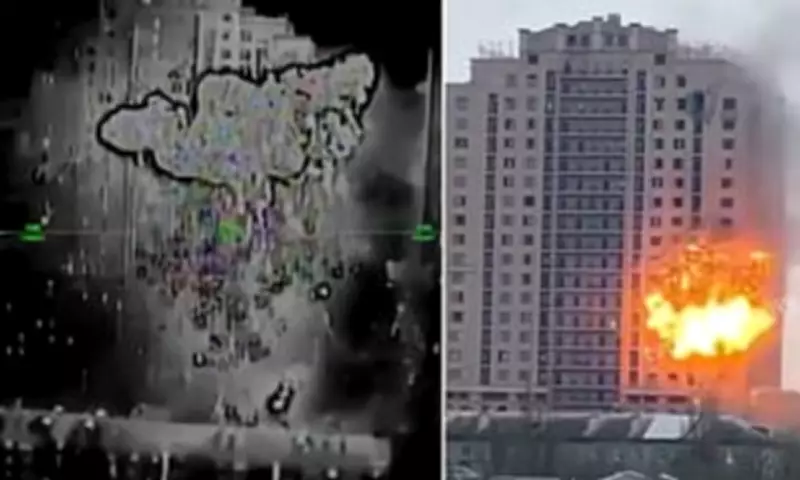
Ukraine has claimed it eliminated 12 officers of the Russian Federal Security Service (FSB) in a precision drone strike on a covert command post deep within occupied territory. Kyiv reported that a swarm of high-precision drones struck a building used by Russia's feared FSB in the Donetsk region, resulting in the deaths of a dozen officers.
Details of the Attack
The attack, described as highly targeted, also left 15 individuals wounded. Robert Brovdi, Ukraine's top drone commander, stated that eight unmanned aircraft were employed to hit the site on Wednesday. Dramatic footage released by his unit depicted first-person-view drones hurtling toward a high-rise building before a series of massive explosions ripped through one of its floors, sending debris across the area. Brovdi confirmed that the strike destroyed a command post and an operational special unit of the FSB, which specialized in counter-intelligence, sabotage, and coordinating pro-Russian militants within Ukrainian territory.
Strategic Context
The reported strike comes at a pivotal moment in the conflict, with fresh analysis suggesting that Moscow's grinding offensive may be stalling for the first time in over two years. According to the Institute for the Study of War, Russian forces have failed to make territorial gains since March and have actually lost nearly 23.2 square miles of ground since the start of the month. Kyiv claims it has inflicted over 55,000 casualties on Russian troops during the same period, largely through drone usage, as President Vladimir Putin continues to pour soldiers into the so-called 'kill zone'—a vast, UAV-patrolled frontline spanning some 800 miles.

Ukraine's Strengthened Position
Ukrainian officials now believe they are in their strongest battlefield position in a year, crediting a growing edge in drone warfare and improved air defenses. Foreign Minister Andriy Sybiha stated, 'We are holding the line. Indeed, our battlefield position is the strongest or most solid it has been in the past year. Truly the strongest.' He added, 'We have minimised the Russians' manpower advantage through drone use.'
In a further boost for Kyiv, the European Union has agreed to release a £78.2 billion loan package after Hungary lifted its long-standing veto. The funds are expected to support Ukraine's battered economy and bankroll weapons production, though officials warn a funding gap of nearly £16.9 billion could still emerge by 2026. Ukrainian President Volodymyr Zelensky said the first tranche could arrive as early as late May or June and would be channelled into domestic arms manufacturing.
Russia's Perspective
Meanwhile, Russia has continued to paint a far rosier picture of the war effort. Valery Gerasimov, the Kremlin's top military officer, has repeatedly claimed sweeping territorial gains, insisting earlier this week that Moscow had captured 656 square miles of Ukrainian land since January. Separate estimates indicate Russia's advances in early 2026 are roughly half of what they were during the same period last year. Military analysts say Moscow's struggles have been compounded by communications issues, including the loss of Elon Musk's Starlink satellite service and restrictions on the Telegram messaging platform, both widely used on the battlefield.
Drone Warfare Advancements
Ukraine, by contrast, has pressed ahead with counter-offensive tactics, particularly around the Zaporizhzhia-Dnipro junction, where it has managed to blunt Russian advances. There are also signs of growing alarm inside the Kremlin over Kyiv's rapid technological progress. Russian military bloggers have claimed that Defence Minister Andrey Belousov recently warned Putin that Ukraine now holds a significant drone advantage. On Wednesday, Ukraine unveiled a new fixed-wing kamikaze drone dubbed the 'Khmarynka', capable of striking targets up to 31 miles away at speeds of 87mph, carrying a 7kg payload.

Economic Impact
Kyiv's long-range drone campaign is also taking a toll on Russia's economy. A Reuters report this week suggested the country could be facing its steepest drop in oil output in six years after sustained strikes on key ports and refineries. Production is believed to have fallen by around 300,000 barrels per day in April following repeated attacks on Baltic Sea facilities at Ust-Luga and Primorsk, as well as the Black Sea hub of Novorossiysk. Earlier this week, a strike on the Tuapse refinery triggered a massive blaze that raged for three days, with hundreds of firefighters battling to contain it. Local officials warned of an environmental disaster, as residents described 'oil rain' coating homes, cars and vegetation in thick black residue. Vil Mirzayanov, an exiled chemist credited with developing the Novichok nerve agent, warned that fumes from burning petrochemicals could cause 'mass poisoning of the population'. Overnight strikes on Wednesday reportedly hit a petrochemical plant in Russia's Samara region and an oil pumping station in Nizhny Novgorod, as Ukraine kept up pressure on critical infrastructure.
Diplomatic Developments
Despite the mounting military and economic strain, Moscow has pointed to diplomatic developments as a sign of resilience. Russia has been invited to attend the G20 summit in the United States later this year, according to Deputy Foreign Minister Aleksandr Pankin. 'There is an invitation to be present at the highest level, but we will see closer to the date,' said Pankin.