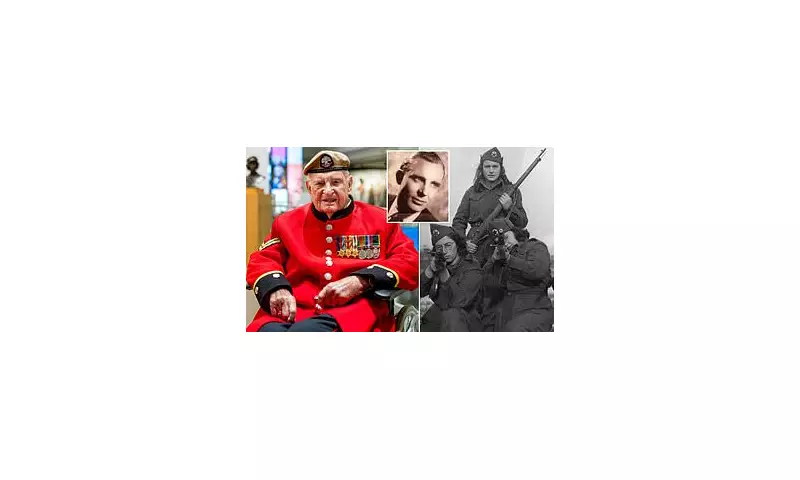
In the remote mountains of Yugoslavia during Christmas 1943, two British special forces soldiers found themselves in a situation that would test both their nerve and their holiday spirit. John Gomer Morris, now 103 and the oldest resident of the Royal Hospital Chelsea, vividly recalls the moment their lightly-armoured Willys jeep accidentally drove into enemy territory.
The Christmas Eve Misadventure
Behind the wheel sat 'Blondie' Smith of the Long Range Desert Group, while Morris cradled a Tommy gun with a drum magazine in his lap. The pair had been sent to collect Christmas mail from Allied-held Dubrovnik but after consuming generous amounts of raki, a potent local spirit, their return journey became disorientated. "We lost our way coming back," Morris remembers, his memory still sharp eight decades later.
By the time they realised their error, they found themselves driving through a German-held village. The appearance of stunned German soldiers ahead created a tense standoff. In keeping with the season of goodwill, Smith whispered instructions to Morris: "Fire over their heads. Don't shoot anybody. It's Christmas Eve. Just frighten the life out of them."

Morris raised his Tommy gun and fired a burst just over the heads of the German troops. As they dived for cover, Smith executed a screaming about-turn and accelerated away. To their relief, no enemy fire followed them, and they heard no vehicles in pursuit. Clearly, the Germans shared their lack of appetite for bloodshed on Christmas Eve.
From Anti-Aircraft Guns to Special Forces
Morris's journey to that moment began in the Cotswolds in 1922. He remembers his father as a troubled Royal Engineer who served on the Western Front in the trenches of the Somme, Ypres and Passchendaele during World War I. "It wasn't a very nice war to fight," Morris reflects on his father's experience.
In 1938, he joined the 89th Heavy Anti-Aircraft Regiment, a Territorial Army unit in Kent. During the Battle of Britain and the Blitz, he manned anti-aircraft guns in London. "Our job was to break the bombers up so the fighters could get at them," he explains. His aim wasn't always perfect - he once hit a chimney of a nearby oast house while firing at a Dornier reconnaissance plane.
By 1943, Morris was serving in Algeria as a machine-gunner and trained radio operator when he fell ill after drinking poisoned water. During his recovery, he discovered an opportunity that would change his war - volunteers were being sought for a new special forces unit: the Raiding Support Regiment (RSR).
Life with the Partisans
The RSR, with its motto "Quit You Like Men," was created to provide heavy weapons support to units like the SAS operating deep behind enemy lines. Morris underwent specialist training in Palestine, learning small boat handling, mule management for mountain operations, and completing rigorous fitness training. His first parachute jump left a lasting impression: "It was bloody awful. I was pushed out through the bomb doors of a Wellington bomber."
Morris found himself deep in Yugoslavian mountains, sometimes attached directly to the headquarters of partisan leader Josip Broz Tito. "My job was teaching the partisan girls how to improve their morse code and how to use the radio sets provided by the British," he recalls. "They were very beautiful girls. We all slept in one big log cabin. This beautiful girl was sleeping next to me... they used to go to bed with hand grenades around their waists."
He was deeply impressed by the female fighters: "They used to go out and come back, some of them shot up. They used to fight like men." The partisans faced multiple threats, not only from Germans but also from the Ustaše, the fascist Croatian militia that Morris describes as "worse than the German SS."
Post-War Adventures and Reflections
Morris's war nearly ended when he was captured after being ambushed while radioing back enemy positions. He and his comrade managed to escape after unsoldering a water bottle containing a concealed pistol, tying up their guard at gunpoint. Back in Allied lines, malaria prevented him from joining the RSR's deployment to Greece, where "a lot of my friends got killed."

After guarding German prisoners who "hated Hitler," Morris returned to civilian life in 1946. But his adventures continued. In December 1963, he and his family were aboard the cruise ship TSMS Lakonia when a catastrophic fire broke out. He helped his wife and children into lifeboats before leaping into the cold Atlantic himself, clinging to floating debris for six hours before rescue. Tragically, his mother-in-law died when her lifeboat davits snapped.
Morris later emigrated to Australia, settling in Parramatta, Sydney for nearly 40 years before returning to Britain in 2020 with assistance from the charity Pilgrim Bandits. Now at the Royal Hospital Chelsea, he frequently visits local schools to share his wartime experiences.
As the last surviving member of the RSR, Morris represents a living connection to one of WWII's least known special forces units. Looking back on more than a century of conflict and change, he offers a poignant reflection: "People are putting greed before need. If we tried to save people rather than kill them, the world would be a better place."