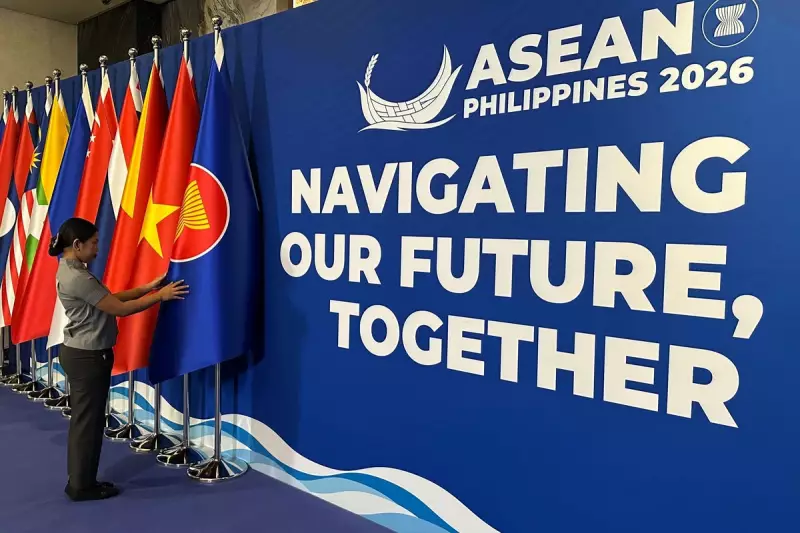
ASEAN Diplomats Confront Twin Regional Challenges in Cebu Summit
Southeast Asia's foremost diplomats have gathered in the central Philippine city of Cebu for their first major meeting of the year, facing mounting pressure on two critical fronts. The Association of Southeast Asian Nations (ASEAN) foreign ministers must breathe new life into a peace plan that has thus far failed to halt Myanmar's devastating civil war, while simultaneously racing against a self-imposed deadline to finalise negotiations with China over a South China Sea code of conduct.
Myanmar's Stalled Peace Process and ASEAN's Credibility Test
The 11-nation bloc, which has long struggled to project unity, confronts one of its most significant challenges in Myanmar. The conflict has claimed tens of thousands of lives and displaced millions since the military ousted Aung San Suu Kyi's democratically elected government in 2021. ASEAN does not recognise the ruling junta, and its leaders remain barred from regional meetings, though lower-level diplomats have been permitted to attend.
Philippine Foreign Secretary Theresa Lazaro, designated as ASEAN's special envoy to Myanmar, is scheduled to report to her counterparts in Cebu about her recent visit to the country, where she met with ruling generals among other officials. She will also discuss outcomes from a conference she recently organised in the Philippines, which brought together various political and ethnic groups opposed to Myanmar's military government.

The Manila conference focused on enforcing ASEAN's five-point peace plan, originally proposed in 2021, which demands an immediate end to fighting and hostilities. Participants examined how to advance de-escalation, facilitate humanitarian assistance, effectively address transnational crime, and foster political dialogue among relevant stakeholders, according to the Philippine Department of Foreign Affairs.
Malaysian Foreign Minister Mohamad Hasan revealed last week that ASEAN leaders decided during their October summit not to send observers to Myanmar's recent elections, determining that conditions for credible polls were not met. However, some member countries, including Cambodia and Vietnam, chose to participate individually.
South China Sea Code Negotiations Reach Critical Juncture
Parallel to the Myanmar crisis, ASEAN foreign ministers face intense pressure to conclude negotiations with China ahead of a year-end deadline for a "code of conduct" to manage disputes in the South China Sea. China's expansive claims overlap with those of four ASEAN members in waters long regarded as a potential flashpoint for regional conflict.
Negotiations on the proposed code have dragged on for more than two decades without major breakthroughs on the most contentious issues, particularly whether the accord should be legally binding. The bloc resolved to conclude negotiations by the end of 2026 during a previous meeting, but analysts remain sceptical about achieving this goal.
"Even with a strong political will, concluding it will remain challenging," said Australia-based analyst Lupita Wijaya, who has conducted extensive research on the South China Sea. "The central roadblock is not the pace of negotiations, but more on fundamental differences between ASEAN claimant states and China over interpretations of international law or whether the COC should be legally binding."
The United States, while having no territorial claims in the disputed waters, has warned China that it is obligated to defend the Philippines—a longtime treaty ally—if Filipino forces come under armed attack in the offshore region. This adds another layer of complexity to the negotiations, with all parties hoping to prevent disputes from escalating into a major conflict that could draw in American forces.
ASEAN's Internal Challenges and Regional Leadership
The Philippines holds ASEAN's rotating chair this year, taking what would have been Myanmar's turn after the country was suspended from chairing meetings following the 2021 military takeover. This leadership role comes as ASEAN continues to grapple with internal divisions and relevance questions.

The bloc faced a significant setback last year when deadly fighting erupted between two members, Thailand and Cambodia, over a longstanding border conflict. The fighting ended with a ceasefire brokered by Malaysia and reinforced by pressure from U.S. President Donald Trump, who threatened to withhold trade privileges unless both parties agreed. Maintaining this fragile ceasefire remains high on the agenda for the Cebu meetings.
As ASEAN diplomats navigate these complex geopolitical waters, their ability to address both the Myanmar crisis and South China Sea disputes will significantly impact the bloc's credibility and effectiveness in promoting regional stability. The outcomes from Cebu could determine whether ASEAN can overcome its internal divisions and external pressures to emerge as a more unified force in Southeast Asian diplomacy.