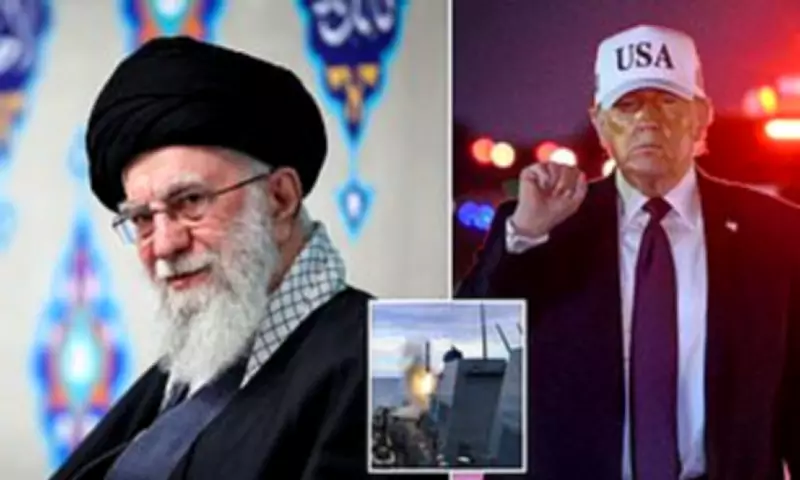
The targeted strike on Iran that resulted in the death of the country's top Islamic leader, Ayatollah Ali Khamenei, was initiated after the Central Intelligence Agency uncovered critical intelligence regarding a clandestine meeting involving the supreme leader. This joint United States and Israeli operation, conducted on Saturday, has ignited a broader war across the Middle East and tragically led to the deaths of three American service members.
Intelligence Gathering and Operation Execution
The CIA and Israeli intelligence services played a pivotal and decisive role in the lead-up to former President Donald Trump's authorization of 'Operation Epic Fury.' The agency successfully obtained intelligence indicating that senior Iranian officials were scheduled to meet with Ayatollah Khamenei at his palace in the heart of Tehran on Saturday morning.
This advanced knowledge of Khamenei's precise whereabouts created a crucial window of opportunity. According to reports from the New York Times, Trump and Israeli leaders made the strategic decision to accelerate the timing of the attack, which completely surprised the Iranian regime. Sources revealed that the US and Israeli governments had initially planned to launch the assault under the cover of darkness.

Surprise Morning Assault
Instead, jets took off from military bases in Israel at 6:00 AM local time on Saturday, armed with long-range missiles and precision munitions. This early morning launch was directly timed after the CIA learned the ayatollah would be convening with top Iranian leadership. US and Israeli intelligence agencies worked in close coordination to track Khamenei's location to a specific compound in Tehran.
Missiles struck the ayatollah's palace a few hours later. During the devastating strike, senior Iranian national security officials were present in another section of the building. The attack not only killed Ayatollah Khamenei, who had ruled over Iran for nearly four decades, but also obliterated two high-level military leaders—Rear Admiral Ali Shamkhani and IRGC commander Major General Mohammad Pakpour—along with four of Khamenei's close family members.
Immediate Aftermath and Regional Escalation
Despite the rapid tactical success of Trump's strike against the Iranian leadership, chaos and death have spread rapidly throughout the Middle East. Tehran has launched immediate retaliatory strikes on US bases and assets across the region. Iran's Revolutionary Guards claimed to have attacked the USS Abraham Lincoln aircraft carrier in revenge for the killing of their Supreme Leader, stating they fired four ballistic missiles.
The Pentagon later denied the Lincoln had been hit, clarifying that missiles were fired but 'did not even come close' to the vessel. Iran has also retaliated with a series of strikes across neighboring Gulf states, with explosions reported in Qatar, Israel, Bahrain, Kuwait, Iraq, Oman, and Saudi Arabia. Residential buildings throughout the Gulf region have been targeted.
Widening Conflict and Further Casualties
The Islamic Revolutionary Guard Corps announced they had attacked nearly thirty US military bases across the Middle East on Sunday morning. In response, Trump promised to strike Iran 'with a force that has never been seen before.' The conflict has continued to escalate, with black smoke seen rising from a US airbase at Erbil International Airport in northern Iraq at sunrise, following the IRGC's promise of their most ferocious counterattack.
In a further significant development, it was revealed that former Iranian President Mahmoud Ahmadinejad has also been killed in airstrikes, according to reports from Israeli state television. This joint military and intelligence operation underscores the exceptionally close cooperation between US and Israeli forces, while simultaneously plunging the entire region into a dangerous and expanding state of warfare with mounting casualties on all sides.