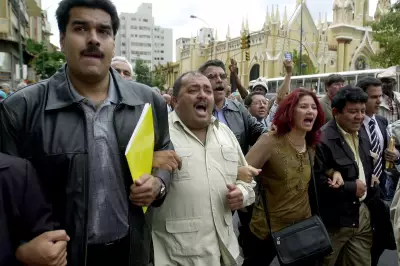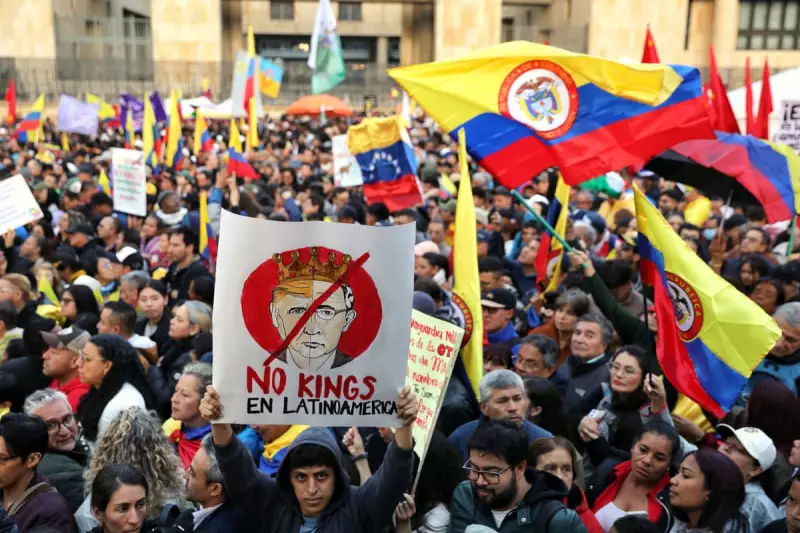
Thousands of demonstrators have flooded the streets of Colombian cities in a powerful display of anger against former US President Donald Trump's threats of military intervention in the region.
‘Out with the Yanks!’: Anger Spills onto Colombian Streets
The nationwide protests were called by Colombia's left-wing President, Gustavo Petro, following Trump's alarming comments. Trump indicated he favoured the idea of military action in Colombia after a dramatic US special forces raid in Venezuela last Saturday. During that assault, Venezuelan President Nicolás Maduro and First Lady Cilia Flores were captured, and dozens of bodyguards were killed.
In Bogotá's historic Bolívar Plaza, President Petro addressed a large crowd, stating that the events in Venezuela were, in his view, illegal. The scene was charged with emotion, with one protester's sign delivering a blunt message: "Go to hell shitty yanks".
The anger was palpable in Cúcuta, a city on the volatile border with Venezuela. Hundreds marched towards its cathedral, waving Colombian flags and chanting "Fuera los yanquis!" ("Out with the Yanks!").
"Trump is the devil … he’s the most abhorrent person in the world," said Janet Chacón, a 55-year-old businesswoman among the protesters. Another, José Silva, 67, accused Trump of being a "president of war" and a "maniac", calling on the US Congress to remove him from power.
A Diplomatic Dance Amidst Rising Tensions
Despite the fiery public rhetoric, a phone call between the two leaders revealed a more diplomatic tone. Shortly before his public statement, Petro spoke with Trump for the first time. Afterwards, Trump described it as a "great honor" on his Truth Social platform, praising Petro's tone and expressing a desire to meet.
President Petro indicated a willingness to engage but struck a cautious note, warning "We cannot lower our guard" and that "words need to be followed by deeds". This caution follows deeply personal attacks from Trump, who recently labelled Petro "a sick man who likes making cocaine and selling it to the United States"—an allegation for which there is no evidence.
When questioned by reporters about potentially replicating the Venezuelan intervention in Colombia, Trump's response was stark: "It sounds good to me."
Regional Shockwaves and Fears of a Wider Conflict
Trump's actions have sent shockwaves throughout Latin America, sparking solidarity protests in Mexico City, São Paulo, and Buenos Aires. The underlying motive, as admitted by Trump himself, is to secure "total access" to Venezuela's vast oil reserves—a move analysts see as a resource grab.
"He doesn’t want to liberate Venezuela. He just wants the oil," said Marta Jiménez, a 65-year-old teacher protesting in Cúcuta. She and others fear Colombia is next in line. Protester Juan Carlos Silva, 59, expressed a common dread: "We’re not against North America… But this guy [Trump] is possessed by the devil."
Latin American diplomats are horrified, with one describing White House behaviour as "unhinged". Benjamin Gedan, a former National Security Council director for South America, criticised Trump's approach, stating he has shown "astoundingly disinterested in US diplomatic relationships" and seems to go "out of his way to maximise the diplomatic wreckage".
The US embassy in Colombia warned its citizens to avoid the demonstrations, which it claimed had "the potential to turn violent". The Caracas raid marks the most dramatic intervention in a series of aggressive moves by Trump in the region since his return to power, including threats regarding the Panama Canal and interference in Brazilian and Honduran politics.
As tensions simmer, the message from the streets of Colombia and beyond is clear: a firm rejection of what is seen as a return to gunboat diplomacy and a stark warning that Latin America will not be treated as a backyard for foreign intervention.