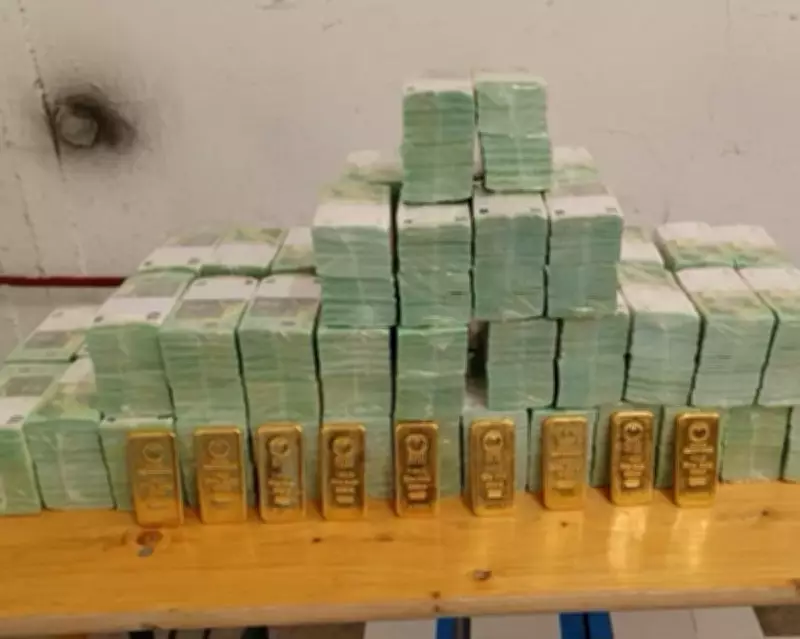
Hungarian Forces Accused of Forced Injection on Ukrainian Bank Staff
Hungarian security operatives are alleged to have administered a forced injection to one of the Ukrainians detained earlier this month during a dramatic raid on bank vehicles transporting gold bars and tens of millions in cash. Sources have informed the Guardian that the incident occurred as tensions between Hungary and Ukraine escalate ahead of a crucial parliamentary election.
Details of the Controversial Raid
Hungary's TEK anti-terrorism police detained seven Ukrainians from the state savings bank, Oschadbank, on 5 March. The individuals were accompanying a convoy of two armoured cars from Vienna to Ukraine, transiting through Hungary in what Kyiv describes as a regular transfer of state funds. Hungarian officials, however, have claimed the money was destined for the Ukrainian war mafia, without providing specific evidence.
The men were held for over 24 hours, much of which they spent blindfolded and handcuffed, before being deported to Ukraine. During this detention, one of the men—a former employee of Ukraine's SBU security service—reportedly received a forced injection. Security sources in Kyiv believe the injection contained a relaxant intended to make subjects more talkative during interrogations, a method reminiscent of so-called truth serums used in historical KGB practices.

Health Complications and Legal Actions
The drug allegedly caused the man, who is diabetic, to experience a hypertensive crisis and lose consciousness, requiring hospitalisation. Lóránt Horváth, the Hungarian lawyer representing the individuals, confirmed that one individual received an injection of unknown contents despite his objections. A Hungarian police source acknowledged hearing about the injection but could not verify its contents.
Oschadbank has filed a criminal complaint against Hungarian authorities for abuse of office, alongside civil claims on behalf of the seven staff members. The bank seeks to overturn the deportation decision and Schengen zone ban, as well as secure the return of the impounded funds. A spokesperson for the bank noted that one detainee has a disability requiring special diet and medication, and his health deteriorated with medical care only provided after he lost consciousness.
Political Context and Diplomatic Fallout
The raid coincides with an upcoming parliamentary election in Hungary, where polls suggest nationalist leader Viktor Orbán may lose power after 16 years. Orbán, known for his pro-Russian stance within the EU, has framed Ukraine and President Volodymyr Zelenskyy as threats to Hungary. Reports allege Russian support for Orbán's campaign, adding to the geopolitical friction.
Ukrainian sources assert that land transfers of government funds have become common due to Russia's war shutting down airspace, with Budapest previously aware of such shipments. They accuse Hungary of fabricating a pretext to escalate bilateral disputes. During the operation, TEK officers reportedly stopped the convoy with weapons drawn, detained the Ukrainians without a Ukrainian interpreter, and only admitted to the capture hours later after GPS tracking revealed their location.
Aftermath and Ongoing Disputes
The seven men were deported to Ukraine and banned from the Schengen zone, with their possessions and the funds still held by Hungarian authorities. Hungary has initiated a money laundering case, claiming the funds were for illicit purposes, a narrative amplified by state-controlled media. Orbán has leveraged this to argue that Brussels and Kyiv are dragging Hungary into the Ukraine war, while refusing to drop his veto on a €90bn EU loan for Ukraine.
In response, Zelenskyy made remarks about giving Orbán's address to the Ukrainian army, which Orbán cited as evidence of threats to his family. Transport minister János Lázár suggested the money seizure was politically motivated, linked to Kyiv's reluctance to repair a pipeline transporting Russian gas to Hungary, stating, If they're blackmailing us ... we won't give the money back. For now, the money stays here.
This incident underscores deepening diplomatic rifts, with implications for EU unity and regional stability as Hungary navigates its electoral landscape and relations with Ukraine remain strained.