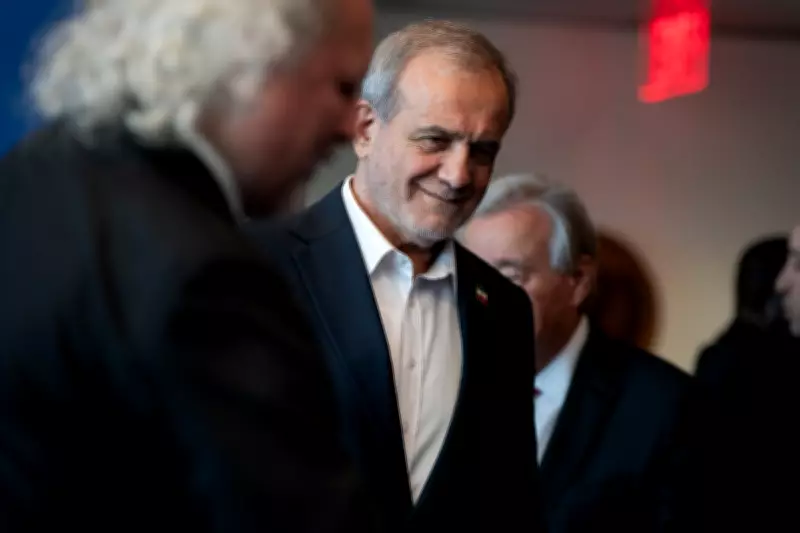
Iranian President Masoud Pezeshkian has issued a defiant statement, declaring that his nation will not yield to international pressure during critical nuclear negotiations with the United States. This comes as former US President Donald Trump openly contemplates limited military strikes against Iran, raising fears of a broader regional conflict.
Defiant Stance Amid Escalating Tensions
Speaking on state television on Saturday, President Pezeshkian asserted, "World powers are lining up to force us to bow our heads... but we will not bow our heads despite all the problems that they are creating for us." His remarks underscore Iran's unwavering position as diplomatic efforts continue amidst heightened military posturing from the United States.
Trump's Military Considerations
Trump has publicly acknowledged considering limited military strikes against Iran, telling White House reporters on Friday, "I guess I can say I am considering it." He later added, "They better negotiate a fair deal." US officials have revealed to Reuters that military planning is advanced, potentially targeting individuals or even seeking leadership change in Tehran if ordered by Trump.

These threats follow Trump's earlier ultimatum of 10 to 15 days for a nuclear deal resolution, accompanied by warnings of "really bad things" and a significant US military buildup in the Middle East. The renewed threats in January came after Tehran suppressed widespread protests with deadly force, further complicating diplomatic relations.
Diplomatic Developments and Counterproposals
Iranian Foreign Minister Abbas Araqchi indicated on Friday that a draft counterproposal could be ready within days following this week's nuclear discussions with the US. After indirect talks in Geneva with Trump's Special Envoy Steve Witkoff and son-in-law Jared Kushner, Araqchi noted an understanding on main "guiding principles" but cautioned that this did not mean a deal was imminent.
In an interview on MS NOW, Araqchi stated that a draft counterproposal could be prepared for top Iranian officials within two or three days, with more US-Iran talks possible in about a week. He warned that military action would significantly complicate efforts to reach a diplomatic agreement.
Human Rights and Casualty Claims
Trump referenced the Iranian government's crackdown on protests, distinguishing between the Iranian people and their leadership. He claimed that "32,000 people were killed over a relatively short period of time," a figure that could not be immediately verified. Trump described it as "a very, very, very sad situation" and asserted that his threats had prevented mass hangings two weeks prior.
However, the US-based human rights monitor HRANA has recorded 7,114 verified deaths from the unrest, with another 11,700 under review. Hours after Trump's claims, Araqchi countered on social media, stating the Iranian government had published a "comprehensive list" of all 3,117 killed in the unrest and challenged critics to provide evidence to dispute their data.
Nuclear Program and Diplomatic Optimism
Araqchi clarified that during the Geneva talks, the United States did not seek zero uranium enrichment, nor did Iran offer to suspend it. He explained, "What we are now talking about is how to make sure that Iran's nuclear program, including enrichment, is peaceful and would remain peaceful forever." Technical and political "confidence-building measures" would be enacted to ensure the program remains peaceful in exchange for action on sanctions, though he provided no further details.
Despite escalating tensions, Araqchi expressed optimism that a diplomatic deal was achievable "in a very short period of time," though he did not specify when the counterproposal would be presented to US officials. The White House responded by reiterating that "the president has been clear that Iran cannot have nuclear weapons or the capacity to build them, and that they cannot enrich uranium."

International Concerns
The United Nations, through spokesperson Stephane Dujarric, voiced concerns over the heightened rhetoric and increased military activities in the region. Dujarric urged, "We encourage both the United States and the Islamic Republic of Iran to continue to engage in diplomacy in order to settle the differences." This call for restraint comes as the international community watches closely, fearing that miscalculations could lead to open conflict.
The situation remains volatile, with Iran maintaining its defiant stance while Trump's administration continues to apply pressure through both diplomatic channels and military threats. The coming days will be crucial as both sides prepare their next moves in this high-stakes geopolitical standoff.