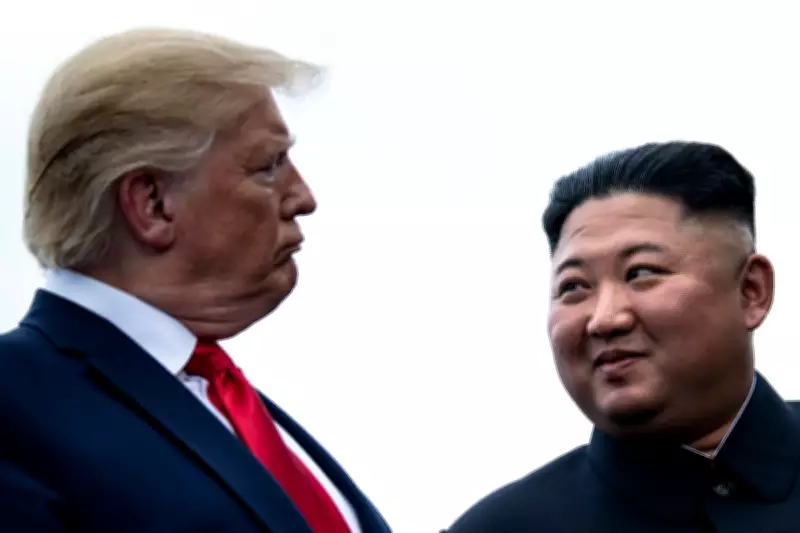
Recent military strikes against Iran by the United States and Israel are anticipated to significantly bolster North Korean leader Kim Jong Un's nuclear ambitions, according to a range of experts and former officials. This development shifts attention to the possibility of Pyongyang re-engaging in high-stakes negotiations with former US President Donald Trump.
Historical Context and Recent Pledges
Previous diplomatic efforts aimed at dismantling North Korea's heavily sanctioned nuclear weapons and ballistic missile arsenal ultimately faltered. This occurred despite historic summits between Kim Jong Un and Donald Trump in 2018 and 2019. However, the landscape may be shifting. The recent attacks on Iran, which resulted in the death of Supreme Leader Ayatollah Ali Khamenei, occurred merely two months after Venezuelan President Nicolas Maduro—another leader lacking a nuclear deterrent—was captured in a US special forces raid ordered by Trump.
"Kim must have thought Iran was attacked like that because it didn't have nuclear weapons," stated Song Seong-jong, a professor at Daejeon University and former official of South Korea's Defence Ministry. This sentiment underscores a critical lesson Pyongyang may be internalising.

North Korea's Official Stance
In a statement published by state media, a North Korean foreign ministry spokesperson described the military operation against Iran as inevitable, citing the "hegemonic and rogue" nature of the United States. This rhetoric aligns with Kim Jong Un's recent pledge, made just days before the Iran attack, to expand his nuclear arsenal during a ruling party congress. Notably, he also indicated a conditional openness to further talks, dependent on Washington's diplomatic approach.
"If the United States withdraws its policy of confrontation with North Korea by respecting our country's current status ... there is no reason why we cannot get along well with the US," Kim was cited as saying by the state news agency KCNA.
Strategic Calculations and Expert Analysis
Donald Trump has repeatedly expressed a desire to hold fresh talks with North Korea, fueling speculation of a potential meeting during his scheduled travel to China from March 31 to April 2. Analysts are deeply divided on how the Iran strikes will influence Kim's calculus.
"The lesson the Trump administration wants pariah states to take is clear; stop threatening America and its allies and make a deal before it is too late," said Leif-Eric Easley, a professor of international studies at Ewha Womans University in Seoul. He emphasised, however, that North Korea is far more advanced than Iran in nuclear warhead development and delivery systems, including intercontinental ballistic missiles.
The Preemptive Strike Doctrine
In 2022, North Korea officially enshrined the right to use preemptive nuclear strikes in a law that Kim declared made its nuclear status "irreversible". This legal framework complicates any future denuclearisation talks.
According to Sydney Seiler, a senior adviser at the Center for Strategic and International Studies and former US special envoy, renewed talks with the United States have been a low priority for Kim. "President Trump's willingness to use military force and threats for negotiating leverage must make Kim nervous and less likely to hastily seek talks," Seiler added.
Diverging Views on Denuclearisation and Diplomacy
Despite this, some analysts believe Kim's heightened threat perception could paradoxically push him back to the negotiating table. "Unlike Iran, it's impossible to denuclearise North Korea," argued Cho Han-bum of the state-run Korea Institute for National Unification, citing the widespread scattering of nuclear sites across the isolated nation.
Estimates from the Stockholm International Peace Research Institute suggest North Korea has assembled approximately 50 warheads and possesses enough fissile material to produce up to 40 more.

A Potential Window for Engagement
There remains a potential diplomatic opening. Yang Moo-jin, a professor at Seoul's University of North Korean Studies, suggested Kim might seek "to leverage his personal rapport with President Trump to explore Washington's position on North Korea, while at the same time buying time to further advance the country’s nuclear capabilities."
Nam Sung-wook, a professor at Sookmyung Women's University and former head of a South Korean spy agency think-tank, posited that Kim may consider a conditional meeting with Trump if the United States formally acknowledges North Korea's nuclear status. The North Korean leader is also likely to derive confidence from his strengthened ties with China and Russia, exemplified by his rare armoured train trip to Beijing in September to stand with Presidents Xi Jinping and Vladimir Putin.
Managing a Complex Relationship
Despite these alliances, Kim may still feel compelled to reassure Trump. "The incident in Iran must have made him think he should manage relations with the United States better," said Ko Young-hwan, a North Korean diplomat-turned-defector who has advised the South Korean government. This could involve assurances that nuclear weapons would not be used against the US, even as Pyongyang solidifies its deterrent capabilities.
The confluence of events—the Iran strikes, Kim's recent congress pledges, and Trump's expressed willingness to talk—creates a volatile yet potentially pivotal moment for nuclear diplomacy on the Korean Peninsula. The world watches to see if confrontation or negotiation will define the next chapter.