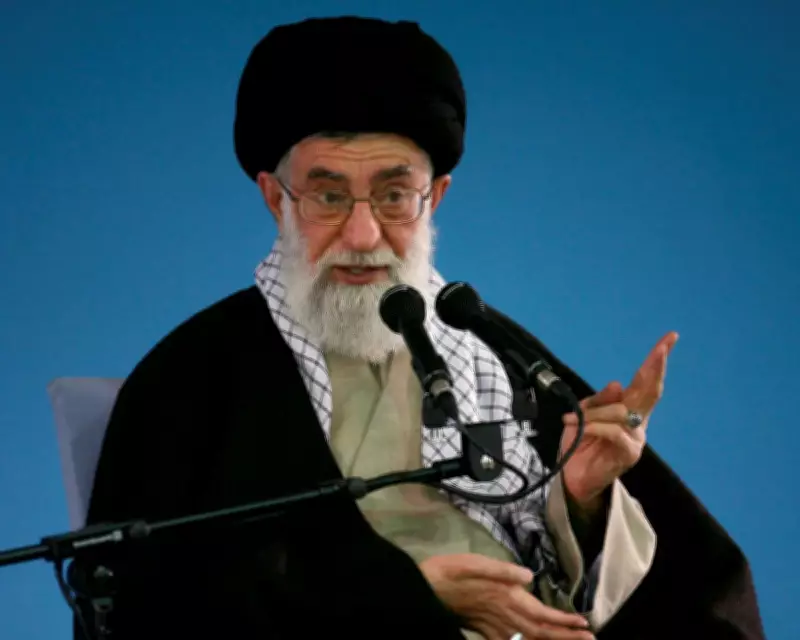
Ayatollah Ali Khamenei, Iran's Supreme Leader, Dies in US-Israel Air Strike
Ayatollah Ali Khamenei, the supreme leader of Iran, has died at the age of 86 following a large-scale air attack on the country by the United States and Israel. His death marks the conclusion of a decades-long reign characterized by brutal theocratic enforcement at home and the cultivation of an anti-Western axis of resistance across the Middle East.
A Reign of Absolute Power and Regional Influence
Khamenei ascended to ultimate power in 1989, succeeding Ayatollah Ruhollah Khomeini, the founder of the Islamic Republic. From that point, he wielded absolute authority, serving as commander-in-chief of Iran's armed forces and holding the final say on all critical matters, including the nation's controversial nuclear programme and its relations with the West.
Under his leadership, Iran became a principal state sponsor of terrorism, heading the so-called "axis of resistance." This alliance included Hezbollah in Lebanon, Hamas and Palestinian Islamic Jihad in Gaza, Shia militias in Iraq, the Houthi rebels in Yemen, and the regime of Bashar al-Assad in Syria. His rule thus exerted a direct and profound impact on regional stability and conflict.

Domestic Repression and Economic Decline
Domestically, Khamenei's regime was marked by severe repression and economic deterioration. In January 2026, following a failed US-Israel bombing campaign against Iran's nuclear facilities in June 2025, mass protests erupted across the country. An estimated 30,000 or more demonstrators were killed in what became the largest death toll in modern Iranian history.
Khamenei amassed control over charitable foundations worth tens of billions of dollars, yet his rule was plagued by systemic corruption, mismanagement, and rising public anger towards the clerical establishment. Despite this, he maintained power through the brutal suppression of dissent, including the violent crackdowns on the Green Movement in 2009 and the Woman, Life, Freedom uprising in 2022.
Nuclear Diplomacy and International Isolation
Iran's nuclear ambitions were a central feature of Khamenei's foreign policy. In 2015, under President Hassan Rouhani, Iran signed the Joint Comprehensive Plan of Action (JCPOA), temporarily easing sanctions. This deal was only possible after Khamenei signaled "heroic flexibility" in 2013. However, the agreement collapsed in 2018 when US President Donald Trump withdrew and imposed a "maximum pressure" strategy, including severe sanctions and an oil embargo.
Khamenei consistently viewed the West as bent on regime change, shaping every decision within that context. His distrust was compounded by historical events, such as the CIA-MI6 coup in 1953 and Western support for Iraq during the Iran-Iraq war.
Succession Struggles and Final Years
The latter years of Khamenei's rule were tumultuous. In 2021, hardliner Ebrahim Raisi was elected president in an engineered vote with historically low turnout, widely seen as Khamenei's chosen successor. However, Raisi died in a helicopter crash in May 2024, leading to a snap election that brought reformist Masoud Pezeshkian to power—a move seen as a tactical concession to public discontent.
In 2025, renewed US-Israel tensions culminated in the "12-day war," with attacks on Iran's military and nuclear infrastructure. Despite a ceasefire, protests erupted again in late 2025 over economic collapse, culminating in a massacre on 8 January 2026 after Khamenei issued kill orders against demonstrators.
Early Life and Ideological Formation
Born in Mashhad in 1939, Khamenei's early life was shaped by poverty and Islamic scholarship. His revolutionary consciousness was ignited in 1952 by cleric Navvab Safavi's anti-monarchy speech. Studying in Qom under Khomeini, he embraced anti-Western ideologies, influenced by thinkers like Sayyid Qutb and Jalal Al-e-Ahmad, while also appreciating Western literature such as Victor Hugo's Les Misérables.
Imprisoned and tortured by the Shah's secret police for his activism, Khamenei played key roles after the 1979 Revolution, including as president from 1981 to 1989. He survived an assassination attempt in 1981 that paralyzed his right hand.

Khamenei is survived by his wife, Mansoureh Khojasteh Bagherzadeh, and their six children. His death closes a chapter of Iranian history defined by theocratic rigidity, regional proxy wars, and relentless confrontation with the West.