Israel Accused of Deliberately Targeting Medical Facilities in South Lebanon
Lebanese healthcare workers and officials have accused Israeli forces of deliberately targeting medical facilities and personnel in south Lebanon, employing tactics such as double-tap strikes in what they describe as a systematic campaign to render the region uninhabitable. Since the conflict began on 2 March, Israel has struck at least 128 medical facilities and ambulances across south Lebanon, resulting in the deaths of 40 healthcare workers and injuries to 107 others, according to the Lebanese Ministry of Health.
Systematic Attacks on Medical Infrastructure
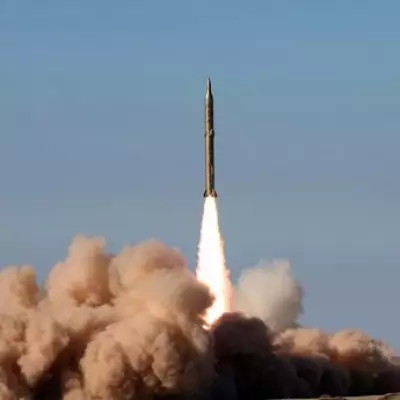
The war erupted when Hezbollah launched rockets at Israel, prompting an extensive Israeli military response. Most strikes on medics occurred while they were stationed in ambulances or at first aid centres, many of which have been completely destroyed. Israel has also conducted at least five double-tap strikes, a controversial tactic where an initial bombardment is followed by a pause, allowing medical responders to arrive before a second strike targets the same area.
Medical workers and hospitals are protected under international law, and deliberately targeting them could constitute a war crime. Amnesty International emphasised on Thursday that, regardless of political affiliations, medical personnel are considered civilians, and attacking them is unlawful.

Eyewitness Accounts and Destroyed Sites
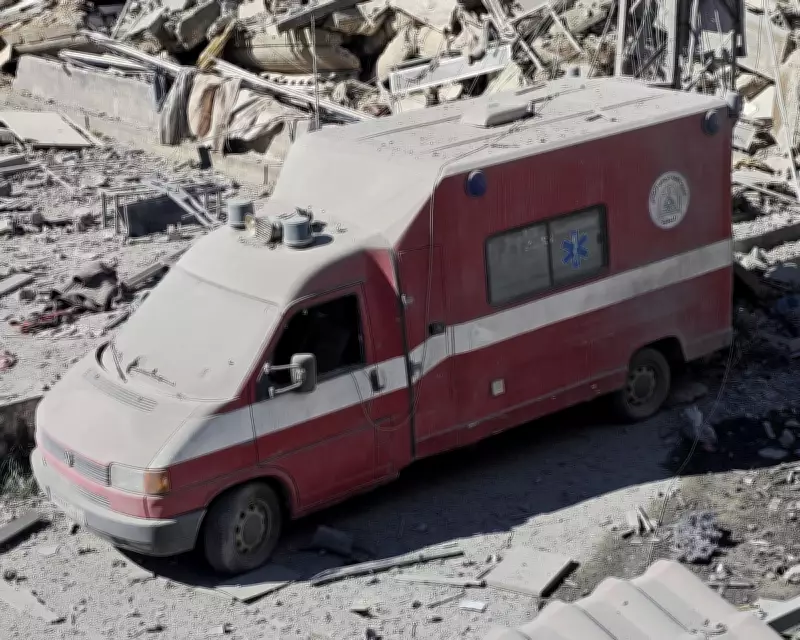
The Guardian conducted interviews with nine medical workers, including eyewitnesses of Israeli strikes on three separate medical facilities. Journalists visited three destroyed medical centres in the Nabatieh and Tyre governorates and inspected two damaged ambulances. None of these sites showed any evidence of military use.
The Israeli military has accused Hezbollah of using ambulances for military purposes, stating it would "act in accordance with international law" if such practices continued. Similar accusations were made in 2024, though no evidence has been provided. The Lebanese Ministry of Health condemned these claims, calling them an attempt to justify potential war crimes.
Impact on Healthcare Services and Civilians
The vast majority of attacks have targeted the Islamic Health Association (IHA), a health service affiliated with Hezbollah that collaborates with the Lebanese Ministry of Health. Strikes have also hit the state civil defence service, the Amal movement’s Islamic Scouts Association health service, a local healthcare charity, and the Lebanese Red Cross.
Medical workers in the region assert that these attacks are designed to make life "uninhabitable" in south Lebanon, viewing them as part of broader Israeli assaults on civilian infrastructure. During the last Hezbollah-Israel conflict in 2024, nearly 230 medical workers were killed by Israeli forces in Lebanon.
"The Israeli enemy is trying as much as possible to prevent life in our region and push people to flee. Our role is to help people, to stand by them and to provide services so they can remain on their land," said Abdullah Nour el-Din, head of IHA emergency response south of the Litani River, standing before a dozen destroyed ambulances.
Double-Tap Strikes and Precautions
Nour el-Din recounted instances of what appeared to be double-tap strikes, such as in Seddiqin and Nabatieh, where first responders were attacked while rescuing civilians. Healthcare workers also noted a pattern of strikes targeting facilities during Ramadan iftar gatherings at sundown.
An Israeli airstrike on 8 March completely destroyed an IHA emergency response centre in Zifta, killing two employees and paralysing another. Hussein Moshawrab, the new head of the centre, described FaceTiming with staff shortly before the strike, only to find them under rubble later.
Paramedics have adopted extreme precautions due to the threat of targeted strikes:

- Reducing medical teams from three to two members.
- Avoiding visits to family or friends during working hours.
- Sleeping in ambulances parked far apart to minimise casualties from a single strike.
"We try not to behave unusually, not do anything out of the ordinary, and remain as conspicuous as possible to the drone above, so that it’s clear that you’re a medic and there’s no excuse to hit us," said Ali Nasr al-Din, his eyes red from lack of sleep after rescuing colleagues from a bombed civil defence centre.
Humanitarian Crisis and Hospital Strain
As hospitals in south Lebanon face a surge in casualties, the medical sector is under severe attack. In 17 days of fighting, Israeli strikes have killed over 1,000 people and wounded 2,584, according to the Lebanese health ministry.
At the Nabih Berri governmental hospital in Nabatieh, a man with severe burns from a petrol station strike screamed in pain, highlighting the dire conditions. Dr Hassan Wazni, head of the hospital, noted that the bombing seems more vicious this time, with fewer wounded and more dead arriving.
The emotional toll on first responders is immense. Paramedic Nidal Jafal broke down upon discovering his parents' house was struck, while others, like Ali Nasr al-Din, continue working despite fears, driven by a sense of duty to their homeland.