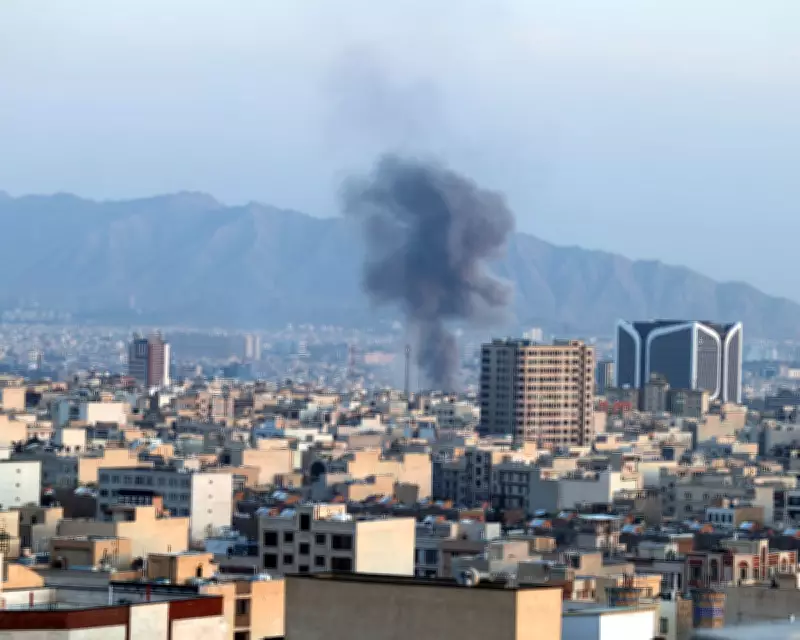
Seven Days of Conflict: Key Questions on the US-Israeli War Against Iran
One week into the joint US-Israeli military campaign against Iran, the Middle East has been plunged into a state of escalating violence. The operation, codenamed "Epic Fury" by the United States and "Roaring Lion" by Israel, has ignited a regional crisis, threatening millions of lives and livelihoods across a vast arc from Central Asia to Europe's periphery. While marketed as a decisive show of force, the conflict's broader impact beyond immediate chaos and bloodshed remains profoundly uncertain.
What Sparked This Military Confrontation?
For decades, Iran has pursued a policy of expanding its influence across the Middle East, supporting militant groups like Hezbollah in Lebanon and the Houthis in Yemen, while developing a nuclear programme it insists is for peaceful purposes. The United States has long contested this claim. Diplomatic negotiations to curb Tehran's nuclear ambitions were abruptly abandoned last Saturday, replaced by the onset of bombing raids.
Israel's regional strategy has consistently involved using overwhelming military power—including targeted assassinations—to weaken perceived enemies in Iran, Lebanon, Iraq, Gaza, Yemen, and Syria. This approach has resulted in tens of thousands of civilian deaths, a retreat from diplomacy, and intensified global condemnation. Israeli Prime Minister Benjamin Netanyahu has advocated for a US-led attack on Iran for years, dismissing international nuclear agreements. Previous US administrations resisted such belligerence, with diplomats and regional governments warning that bombing Iran would engulf the entire Middle East in conflict—a prediction now tragically materialising.
What Are the Stated and Unstated War Aims?
The objectives declared by Washington and Tel Aviv are multifaceted and sometimes contradictory. They include countering general threats from Iran and its proxies, dismantling Tehran's nuclear infrastructure—despite former President Donald Trump's claim to have already "obliterated" it last summer—and pursuing regime change through aerial bombardment. Trump recently demanded an "unconditional surrender."
Some within US Christian evangelical circles interpret the bombing as part of a holy war leading to Armageddon, which they believe will herald the return of Jesus Christ. In the hours following the initial strikes, Trump framed the objective as defending the American people by eliminating imminent threats from the Iranian regime. Netanyahu has stated his goal is removing Iran's missile and nuclear capabilities, while also welcoming regime overthrow if it occurs.
A more striking, emerging strategy involves the US and Israel encouraging anti-government factions, including Kurdish militants, to instigate an uprising within Iran. If successful, this could precipitate an unpredictable and devastating civil war.
What Is the Human Cost After One Week?
According to the Iranian Red Crescent Society, US and Israeli attacks have killed 1,230 people in Iran since the bombing began. Among the most shocking incidents was a strike on a girls' primary school in Minab, southern Iran, which resulted in dozens of child fatalities.
A separate US submarine torpedo attack on an Iranian warship off the coast of Sri Lanka claimed at least 87 sailors' lives, though Sri Lankan authorities managed to rescue some from drowning. In Lebanon, Israeli strikes have displaced hundreds of thousands, with the Lebanese health ministry reporting 217 deaths and 798 injuries, warning of a looming humanitarian catastrophe.
Iranian retaliatory attacks have killed twelve Israelis and six US personnel. Casualties have also been reported in the UAE, Bahrain, Kuwait, Azerbaijan, and Cyprus from Iranian drones and missiles.
Who Leads Iran and What Lies Ahead?
On the first day of the war, Iranian Supreme Leader Ali Khamenei was killed. The regime is now considering potential successors, with Khamenei's son, Mojtaba, viewed as a possible heir. While an interim body currently manages state affairs, no new leader has been formally announced. The government retains control over the armed forces and police, but the spectre of total state collapse looms, raising fears that Iran could fragment.
Historical precedents, such as the US-led wars in Afghanistan (2001) and Iraq (2003), serve as cautionary tales. Initially hailed as successes for toppling the Taliban and Saddam Hussein, these conflicts ultimately led to prolonged warfare and destabilising power vacuums.
How Long Can Iran Sustain Its Resistance?
Iran's conventional military capabilities are no match for the combined might of the US and Israel, and its supply of missiles and drones is limited. However, Tehran has a long history of employing asymmetric warfare, leveraging paramilitary groups to inflict significant pain on more powerful adversaries. Its retaliatory strikes have already sown geopolitical and economic chaos, effectively closing the Strait of Hormuz—choking global oil supplies—and disrupting international air travel with missile and drone attacks.
Will Gulf States Maintain Their Neutrality?
This remains uncertain. Iran has repeatedly declared that US military bases and interests across the region are legitimate targets. However, patience in the Gulf is wearing thin after attacks on hotels, residential towers, oil facilities, and airports. While monarchies like Saudi Arabia and the UAE view the Iranian regime as an adversary, they are equally wary of being drawn into a destructive conflict where all sides would suffer immensely.
Is This Military Campaign Legally Justified?
A chorus of legal scholars, US politicians, and international allies argue that this war violates both international and US law. The US and Israel justify their strikes as acts of pre-emptive self-defence. British Prime Minister Keir Starmer has refused to commit UK forces, stating he will not participate in "unlawful action" and warning against "regime change from the skies."
Spanish Prime Minister Pedro Sánchez has been one of the most vocal critics, describing the escalating conflict as playing "Russian roulette with the destiny of millions." He recently condemned the US-Israeli strikes as an "extraordinary mistake" and "not in accordance with international law."