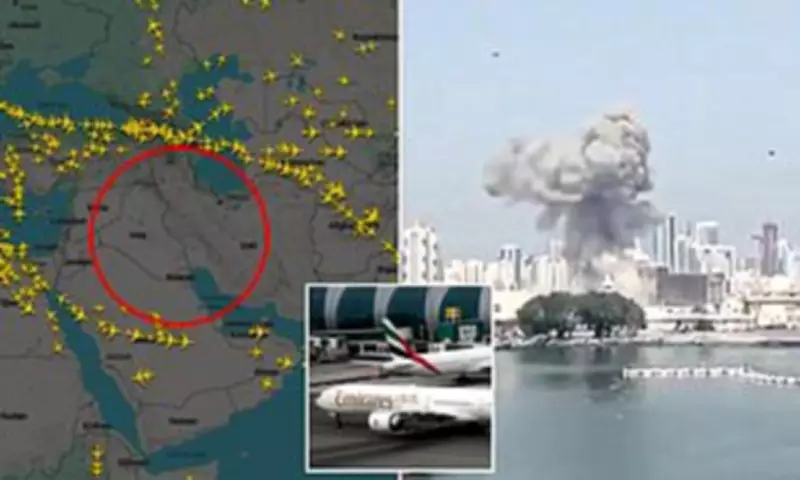
Global Aviation Paralyzed as Middle East Military Strikes Escalate
The world's busiest international airport has suspended all operations and air travel across the Middle East has ground to a complete halt, leaving thousands of travelers stranded worldwide. This unprecedented aviation shutdown follows blistering counterattacks launched by Iran in response to coordinated military strikes by the United States and Israel.
Coordinated Military Action Triggers Regional Chaos
Early Saturday morning, US and Israeli forces launched a synchronized military attack against Iran, prompting immediate retaliatory strikes across multiple Middle Eastern countries that host American military installations. The international community had been anticipating renewed hostilities in the region after recent negotiations between the US and Iran in Geneva ended without resolution.
President Donald Trump announced the offensive operations overnight, describing them as a 'massive and ongoing' military effort while explicitly calling for regime change in Iran. Several nations including Kuwait, Qatar, the United Arab Emirates and Jordan reported intercepting missiles during the counterattacks.

Aviation Industry Faces Unprecedented Disruption
The dramatic escalation of military activity has resulted in massive flight cancellations and delays across the region, as aviation authorities fear commercial aircraft could become collateral damage amid missile exchanges. Dubai International Airport (DXB) and Dubai World Central - Al Maktoum International Airport (DWC), two of the world's most significant airline hubs, suspended all flight operations at 4pm Dubai time.
'Passengers are advised not to travel to the airport at this time and to contact their respective airlines directly for the latest updates regarding their flights,' stated an official spokesperson for the airports. 'We appreciate the cooperation of our guests. Further updates will be provided as we continue to monitor the situation.'
Global Travel Network Severely Impacted
DXB, recognized as the world's largest airport for international travel, experienced the most significant cancellations and delays of any global aviation facility on Saturday afternoon. Other nations including Iraq, Qatar, Oman and Kuwait have implemented temporary bans affecting all commercial flights.
Real-time tracking data from FlightTrader24 revealed startlingly empty airspace above Lebanon, Syria, Israel, Jordan, Iraq, Kuwait, Yemen, and Iran on Saturday afternoon. This presented a stark contrast to the previous day's normal flight patterns, with only limited air traffic passing through the United Arab Emirates, Saudi Arabia, and Qatar.
Major Airlines and Airports Paralyzed
Emirates, FlyDubai, and Ethiad Airways suffered the most severe operational impacts. Emirates alone cancelled 328 flights on Saturday morning according to FlightAware data. Ethiad Airways issued an operational update via their official social media account, announcing that all departures from Abu Dhabi were suspended until Sunday morning local time.
Additional major airports experiencing significant disruptions included Abu Dhabi International, Bahrain International, King Abdulaziz International, Hamad International, Ben Gurion International, King Khalid International, and Kuwait International. Remarkably, the top ten airports with the most cancelled or delayed flights were all located in the Middle East for both incoming and outgoing traffic.
International Ripple Effects and Safety Concerns
The aviation crisis extended beyond the Middle East, with London Heathrow Airport reporting 22 cancelled flights and 53 delayed departures from the UK to the United States. The European Union's aviation safety authority issued urgent warnings to all European airlines, citing a 'high risk' of flying in the region.
Aviation experts noted that missiles launched into Middle Eastern airspace can reach altitudes comparable to commercial flight paths, creating severe collision risks. Additionally, missiles can explode during flight, making aircraft vulnerable to debris. Historical precedents exist, including a 2024 incident where Russian forces accidentally shot down an Azerbaijani commercial flight after mistaking it for military aircraft.

Military and Political Developments Intensify
Initial reports of the US-Israeli attack on Iran emerged around 9:30am Tehran time, with President Trump confirming the strikes on social media as a 'major combat operation.' Both Trump and Israeli Prime Minister Benjamin Netanyahu issued stark messages to Iran, urging citizens to 'take over your government' and 'throw off the yoke of tyranny.'
Iran responded with promises of 'crushing retaliation,' launching missile barrages across the region. 'All occupied territories and the criminal US bases in the region have been struck by the powerful blows of Iranian missiles. This operation will continue relentlessly until the enemy is decisively defeated,' declared Iran's Revolutionary Guards.
International Community Reacts
The global response to the military actions has been divided, with some nations supporting the US-Israeli effort to instigate regime change in Iran, while other officials have condemned the operations as violations of international law. The United Nations Security Council has scheduled an emergency meeting to address the escalating regional tensions.
Meanwhile, frustrated travelers have shared extensive video footage online showing massive crowds packed shoulder-to-shoulder at Dubai airports. Images reveal passengers crammed onto escalators, wandering aimlessly around departure gates, and resorting to sitting on floors outside food courts as virtually every seat near gates remained occupied.