Leaked Audio Exposes Mojtaba Khamenei's Miraculous Survival in Tehran Compound Attack
Newly leaked audio has revealed astonishing details about how Iran's new supreme leader, Mojtaba Khamenei, escaped death by mere seconds during the devastating Israeli missile strike that killed his father on February 28. According to the recording, Khamenei's decision to venture outdoors "to do something" saved his life while his wife, son, and brother-in-law perished in the attack.
Protocol Chief's Detailed Account of the Attack
The audio, leaked to The Telegraph, features Mazaher Hosseini, head of protocol for the Iranian regime, providing a chilling account of the events to senior clerics and Islamic Revolutionary Guard Corps commanders. Hosseini explained that "God's will was that Mojtaba had to go out to the yard to do something and then return." He was outside and heading upstairs when missiles struck the building, instantly killing his wife, Ms. Haddad.
According to Hosseini, Mojtaba Khamenei suffered only "a minor injury to his leg" during the attack. Meanwhile, his brother-in-law was decapitated by the force of the explosion, and Mohammad Shirazi, chief of Khamenei's military bureau, was "blown to pieces" - with only "a few kilos of flesh" remaining for identification purposes.
Multiple Targets Within the Compound
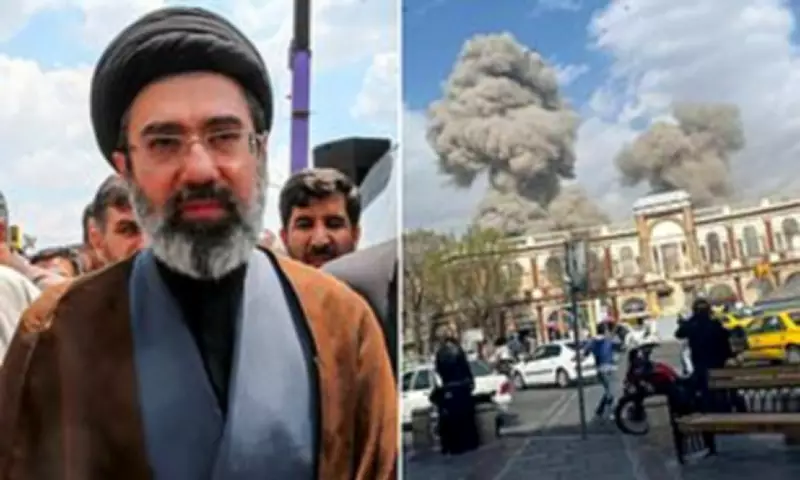
The attack targeted multiple locations within the Tehran compound simultaneously. Hosseini described how "these devils" had considered several locations within the office complex before settling on the area containing the supreme leader, hitting it with three powerful missiles. Mojtaba Khamenei's home on an upper floor was struck, along with the residence below belonging to his brother-in-law and the home of his brother.
Mostafa Khamenei, Mojtaba's brother, was in a nearby residence with his wife when it was also struck. Hosseini noted that "some dust and rubble fell over" but "thank God they came out unharmed." The missiles were described as "so powerful" that they cut Ali Khamenei's brother-in-law's head in half.
Succession Planning Targeted
Hosseini claimed that military chief Mohammad Shirazi had been specifically targeted in an effort to disrupt succession planning, noting that "this dear man had information on all military personnel." The compound where the attack occurred had been Mojtaba Khamenei's residence alongside his father and incorporated a religious hall where the late Ali Khamenei would give speeches, as well as homes for Khamenei's other children.
Speculation and Contradictory Reports
The revelations come amid intense speculation about Mojtaba Khamenei's condition. The 56-year-old was declared supreme leader after his father's death but has yet to appear in public. His first official statement was read on state television last week, fueling rumors about potential injuries sustained during the airstrike.
US Defense Secretary Pete Hegseth stated on Friday that Mojtaba is "wounded and likely disfigured," while CBS News reported that former President Donald Trump has privately expressed doubts about the intelligence regarding Khamenei's condition, suggesting Iran may effectively be leaderless. Meanwhile, Iran's Deputy Foreign Minister Saeed Khatibzadeh told Sky News the Ayatollah was "healthy" and "in charge."
Dynastic Succession Concerns
Reports have emerged suggesting that Ali Khamenei feared his son was "not bright enough" to rule the country, viewing him as "unqualified to be leader" and noting he "struggled in his personal life." President Trump told Fox News that Mojtaba "is not somebody that the father even wanted."
Mojtaba Khamenei represents Iran's third supreme leader since the 1979 Islamic Revolution, succeeding his father Ali Khamenei and Ruhollah Khomeini. His dynastic succession is particularly notable given that the revolution originally overthrew a hereditary monarchy.
Regional Escalation Continues
The revelations coincide with continued regional escalation. Israel announced it destroyed a plane used by the late cleric at Mehrabad Airport in Tehran, reportedly used by senior Iranian officials for domestic and international travel. The IDF claims dismantling the aircraft disrupts Iranian leadership's coordination capabilities with axis countries.
Meanwhile, Iran launched fresh drone strikes on Gulf States including the UAE, temporarily shutting Dubai International Airport after hitting a nearby oil tank. Iran has fired over 1,200 missiles and drones at the United Arab Emirates, making it one of the most heavily targeted countries in the conflict. The Israeli military has also declared it has begun "limited" and "targeted operations" against Iran's proxy Hezbollah in southern Lebanon.