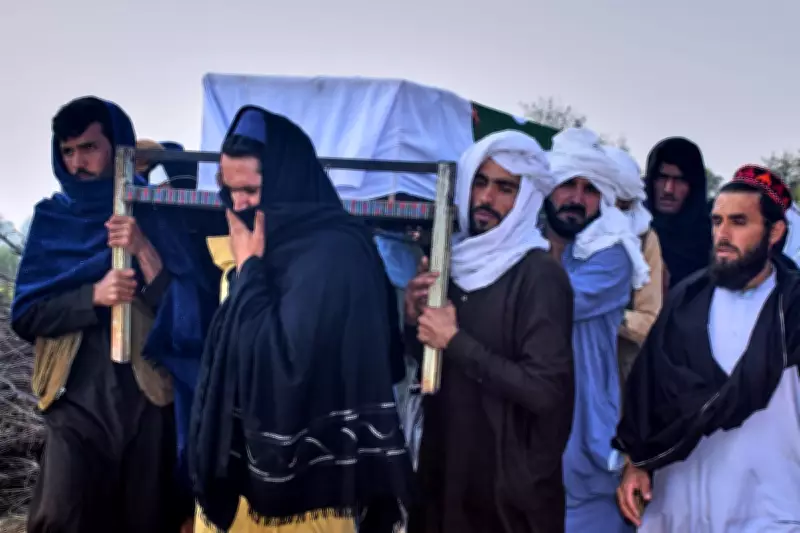
Pakistan has announced that its military conducted extensive airstrikes deep inside Afghanistan, resulting in the deaths of more than 300 Afghan forces over several days of intense border clashes. The operations, supported by artillery and air power, targeted Afghan military installations overnight into Saturday, according to government spokesmen and officials.
Escalating Military Confrontation
The cross-border hostilities began on Thursday night when Afghanistan launched retaliatory strikes. This was in response to earlier Pakistani attacks that Islamabad claimed targeted seven training camps and hideouts of the outlawed Pakistani Taliban, known as Tehrik-e-Taliban Pakistan (TTP). The TTP is a separate entity but maintains close alliances with Afghanistan's ruling Taliban government.
Casualty and Damage Claims
Pakistan's Information Minister, Attaullah Tarar, provided detailed figures, stating that over 331 Afghan Taliban forces were killed and more than 500 wounded in the ongoing military strikes. He further reported that Pakistan destroyed 102 Afghan posts, captured 22 others, and eliminated 163 tanks and armored vehicles across 37 locations. On Saturday, state-run media in Pakistan confirmed that air force strikes had hit key military installations in eastern Afghanistan.

Afghanistan's Response and Counterclaims
Afghanistan's Defense Ministry issued a statement on Saturday, asserting that its forces attacked Pakistani military bases in Miranshah and Spin Wam overnight. They claimed to have destroyed military installations and inflicted heavy casualties in retaliation for Pakistan's airstrikes. Additionally, the Department of Information and Culture in eastern Afghanistan accused Pakistan of targeting civilian areas, destroying homes, and killing at least 11 people. Pakistan has not immediately responded to these allegations, maintaining that it only targets military installations to avoid civilian casualties.
Diplomatic Tensions and Statements
On Friday, Afghan government spokesman Zabihullah Mujahid declared that Afghanistan's attacks on Pakistani military targets were intended as "a message that our hands can reach their throats and that we will respond to every evil act of Pakistan." He criticized Pakistan for not seeking resolution through dialogue. In a stark response, Pakistan's Defense Minister Khawaja Mohammad Asif posted on X, stating, "Our patience has now run out. Now it is open war between us."
Pakistan has repeatedly accused Kabul of providing shelter to the TTP, allegations that both the group and Afghanistan's Taliban government deny. Pakistan's army spokesman, Lt. Gen. Ahmed Sharif Chaudhry, emphasized on Friday that the Afghan government faces a critical choice: "either choose TTP or Pakistan."
Humanitarian Impact and Civilian Displacement
The conflict has severely affected civilians on both sides of the border. Pakistani authorities reported that hundreds of residents near the northwestern Torkham border crossing have fled to safer areas. In recent days, Pakistan has assisted by transporting dozens of Afghan refugees, who were stranded at the Torkham crossing, to safer locations. Ejaz Ul Haq, an Afghan refugee trapped near Torkham with his family, expressed inability to return to Afghanistan due to the fighting, highlighting struggles for food during the fasting month of Ramadan.
Guftar, a Pakistani villager living near Torkham, appealed for a ceasefire, noting that ordinary people are bearing the brunt of the conflict. Mullah Taj Mohammad Naqshbandi, an Afghan commissioner on the Afghan side of the Torkham border, claimed in a statement that Afghan forces destroyed Pakistani military commissariats, units, and three security towers.
Historical Context and Mediation Efforts
Tensions between Pakistan and Afghanistan have been elevated since October, when border clashes resulted in dozens of soldier, civilian, and suspected militant deaths. A Qatari-mediated ceasefire temporarily halted intense fighting that month, but subsequent peace talks in Turkey during November failed to establish a lasting agreement. Sporadic exchanges of fire have occurred since, with the ceasefire largely holding until last week, when Pakistan struck alleged TTP hideouts.

In response to the renewed hostilities, several countries, including Turkey, Saudi Arabia, Qatar, and China, are attempting to defuse tensions by offering mediation. Qatar's minister of state, Mohammed bin Abdulaziz Al-Khulaifi, engaged in discussions with the foreign ministers of Afghanistan and Pakistan on Friday, aiming to de-escalate the situation, as confirmed by Qatar's Foreign Ministry in a post on X.
The conflict underscores ongoing regional instability, with both nations entrenched in a cycle of retaliation and diplomatic stalemate, while civilians continue to suffer the consequences.