Rubio's US Financial Pledge to Hungary Intensifies EU Anxieties Over Election Influence
Marco Rubio's warm overtures to Viktor Orbán, including a promise of US financial assistance, have significantly heightened European Union fears that the United States is actively seeking to foster disunity among its allies. This development occurs just two months before Orbán's Fidesz party confronts a punishing parliamentary election, representing the most substantial threat to his control of Hungary in over a decade and a half.
Provocative Itinerary and Political Endorsement
Even before effectively endorsing Viktor Orbán ahead of the crucial parliamentary vote, Rubio's European itinerary was designed to be provocative. Following meetings with US allies at the Munich Security Conference during a period of notably tense transatlantic relations, the US secretary of state proceeded to Slovakia and Hungary. These two EU nations are notably the most reliant on Russian energy and express scepticism towards the bloc's support for Ukraine.
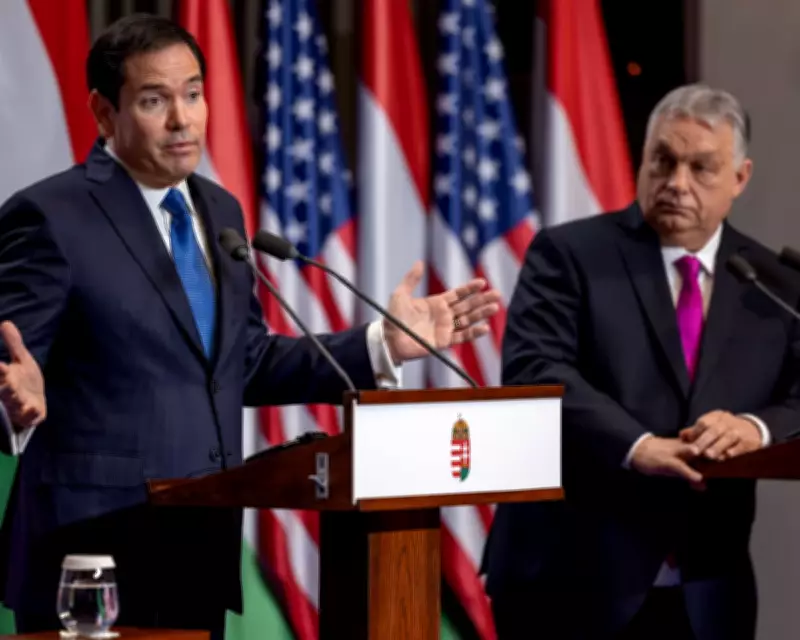
In what bordered on an explicit political endorsement, Rubio informed Orbán that relations between Hungary and the US had entered a "golden age" and would remain so as long as Orbán retains power. "If you face financial struggles, if you face things that are impediments to growth, if you face things that threaten the stability of your country, I know that President Trump will be very interested ... to finding ways to provide assistance if that moment ever were to arise, and obviously with regards to finances and the like," Rubio stated.

Timing and Broader Context of US Support
The offer of financial support, coupled with a nod towards extending Hungary's exemption from sanctions on purchasing Russian oil and gas, arrives precisely two months prior to the pivotal election. This move recalls similar offers made by the White House to other right-wing allies abroad, such as a $20 billion bailout for Argentina's Javier Milei, which is credited with aiding his party's success in crucial midterm elections by stabilising the economy and currency.
"Especially as long as you're the prime minister and the leader of this country, it's in our national interest that Hungary be successful," Rubio told Orbán, reinforcing the perception of targeted support.
EU Concerns Over Disunity and Election Sway
In Brussels, Rubio's visit to Hungary was guaranteed to amplify fears that the US is promoting chaos and disunity among its allies as tensions escalate over issues ranging from Ukraine and Greenland to trade deals and defence spending. Analysts suggest his remarks closely resemble an effort to influence an election at the heart of Europe.
"It's an 'eff you' to the EU," remarked Theresa Fallon, director of the Brussels-based Centre for Russia, Europe, Asia Studies. "It was really clear." The past few months have been particularly bruising for transatlantic relations, with Donald Trump demanding the Netherlands cede Greenland on national security grounds and making disparaging comments about Denmark's defence capabilities.
Diplomatic Reactions and Policy Implications
European diplomats in Washington DC expressed relief at the dispatch of Rubio rather than JD Vance, viewing Rubio as a more traditional Republican who had previously backed conventional US foreign policy. However, concerns persist. "He is much preferred to Vance, but they still both work for Trump," noted one European diplomat.
Rubio's speech in Munich was more restrained than Vance's from the previous year, earning a standing ovation from many European officials. He argued for revitalising the NATO alliance rather than dismantling it, addressing key fears post-Trump's re-election. Matthew Kroenig of the Atlantic Council observed that Rubio "did not repudiate anything in Vice President JD Vance's more pugnacious speech last year, but he presented the same themes in a more positive light."
Fallon added, "Everybody wanted to hear something positive. And when they slept on it, they realised, oh my gosh, no, it's the same thing, just packaged a little better." Ultimately, as one diplomat summarised, "The message coming from both [Rubio and Vance] is clear: you are on your own."