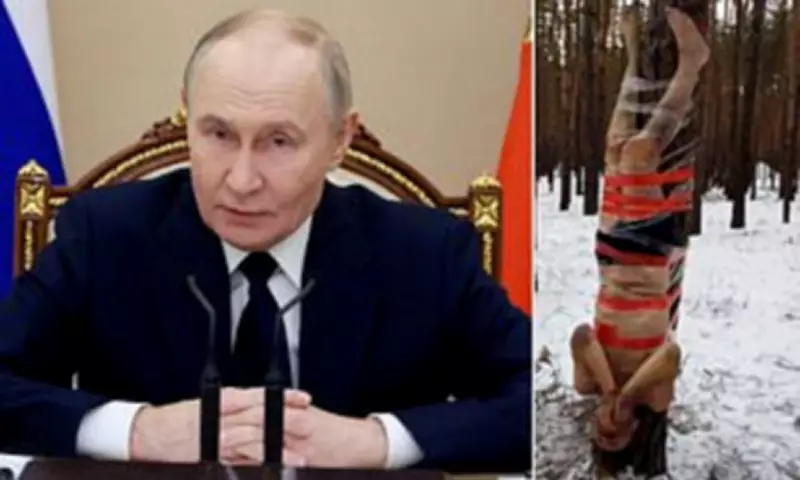
In a chilling display of military discipline, Russian soldiers in Ukraine are being subjected to medieval-style punishments for refusing orders to advance. One particularly disturbing video shows a man stripped to his underwear, bound with tape, and hung upside down from a tree trunk like a slab of meat in the open winter air. A second soldier is taped upright to a neighbouring tree as a Russian-speaking man screams at them, stuffing snow into one of their mouths while both cringe in terror.
Systematic Brutality as Military Strategy
This is not isolated sadism but calculated military strategy in 21st century warfare. The men's alleged crime was refusing to walk into what soldiers call 'the meat grinder' - frontal assaults against dug-in Ukrainian positions where life expectancy is measured in minutes. The punishment was filmed not to shame the perpetrators, whose voices were digitally disguised, but to terrorise other conscripts into compliance.
Other videos that have surfaced tell similar stories of systematic brutality. Soldiers are beaten with rifle butts for retreating, denied food, and endlessly threatened with execution. In one documented case, a deserter was forced to dig his own grave before being 'reprieved' and sent back to the front lines - a particularly cruel form of psychological torture. Unit commanders have been filmed shooting over their own men's heads to drive them out of trenches and into enemy fire.
The Wagner Group's Barbaric Warning
Perhaps the most horrific warning came in November 2022 when Yevgeny Nuzhin, a Wagner Group recruit who tried to defect after capture near Bakhmut, was returned in a prisoner exchange. His punishment for disloyalty was recorded for maximum impact: his head was taped to a brick, his arms bound, and he was forced to kneel before a man in combat gear calmly smashed a sledgehammer into his skull repeatedly until his body went limp.
This barbaric execution was circulated by Wagner channels as a clear message to anyone considering desertion - filmed in high definition and shared globally to maximise its terrorising effect.
Widespread Abuse and Minimal Accountability
Across conflict zones in Luhansk and Zaporizhzhia, soldiers refusing to advance have been chained to poles and radiators, thrown into open pits in the ground, and left for days without food in freezing conditions. Some were kept under drone surveillance - a menacing presence hovering above, waiting for any escape attempt that would likely result in execution.
Investigators have documented scores of Russian officers who have shot their own soldiers in cold blood. Men accused of refusing orders, hesitating, or speaking back are taken aside for 'obnuleniye' - a neutral term masking the egregious crime of execution. Some are killed before their platoons as warnings, while others vanish into cellars or woods, buried in shallow graves scraped over by frozen soil.
The Chief Military Prosecutor's Office has received more than 12,000 complaints about various abuses since the 2022 invasion, but due process remains largely illusory. Despite the volume of grievances, only ten criminal cases have been launched as of October, with just five officers convicted of killing subordinates. Reports suggest an unofficial ban on interrogating field commanders, ensuring most abuses go unpunished.
Human Wave Tactics and Staggering Casualties
This brutal disciplinary system enables Russia's devastating human wave tactics. Western intelligence estimates put total Russian casualties close to one million, with over 200,000 dead. At times, the army has been losing more than a thousand men daily - killed or wounded - in battles reminiscent of Second World War attrition.
Analysis by the Centre for Strategic and International Studies reveals the pitiful progress rate: Russian forces have advanced between 15 and 70 metres per day since early 2024. In the assault on Chasiv Yar, Putin's forces have managed barely 15 metres daily - slower than a snail's pace. For comparison, British and French soldiers gained an average of 80 metres daily during the 1916 Battle of the Somme.
Historical Precedents and Cultural Foundations
The Russian military's reliance on fear has deep historical roots. The tradition of 'dedovshchina' - savage hazing of conscripts - long predates the Ukraine conflict. This system based on violence and humiliation treats suicides as acceptable losses.
Documented cases from Russian garrisons reveal the brutal reality: young conscripts stripped to underwear, beaten with belts and rifle slings, forced to stand for hours in snow while senior soldiers pour cold water over them. Recruits have been made to crawl corridors while being kicked and stamped on, ordered to kiss comrades' boots, then locked in cupboards overnight.
These rituals form part of an established system where terror, not training, holds units together. The state tolerates such brutality because it keeps the military machine running, maintaining the centuries-old Russian message: your body belongs to the state.
Families Targeted and Societal Implications
The cruelty now extends beyond soldiers to their families. In Russia's far eastern provinces, military police and masked enforcers hunt deserters' families like animals. Sons who escape the front find their mothers seized, beaten, and shocked with electric batons. Fathers are dragged off, hooded, and threatened that they and their sons will suffer unless the missing men return to combat lines.
This represents a terrifying escalation: the state taking family members hostage to feed its war machine, demonstrating how conflict strips away military restraints and spreads brutality throughout society.
Broader Geopolitical Context
Ukrainian soldiers understand they're fighting not just military units but an entire state culture that fetishises death and enforces obedience through violence. They've seen mass graves in liberated towns - bodies piled high with bullet holes and torture marks. They've listened to intercepted calls where Russian soldiers describe torturing Ukrainian prisoners and committing sexual violence.
The fundamental truth remains unchanged despite diplomatic discussions: Ukraine faces a state that has invaded Georgia, Crimea, Syria and eastern Ukraine, pushing further each time because international responses have been insufficient. When such regimes are appeased, they don't stop - they advance.
The choice facing the international community isn't between war and peace - we're already at war with Russia, whether acknowledged or not. The real choice is between stopping this system of horrific brutality in Ukraine now or facing it later in more powerful, widespread form. The men hanging upside down in snow already know the answer, and by now, so should we all.