Six Dead in Karachi as US Consulate Stormed Over Khamenei Killing
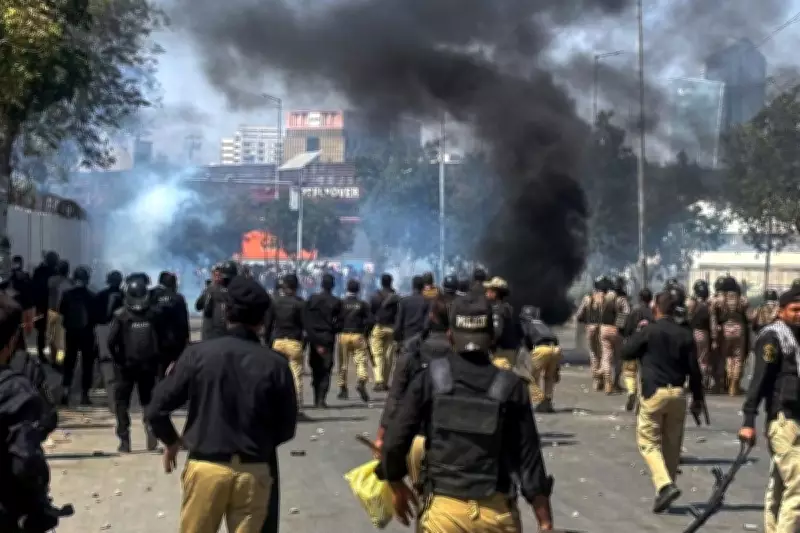
At least six people have been killed in violent clashes with police after hundreds of protesters stormed the US consulate in Karachi, Pakistan, on Sunday. The unrest erupted as anger spilled onto the streets following the killing of Iran's supreme leader, Ayatollah Ali Khamenei, in joint US and Israeli air strikes on his Tehran office.
Violent Protests Across Pakistan
Police and paramilitary forces used batons and tear gas to disperse crowds who smashed windows at the diplomatic compound in Karachi, the country's largest city and capital of the southern Sindh province. Summaiya Syed Tariq, a police surgeon at the city's principal public hospital, confirmed that six bodies, along with several injured individuals, had been taken there. Officials reported that eight others were injured during the clashes.
The violence in Karachi came hours after confirmation that Khamenei, 86, had been killed in the strikes. The attack has triggered widespread protests across Pakistan, Iraq, and India-administered Kashmir, while Iran retaliated with missiles and drones targeting Israel and US military installations across the Gulf region.

Regional Unrest and Retaliation
In Pakistan's northern Gilgit-Baltistan region, protesters set fire to a United Nations office in Skardu. Local government spokesperson Shabbir Mir stated, according to the Press Trust of India, that "a large number of protesters have gathered outside the UN office in GB and burned down the building," adding that no casualties were reported.
In Lahore, hundreds gathered outside the US consulate, with eyewitness Aqeel Raza noting that some protesters tried to damage the security gate but were stopped by police without force. In Baghdad, pro-Iranian demonstrators assembled outside the Green Zone, where the US embassy is located.
Iran's Response and Global Fallout
The killing of Khamenei marks the second Trump administration strike on Iran in eight months. Iranian state television reported the supreme leader died in the early hours of Saturday. The cleric, who took power in 1989 after Ayatollah Ruhollah Khomeini's death, held final authority over Iran's political and military apparatus, including the Islamic Revolutionary Guard Corps (IRGC).
US President Donald Trump described the moment as transformative, stating, "This is the single greatest chance for the Iranian people to take back their Country." He warned Tehran against escalating retaliation, saying, "Iran just stated that they are going to hit very hard today, harder than they have ever hit before... THEY BETTER NOT DO THAT, HOWEVER, BECAUSE IF THEY DO, WE WILL HIT THEM WITH A FORCE THAT HAS NEVER BEEN SEEN BEFORE!"
Iran's cabinet called the killing a "great crime that will never go unanswered," while the Revolutionary Guard threatened its "most intense offensive operation" against Israeli and American bases. Parliamentary speaker Mohammad Bagher Qalibaf declared, "You have crossed our red line and must pay the price. We will deliver such devastating blows that you yourselves will be driven to beg."
Widespread Demonstrations and Mourning
Iran launched missiles and drones at Israel and US installations in Bahrain, Kuwait, and Qatar. The Israeli military reported dozens of missiles were fired, with many intercepted. Israel's Magen David Adom medical emergency service said a woman died after being wounded in a strike near Tel Aviv.
Across the Gulf, flights were disrupted as air defence systems were activated over Dubai, with explosions continuing into Sunday morning. Shrapnel from a missile attack killed one person in the United Arab Emirates, state media said, while debris from interceptions caused fires at Dubai's main port and on the facade of the Burj Al Arab hotel. Saudi Arabia said it repelled attacks on its capital and eastern region, and Jordan reported it had "dealt with" 49 drones and ballistic missiles.

In India-administered Kashmir, thousands gathered in Srinagar's Lal Chowk and the Old City, raising anti-US and anti-Israel slogans. Black flags and portraits of Khamenei were displayed, and mourners recited marsiya, a poetic lament. Demonstrations spread to Budgam, Baramulla, and other districts, with some blocking highways, according to The Indian Express.
Muslim organisations in Lucknow, the capital of India's most populous state Uttar Pradesh, announced protests, condolence meetings, and three days of mourning. Religious and community leaders in Uttar Pradesh said programmes would be held across Shia and Sunni institutions to express grief and anger.
Aftermath and Governance in Iran
Iran has formed a council to govern until a new supreme leader is chosen. State media reported that senior military figures, including the head of the Revolutionary Guard and a top security adviser, were killed in the strikes. Major General Mohammad Pakpour had recently taken over as Guard commander after his predecessor was killed in a 12-day war last June.
As Tehran declared 40 days of mourning and raised a black flag over the Imam Reza shrine in Mashhad, eyewitnesses reported mixed reactions in the capital, with some residents mourning and others celebrating from rooftops.