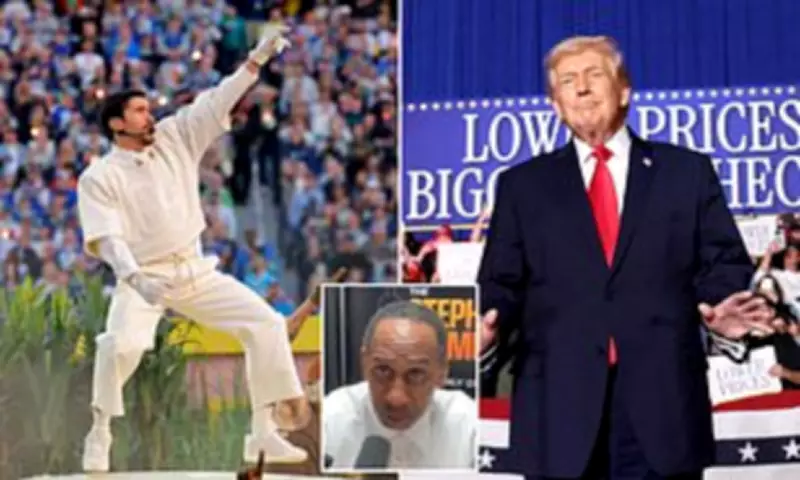
Stephen A. Smith Endorses Trump's View on Bad Bunny's Super Bowl Performance
ESPN personality Stephen A. Smith has publicly concurred with former President Donald Trump's disapproval of Bad Bunny's Super Bowl halftime show, which was conducted entirely in Spanish. The celebrated Puerto Rican artist, whose real name is Benito Antonio Martínez Ocasio, headlined the spectacle at Super Bowl LX, where the Seattle Seahawks decisively defeated the New England Patriots with a score of 29–13.
A Celebration of Latin Culture Sparks Controversy
Bad Bunny, acclaimed as Spotify's most-streamed artist of 2025, delivered a vibrant tribute to Latin and Hispanic heritage during the halftime show at Levi's Stadium in California. He was joined by an array of notable figures, including Lady Gaga, Pedro Pascal, Ricky Martin, Jessica Alba, Karol G, and Cardi B. The performance featured his chart-topping hits such as 'Debí Tirar Más Fotos' and 'Tití Me Preguntó,' set against a backdrop designed to evoke a sugarcane plantation, complete with domino players, a Latino wedding scene, and utility poles for climbing.
Despite the artistic celebration, the all-Spanish nature of the show drew criticism from various quarters, most prominently from Donald Trump. The former president lambasted the performance on his Truth Social platform, describing it as 'absolutely terrible' and a 'slap in the face' to the United States. Trump argued that the show lacked inspiration and was inaccessible to many Americans due to the language barrier, also condemning certain suggestive dance moves as inappropriate for young audiences.

Smith's Nuanced Agreement with Trump's Stance
In a recent episode of his self-titled show, Stephen A. Smith addressed the controversy, acknowledging that Trump had raised a legitimate concern. Smith emphasized that while he did not necessarily oppose the performance, the president's point about millions of Americans being unable to understand the lyrics was valid. He suggested that incorporating some English-language songs could have enhanced the experience for a broader audience.
'If most people don't understand it because you're speaking it in what they deemed to be a foreign language, that is a legitimate point that the president made,' Smith stated. 'There's millions upon millions of Americans that would have wanted to hear something in English other than Lady Gaga. That is true.'
Smith further expressed personal disappointment at the absence of artists like Jennifer Lopez or Shakira, who could have celebrated Hispanic heritage while potentially bridging the language gap. However, he clarified that his agreement with Trump was limited to the language issue, not the overall merit of the show.
Political and Cultural Divisions Amplified
The halftime show also highlighted deeper cultural and political divides. Bad Bunny, a vocal critic of Trump's Immigration and Customs Enforcement (ICE) agency, incorporated subtle political messages into his performance. He held a football inscribed with 'Together, we are America' while listing countries across the Americas, and a screen displayed the message: 'The only thing more powerful than hate is love.' In a poignant moment, he placed his hand on a young actor's head and handed him a Grammy, a gesture some initially mistook for a reference to a child detained by ICE.
In response to the mainstream halftime show, Turning Point USA organized an alternative 'All-American Halftime Show' on YouTube, featuring Kid Rock, Brantley Gilbert, Lee Brice, and Gabby Barrett. This stream attracted over 5 million viewers at its peak, underscoring the polarized reactions to Bad Bunny's performance. The alternative show was initially planned for X but faced last-minute licensing issues, redirecting audiences to YouTube.
Trump's critique extended beyond language, as he reiterated his disdain for the NFL's kickoff rule in his social media post, concluding with his signature 'Make America Great Again' slogan. The controversy surrounding Bad Bunny's show thus encapsulates broader debates about cultural representation, language accessibility, and political expression in high-profile American events.