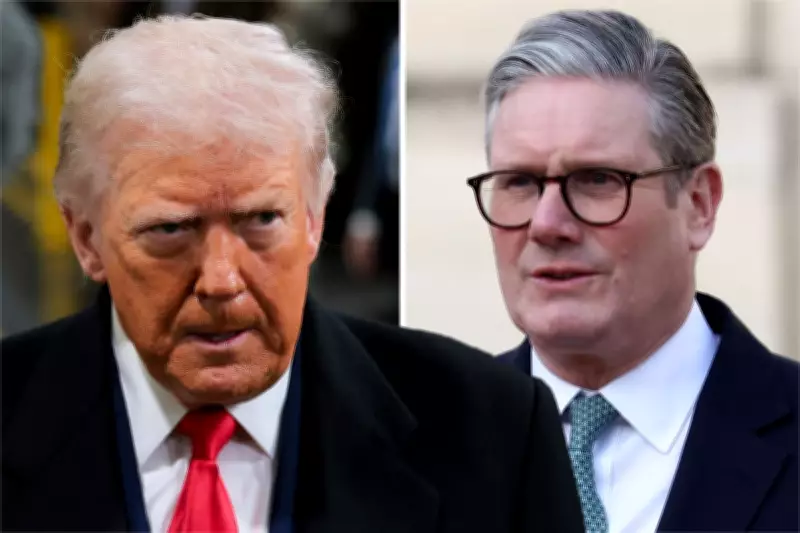
Starmer Defiantly Rejects Trump's Criticism Over Iran Stance
Prime Minister Keir Starmer has delivered a defiant response to Donald Trump, firmly defending his decision not to permit British military bases to be used by the United States for initial offensive strikes against Iran. In a statement to the House of Commons, Starmer declared, "I stand by my decision," emphasising that his primary duty is to judge what serves Britain's national interest.
Learning from the Past: The Shadow of Iraq
Sir Keir explicitly warned that his government had "learnt the lessons of Iraq," a clear reference to former Prime Minister Tony Blair's controversial decision in 2003 to support the US-led invasion. He stressed that any UK actions must always have a lawful basis, stating, "How we operate on the world stage matters so much. We all remember the mistakes of Iraq and we have learned those lessons."
The prime minister clarified that while he granted permission on Sunday for the US to use UK bases to target Iran's missile launchers and stores defensively—to help protect countries targeted by Tehran—he refused initial authorisation for the US to use the UK-US Diego Garcia base on the Chagos Islands as part of an offensive operation.

Trump's Disappointment and Escalating Tensions
President Trump expressed being "very disappointed" with Sir Keir over the initial refusal, claiming it "took far too long" for the prime minister to change his mind regarding defensive use of bases. This rebuke came as Trump warned that the "biggest wave" of attacks on Iran was yet to come, signalling a rapid escalation in the Middle East conflict.
An Iranian drone attack on the Akrotiri RAF base in Cyprus on Sunday night, which occurred after the prime minister's defensive authorisation, was highlighted as an example of Iran's "indiscriminate" retaliation. Sir Keir noted this attack was initiated before his decision and pointed out that bases in Cyprus were unsuitable for American use regardless.
"It is clear that Iran's outrageous response has become a threat to our people, our interests and our allies, and it cannot be ignored," Starmer stated. However, he insisted, "We are not at war and we are not getting involved in the offensive action the US and others are taking."
Political Reactions and National Security Concerns
The prime minister's statement received a mixed political response. Labour MPs largely welcomed his commitment to international law, while Conservative and Reform UK critics argued he failed to clearly state whose side the UK is on.
Conservative leader Kemi Badenoch criticised Starmer, saying, "Unbelievably in his statement today, the prime minister still cannot say whether he backs the strikes or not." She questioned why international law seemed "at odds with our national interest" under his leadership.
Conversely, Labour's foreign affairs committee chair Emily Thornberry acknowledged the US-Israel attack on Iran was "ill-advised, ill-judged and illegal," but condemned Iran's reckless bombardment of Gulf neighbours. She inquired about UK collaboration with Ukraine to counter Iranian Shahed drones, given Ukraine's expertise in drone warfare.
Sir Keir confirmed, "Ukraine, sadly, has more expertise than anyone in dealing with drones, and that's why we're putting their expertise and our expertise together and using it to help our allies in the region."
Evacuation Plans and Parliamentary Scrutiny
With approximately 300,000 Britons in countries targeted by Iran—102,000 of whom have registered with the Foreign Office—contingency plans, including potential mass evacuation, are being developed. The situation underscores the grave human security dimensions of the conflict.
Veteran Labour MP Diane Abbott warned that "the shadow of Iraq" loomed over the decision, while several MPs pressed Sir Keir to guarantee that the UK would not enter the war without a parliamentary vote, emphasising democratic accountability in matters of military engagement.
This stance marks a significant moment in UK foreign policy, balancing alliance obligations with independent strategic judgement amidst a volatile international crisis.