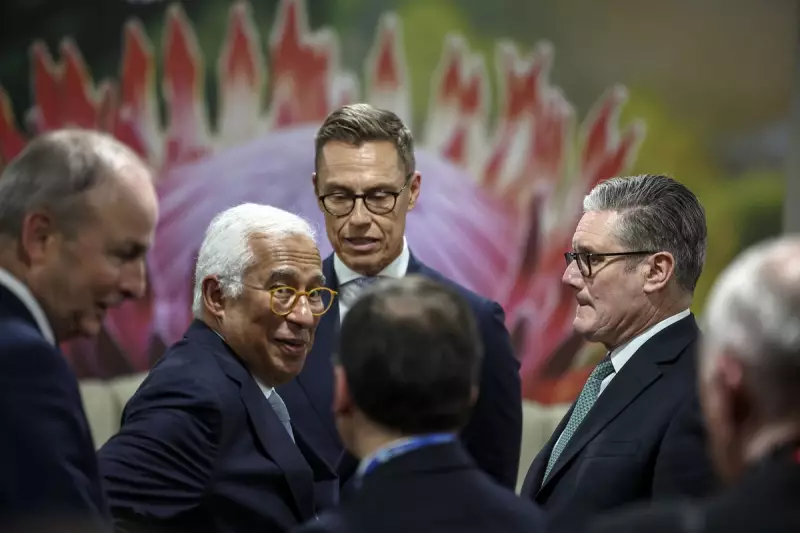
Sir Keir Starmer has joined other world leaders in raising serious concerns about a controversial US-drafted peace plan for Ukraine, describing it as merely "a basis which will require additional work" during critical discussions at the Johannesburg G20 summit.
International Unity Against Forceful Border Changes
The Prime Minister united with twelve other European and international leaders to issue a powerful joint statement emphasising that "borders must not be changed by force" - a clear response to Washington's proposed agreement that would see Ukraine make significant concessions including surrendering territory to Russia.
According to reports, the United States had been secretly pressing Kyiv to accept an agreement it drafted with Moscow without consulting Ukraine or its European allies. The proposed 28-point plan would require the invaded nation to make major compromises, including reducing the size of its military forces, potentially leaving the country vulnerable to future aggression.
Diplomatic Concerns Over Military Limitations
In their carefully worded response, the coalition of leaders acknowledged American efforts while expressing specific reservations. "We welcome the continued US efforts to bring peace to Ukraine," the statement read. "The initial draft of the 28-point plan includes important elements that will be essential for a just and lasting peace."
However, the leaders highlighted particular unease about provisions that would restrict Ukraine's defensive capabilities. "We are also concerned by the proposed limitations on Ukraine's armed forces, which would leave Ukraine vulnerable to future attack," they stated unequivocally.
The diplomatic gathering saw Sir Keir Starmer engage in 25-minute talks with France's Emmanuel Macron and Germany's Friedrich Merz before expanding discussions to include leaders from Japan, Canada, Italy, Norway and European Union representatives.
Complex Negotiation Landscape
The controversial peace proposal is understood to have been negotiated between US president's special envoy Steve Witkoff and Kremlin representative Kirill Dmitriev, conspicuously excluding both Ukrainian officials and European allies from the process.
As diplomatic tensions escalate, officials from the United States and Ukraine are scheduled to hold crucial talks in Geneva on Sunday, with Mr Witkoff and US secretary of state Marco Rubio expected to represent American interests. National security advisers from the UK, France and Germany are also anticipated to attend these critical discussions.
The political pressure continues to mount, with Donald Trump telling Fox News Radio on Friday that he wanted a response to the peace plan from Ukraine by Thursday, though suggesting a potential extension might be possible. The former president told reporters that Ukrainian President Volodymyr Zelensky is "going to have to approve it."
Russian President Vladimir Putin, who like Mr Trump is not attending the gathering of world economic leaders, offered cautious approval of the American proposal, saying it "could form the basis of a final peace settlement." However, he noted the plan hadn't been substantially discussed with Russian officials, suggesting this might indicate Washington's inability to secure Ukraine's consent.
Earlier on Friday, President Zelensky captured the gravity of the situation in a video address to his nation, describing Ukraine's position as facing "one of the most difficult moments" in its history, torn between "losing its dignity or the risk of losing a key partner."
The joint statement concluded with a reaffirmation of continued support for Ukraine, pledging close coordination "with Ukraine and the US over the coming days" as diplomatic efforts intensify. The united front included signatures from France, Germany, Japan, Canada, Italy, Norway, the Netherlands, Spain, Finland, Ireland, the EU Commission and EU Council alongside the United Kingdom.