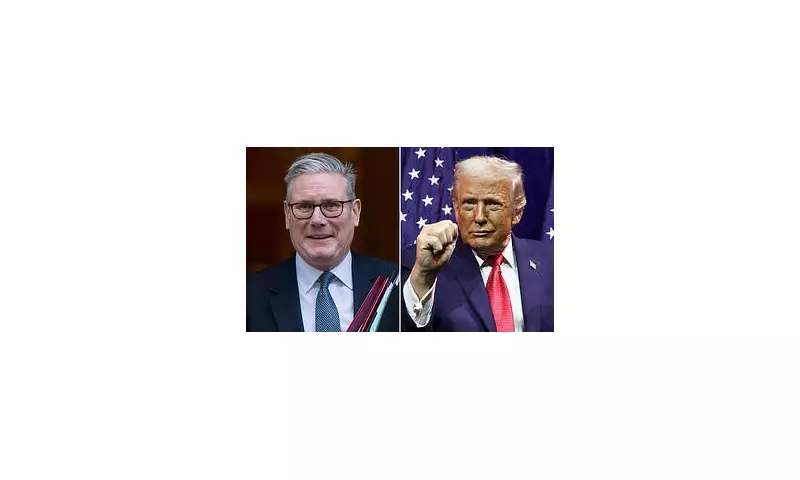
Prime Minister Keir Starmer launched a desperate diplomatic offensive on Thursday night in a bid to convince former US President Donald Trump that Nato is capable of defending the Arctic without Washington seizing control of Greenland.
High-Stakes Calls to Avert an Alliance Crisis
The Prime Minister engaged in a whirlwind series of calls, speaking first with Danish Prime Minister Mette Frederiksen and Nato Secretary General Mark Rutte, before holding his second conversation with President Trump in just two days. The dispute over Greenland's future has escalated into a major threat to the unity of the transatlantic alliance, with European leaders firmly backing Denmark.
Downing Street revealed that Sir Keir attempted to persuade Mr Trump that Europe was already actively defending Arctic interests, but ultimately acknowledged that more could be done to bolster security in the region. A government statement noted the leaders had "discussed Euro-Atlantic security and agreed on the need to deter an increasingly aggressive Russia in the High North."
The Greenland Gambit and Russian Deterrence
President Trump's controversial plan to acquire Greenland—whether through purchase or military action—has drawn fierce criticism from political opponents and allies on both sides of the Atlantic. Critics allege his true interest lies in the territory's vast reserves of minerals and rare-earth energy supplies.
In his call with the Danish leader, Sir Keir reiterated the UK's position. Both agreed on "the importance of deterring Russian aggression in the High North and that Nato should step up in the area to protect Euro-Atlantic interests." This sentiment was echoed in discussions with Nato's Mark Rutte, where both leaders concurred that more needed to be done to counter Moscow's threats in the Arctic.
The crisis has reached such a pitch that Danish PM Mette Frederiksen has previously warned that if the US militarily attacked another Nato member, "then everything stops." Such a scenario could theoretically pit US and Danish troops against each other, despite their longstanding cooperation in defending Greenland.
Diplomatic Showdown Looms
US Secretary of State Marco Rubio has informed American politicians that the Trump administration's preferred method is to purchase Greenland, not use military force. He has arranged crisis talks for next week, where White House advisers will aim to negotiate a peaceful transition for the world's largest island.
Greenland, while self-governing, remains part of the Kingdom of Denmark, though its 57,000 inhabitants largely favour independence from Copenhagen. The Greenlandic government has confirmed it will participate in the upcoming US-Denmark meeting announced by Secretary Rubio.
The fundamental objection from European capitals is that the US could easily collaborate with allies to strengthen the island's defences without challenging Danish sovereignty, thereby avoiding the severe damage Trump's plans are inflicting on Nato cohesion. French President Emmanuel Macron has condemned the "law of the strongest" that is making people "wonder if Greenland will be invaded."
As the diplomatic clock ticks, Sir Keir's frantic efforts underscore the profound alarm in European chancelleries that a dispute over a remote Arctic territory could unravel the very alliance designed to guarantee their security.