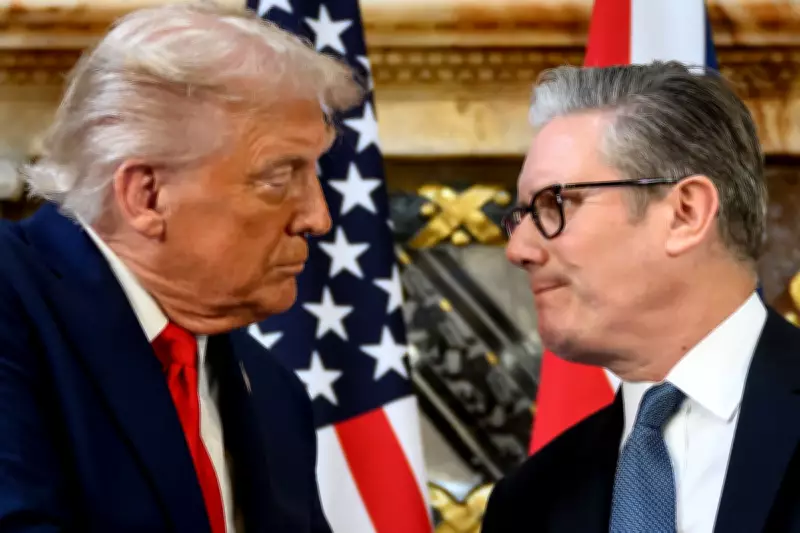
The conduct of world leaders during times of international tension often defines their legacies, with recent events underscoring a stark contrast between British Prime Minister Keir Starmer and former US President Donald Trump. As Trump's provocative social media outbursts threaten to escalate conflicts, Starmer's steadfast and dignified approach offers a model of statesmanship in an increasingly volatile global landscape.
A Tale of Two Leaders: Decorum Versus Desperation
Imagine, for a moment, if Keir Starmer adopted the brash style of Donald Trump. Picture Prime Minister's Questions transformed into a spectacle of expletives, with Starmer swapping parliamentary niceties for crude insults directed at political opponents. While such behaviour might inject drama into Westminster, it would starkly deviate from the norms of British politics, emphasising the profound gulf between Starmer's professionalism and Trump's often juvenile antics.
Trump's recent post on Truth Social exemplifies this divide. In a rant targeting Iran, he wrote, "Open the F****n' Strait, you crazy bastards, or you'll be living in Hell — JUST WATCH." This threat to civilian infrastructure over the Strait of Hormuz, a critical chokepoint for global oil supplies, was met with warnings from the Iranian military of "devastating and widespread" consequences. Beyond the immediate geopolitical risks, Trump's language reveals a desperation that contrasts sharply with Starmer's measured responses.

Starmer's Steadfast Stance Amid Mounting Pressure
Keir Starmer is not without controversy in this crisis. His government has permitted the use of British bases for US defensive operations in Iran and deployed HMS Dragon with Royal Navy helicopters to enhance security in the eastern Mediterranean. However, he has firmly resisted calls for offensive action, refusing to join the US and Israel in aggressive moves to reopen the Strait of Hormuz or commit British troops to ground operations in Iran.
In a statement this week, Starmer articulated his position with characteristic composure: "Whatever the pressure on me and others, whatever the noise, I'm going to act in the British national interest in all the decisions that I make. And that's why I've been absolutely clear that this is not our war and we're not going to get dragged into it." This resolve persists despite reports that his stance has strained his relationship with Trump, who has mocked Starmer publicly, imitating him in a falsetto voice and deriding British military contributions.
The Global Fallout of Trump's Actions
Trump's confrontational approach has far-reaching implications. His threats have contributed to economic instability, with inflation soaring, oil and gas prices surging, and fears of a global recession intensifying. Additionally, his actions have inadvertently bolstered adversaries like Vladimir Putin, as rising energy prices enhance the value of Russia's reserves. Trump has further complicated alliances by threatening US withdrawal from NATO and urging European partners to take reckless actions in the Strait of Hormuz.
Amid this chaos, Starmer's ability to remain unruffled—akin to Marty McFly resisting taunts in Back to the Future—demonstrates a strength of character crucial in today's world. His resilience in the face of Trump's bullying tactics, including private insults and public ridicule, highlights a leadership style prioritising national interest over personal provocation.
Conclusion: Choosing Leadership in Turbulent Times
As the world grapples with economic peril and escalating conflicts, the choice between Starmer's decorum and Trump's desperation becomes increasingly clear. While Trump's erratic behaviour fuels global uncertainty, Starmer's calm and principled stance offers a beacon of stability. In this high-stakes environment, the value of statesmanship over bluster cannot be overstated, reminding us that true leadership often lies in quiet resolve rather than loud threats.