Takaichi Reaffirms US Alliance Amid Iran War and Strait of Hormuz Tensions
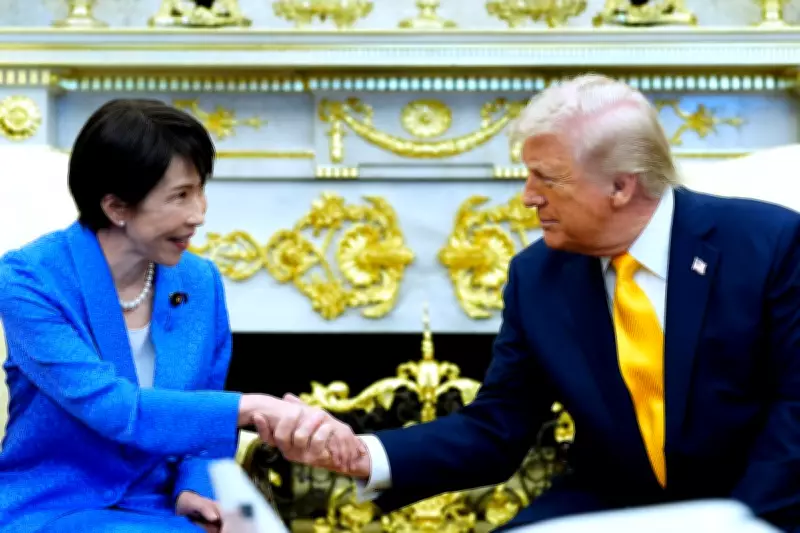
Japanese Prime Minister Sanae Takaichi sought to reaffirm her nation's alliance with President Donald Trump during a high-stakes meeting at the White House on Thursday. This diplomatic effort came after Trump publicly complained that Japan and other allies had not swiftly joined his call to help protect the critical Strait of Hormuz, a vital waterway for global oil and gas transport.
Warm Words and Underlying Tensions
During their roughly 30-minute public appearance in the Oval Office, the two leaders exchanged compliments, with Trump praising Takaichi as a "popular, powerful woman." However, underlying tensions surfaced as reporters repeatedly questioned Japan's support for the ongoing war with Iran. Takaichi, speaking through an interpreter, acknowledged the "very severe security environment" in the Middle East and globally, but expressed firm belief that only Trump could achieve worldwide peace.
Observers noted visible discomfort during the exchange. Takaichi was seen checking her watch, and Trump made a particularly awkward remark invoking Japan's 1941 attack on Pearl Harbor when asked about not notifying allies ahead of U.S. strikes on Iran. "We didn't tell anybody about it because we wanted surprise. Who knows better about surprise than Japan?" Trump joked, causing Takaichi's smile to fade as she raised her eyebrows.

Strait of Hormuz and Nuclear Reactor Deal
The Strait of Hormuz emerged as a central point of discussion. Trump emphasized that much of Japan's oil passes through this strategic chokepoint, stating "so that's a big reason to step up." He referenced U.S. military spending in Japan and troop deployments, clearly expecting greater Japanese support. Earlier that day, Japan had joined five European nations in a joint statement demanding Iran cease attacks blocking commercial shipping through the strait, though specific contributions remained undefined.
Beyond security matters, the leaders were expected to announce a significant $40 billion nuclear reactor deal. According to a White House official speaking anonymously, U.S.-based GE Vernova Inc. and Japan's Hitachi Ltd. would collaborate to build advanced small modular reactors in Tennessee and Alabama, aiming to stabilize electricity prices and expand U.S. power generation.
Constitutional Constraints and Regional Implications
Japan faces significant constitutional limitations regarding military involvement in Iran. Its post-World War II constitution prohibits the use of force except for territorial defense, with its military officially termed the Self-Defense Force. Experts noted that while Japan could potentially assist with minesweeping and has maintained a small naval presence in the region for anti-piracy missions, joining the U.S. mission would require Takaichi to clear "an exceptionally high bar politically to invoke collective self-defense"—a move never before undertaken.
The meeting carried substantial geopolitical implications. Kurt Campbell, former U.S. deputy secretary of state, suggested Takaichi needed to position Japan as part of U.S. Middle East strategy to gain leverage on other concerns, particularly regarding Taiwan. Meanwhile, Christopher Johnstone of The Asia Group warned that U.S. troop shifts from Japan to the Middle East could weaken deterrence in East Asia, especially as China increases military exercises around Taiwan.
Broader Context and Delayed China Trip
Takaichi, Japan's first female prime minister and a protégé of former leader Shinzo Abe, had initially hoped to focus on trade and Indo-Pacific security during her Washington visit. However, the Iran war and Strait of Hormuz dispute dominated discussions, even delaying her planned trip to China. Japanese officials had anticipated discussing deepened cooperation in regional security, critical minerals, energy, and China relations.
The prime minister had acknowledged before departing Japan that her meeting with Trump would be "very difficult," a prediction borne out by the complex negotiations over military support and alliance commitments. As global tensions escalate, this diplomatic encounter highlighted both the enduring strength and underlying strains in the U.S.-Japan relationship during a period of international uncertainty.