Toxic Rain Alert Issued for Tehran Following Israeli Bombardment of Oil Depots
Iran's Red Crescent society has issued a severe public health warning, stating that Tehran could soon experience toxic rainfall capable of causing chemical burns and significant lung damage. This alarming advisory comes directly after Israeli military forces targeted oil storage facilities within the Iranian capital. The humanitarian organisation delivered a dire notification early this morning, cautioning residents of Tehran that they now face serious risks of developing chronic lung and skin diseases as a consequence of last night's intense bombardment campaign.
Critical Health Precautions for Citizens
The non-governmental organisation provided explicit instructions to Tehran's inhabitants, urging them to remain indoors even after rainfall ceases. The warning emphasised that 'evaporation of acid droplets from the hot ground or surfaces increases the concentration of toxins in the breathing air by several times.' Furthermore, citizens were advised to meticulously wipe down all food containers, including those that are sealed, because 'microscopic acidic particles on the container wall can contaminate the contents when opened.'
In additional guidance, the Red Crescent society recommended that residents replace their water filtration systems wherever possible. The advisory noted that toxic water resulting from the attacks could rapidly destroy older, less robust filters, compromising water safety.
Hellish Scenes from Tehran Bombing Campaign
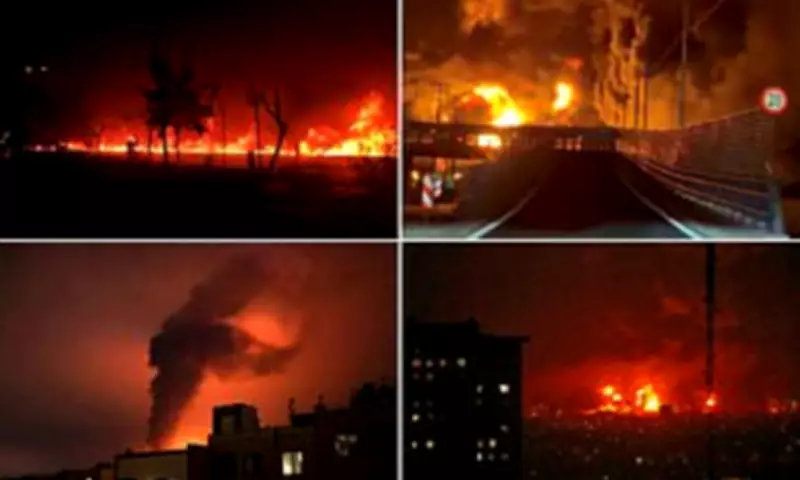
Disturbing footage from last night's military strikes against Tehran has emerged, depicting catastrophic fires and immense plumes of smoke. Harrowing video showed a massive inferno erupting from the Shahran oil depot in north-west Tehran, with an impossibly tall column of smoke consuming the night sky. This attack appears to mark the first instance in the conflict where a civilian industrial facility has been deliberately targeted.
Additional fires were seen raging through city streets as ignited oil infiltrated the sewer system, illuminating entire roadways. Residents throughout Tehran reported a persistent burning odour lingering in the air. These developments occurred as both the United States and Israel reinforced their commitment to continue fighting until what they term the 'eradication' of the Iranian regime.
Regional Conflict Escalation and Civilian Impact
The Middle Eastern war continues to intensify dramatically. Today, Israeli forces conducted strikes against southern Lebanon, Beirut, and additional oil storage facilities in Tehran. Israeli Prime Minister Benjamin Netanyahu has promised 'many surprises' for the next phase of the ongoing conflict. In a retaliatory move, Iran struck a desalination plant in Bahrain, with Iranian Foreign Minister Abbas Araghchi noting that such infrastructure is critical for drinking water supplies in the arid Gulf region.
The conflict, which erupted on February 28th following joint US-Israeli strikes against Iran, has resulted in substantial casualties. Official reports indicate at least 1,230 fatalities within the Islamic Republic, more than 300 in Lebanon, and approximately a dozen in Israel. The Iranian Health Ministry disclosed on Sunday that US and Israeli strikes in Iran have killed 200 children and around 200 women among the total casualties.
Tragically, the conflict has claimed civilian lives beyond the immediate warzone. A Pakistani driver was killed overnight in Dubai when debris from an aerial interception fell on his vehicle, marking the second death of a Pakistani national there in recent days. Pakistan's Prime Minister Shehbaz Sharif expressed profound grief over these deaths. Additionally, two other civilians from Nepal and Bangladesh have been killed by missile debris in Dubai since the war's inception.
Global Economic Repercussions and Political Statements
Iran's parliament speaker, Mohammad Bagher Qalibaf, declared today that oil prices will continue to surge, inflicting significant pain on the global economy for as long as the Middle Eastern war persists. Oil prices have skyrocketed since the initial US and Israeli attack on Iran, reaching their highest levels since 2023. The price for a barrel of Brent crude jumped 8.5% to $92.69 on Friday, while benchmark US crude climbed 12.2% to $90.90 per barrel.
Qalibaf warned in a social media post, 'If the war continues like this, there will be neither a way to sell oil nor the ability to produce it.' He asserted that the conflict's impact extends beyond the United States to affect the entire Middle East and the world, attributing the situation to 'Netanyahu's delusions.'
Iranian President Masoud Pezeshkian has threatened to escalate attacks on American targets throughout the Middle East as the US-Israeli air campaign continues. In video comments made on Sunday, Pezeshkian stated, 'When we are attacked, we have no choice but to respond. The more pressure they impose on us, the stronger our response will naturally be.' He emphasised that Iran 'will not bow easily in the face of bullying, oppression or aggression.'
These remarks appeared to backtrack from more conciliatory comments made toward Gulf neighbours on Saturday, which were quickly contradicted by Iranian hard-liners. Pezeshkian clarified that Iran seeks no conflict with neighbouring Arab countries, describing them as 'our brothers,' while accusing the United States of attempting to pit regional nations against each other.
Infrastructure Attacks and Military Developments
Bahrain has reported that an Iranian drone attack caused material damage to a desalination plant, marking the first time an Arab nation has stated Iran targeted such a facility during the nine-day war. Hundreds of desalination plants line the Persian Gulf coast, with Arab countries heavily reliant on these facilities for drinking water. Meanwhile, Israel's military announced on Sunday that it struck a series of F-14 fighter jets, purchased by pre-revolutionary Iran from the United States, which were parked at Isfahan Airport south of Tehran. The Israeli military did not confirm whether the jets were destroyed but stated it had also targeted detection and air defence systems.
The skies over Tehran transformed into a haunting shade of red, filled with acrid smoke after several oil and fuel depots were destroyed. As missile alerts sounded in Dubai on Sunday morning, the regional conflict shows no signs of abating, with profound implications for public health, regional stability, and the global economy.