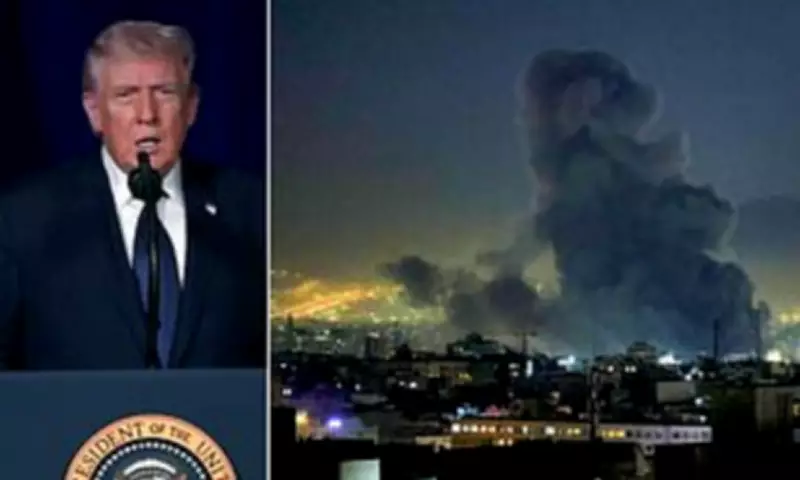
Trump Announces Iran's Willingness for Peace Negotiations After Supreme Leader's Death
In a significant development amid escalating Middle Eastern hostilities, US President Donald Trump has revealed that Iran is prepared to initiate discussions towards a peace agreement. This announcement follows the death of Iran's Supreme Leader, Ayatollah Ali Khamenei, who was killed in an Israeli air strike over the weekend.
Diplomatic Overture Amid Regional Turmoil
President Trump confirmed to The Atlantic magazine that Iran's interim leadership has made contact with the United States, stating emphatically: 'I will be talking to them.' This diplomatic gesture emerges after a day of intense bombardments across the region, creating a glimmer of hope for peace as hundreds of British troops remain on defensive alert and thousands of UK citizens find themselves stranded.
'They should have done it sooner,' Trump remarked regarding Iran's approach. 'They should have given what was very practical and easier to do sooner.' The President also provided an update on the US military offensive in Iran, codenamed Operation Epic Fury, asserting that it is 'ahead of schedule and moving along very well.'

In comments that appeared to reference reluctant allies, Trump added: 'We're doing our job. Not just for us, but for the rest of the world.'
Escalating Conflict and Regional Fallout
The death of Ayatollah Khamenei on Saturday triggered immediate retaliation from Iran, with missiles and drones threatening Western interests throughout Sunday. Iran further escalated tensions by threatening to blockade the Strait of Hormuz, a strategic move designed to disrupt global oil markets upon their reopening.
The International Maritime Organisation reported casualties aboard commercial vessels targeted in the Gulf, while three US troops were killed and many more wounded by Iranian rocket fire at bases in northern Iraq and across the region.
British forces have been actively engaged in defensive operations:
- An RAF Typhoon intercepted a drone over Qatar
- Hundreds of personnel implemented defensive measures in Bahrain, Cyprus, and other locations
- UK troops were positioned 'within several hundred yards' of where Iranian missiles landed, according to Defence Secretary John Healey
Political Divisions and Military Responses
Despite Iranian attacks on UK military installations, Prime Minister Sir Keir Starmer has maintained that British troops will not participate in offensive actions. This stance has drawn criticism from former Defence Secretary Ben Wallace, who accused Starmer of 'thinking like a lawyer rather than a politician.'
Current Defence Secretary John Healey defended the UK's position, stating: 'We're taking down the drones that are menacing our bases, our people and our allies. This is a really serious and deteriorating situation.' He confirmed there have been no British casualties despite the proximity to conflict zones.
Widening Regional Impact
The conflict has produced significant casualties and damage across multiple nations:
- Iran: Approximately 48 senior officials killed since Saturday, with the death toll exceeding 200 after missiles struck a girls' school
- Israel: Nine people killed in Beit Shemesh, with buildings destroyed in Tel Aviv
- Kuwait: One fatality and 32 injuries, with minor damage at Kuwait International Airport
- United Arab Emirates: Three deaths and 58 wounded, including strikes on Dubai International Airport
Satellite imagery revealed substantial plumes of black smoke rising from Dubai's Jebel Ali port, where Iranian forces struck a US Navy warehouse. A French naval base in Abu Dhabi was also hit, though Iranian claims of threatening the USS Abraham Lincoln aircraft carrier proved unfounded.
Strategic Developments and Future Concerns
The US military announced the destruction of Iran's Revolutionary Guard Corps headquarters, while coordinated US-Israeli cyber-attacks disabled Iranian government websites. Iran has entered what it describes as a 'transitional phase' under the leadership of President Masoud Pezeshkian and judiciary chief Gholam-Hossein Mohseni-Ejei.

With Israel mobilizing 100,000 additional troops and reports suggesting potential offensives in the Occupied Territories, fears of broader regional conflict continue to mount. The situation remains fluid, with diplomatic channels now potentially opening even as military engagements persist across the Middle East.