The First 48 Hours of Trump's Devastating Iran Campaign
In a dramatic escalation of tensions, President Donald Trump authorized a massive military operation against Iran that unfolded over two devastating days, resulting in hundreds of casualties including Iran's Supreme Leader and multiple American service members. The operation, codenamed "Operation Epic Fury," saw more than 10,000 rounds of munitions fired and over 1,000 targets hit within the first 24 hours alone.
The Final Order and Campaign Rally
At 3:38 p.m. EST on Friday, February 28, 2026, President Trump gave the final authorization for strikes through Defense Secretary Pete Hegseth. The message to U.S. Central Command was brief and definitive: "Operation Epic Fury is approved. No aborts. Good luck. Close."
Remarkably, just one hour later, Trump took the stage at a campaign rally in Corpus Christi, Texas, where he told supporters about a "big decision" facing the country. "I'd rather do it the peaceful way, but very difficult people," he declared, having already set in motion what would become one of the most significant military operations of his presidency.

Between Burgers and Bombs
After concluding his rally speech at 5:47 p.m., the president visited a Whataburger restaurant in Texas, where he shook hands with diners and staff while wearing a "Gulf of America" hat. He left with a bag of cheeseburgers, telling the crowd, "I'm gonna take this and I'm gonna be thinking about you." Trump then boarded a plane for his Mar-a-Lago residence in Palm Beach, Florida, arriving at 8:37 p.m.
Meanwhile, military preparations were intensifying. The U.S.S. Gerald R. Ford aircraft carrier, which had been redeployed across the Atlantic Ocean in the weeks leading up to the attack, was preparing for combat operations. According to General Dan Caine, chair of the Joint Chiefs of Staff, "The ship, her crew, their families and the entire strike group took a deep breath, and as they always do, began planning to conduct combat operations."
Operation Epic Fury Begins
At 1:15 a.m. EST on Saturday, February 29 (9:45 a.m. in Tehran), "major combat operations" commenced. General Caine described how "the skies surged to life" as more than 100 aircraft launched in "a single, synchronized wave." U.S. Navy vessels fired Tomahawk missiles from the sea while precision stand-off weapons were deployed on the ground.
Just over an hour later, at 2:30 a.m., President Trump published an eight-minute video to his Truth Social platform. Standing behind a podium bearing the presidential seal, he announced that the United States had begun "major combat operations in Iran." His message to the Iranian people was stark: "Bombs will be dropping everywhere. When we are finished, take over your government. It will be yours to take. This will be probably your only chance for generations."
Mar-a-Lago Monitoring and Mounting Casualties
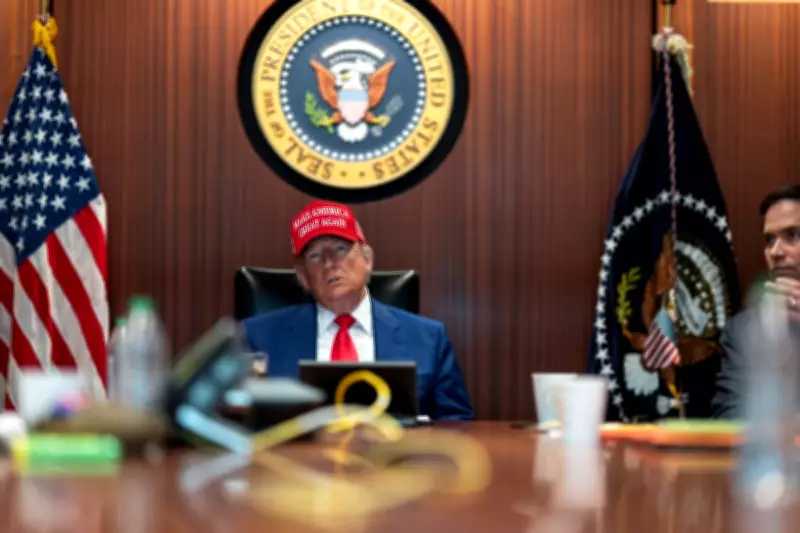
As the attacks unfolded, Trump was pictured at Mar-a-Lago wearing a white "USA" hat in gold letters, sitting with Secretary of State Marco Rubio and White House chief of staff Susie Wiles in a curtained-off room. A map of the Middle East showing U.S. ship deployments was installed above them.
The president attended a fundraising event for Place of Hope, a faith-based foster program, where the Trump-linked MAGA Inc. super PAC fundraiser reportedly carried a $1 million entry fee. Video posted online showed Trump wearing a gold tie, shaking hands in an ornate ballroom, and dancing to The Village People's "YMCA."
By Sunday, March 1, the human cost was becoming clear. U.S. Central Command confirmed three Americans were killed in the opening salvo, with a fourth service member dying from wounds by Monday morning. Iran state media confirmed the death of Supreme Leader Ayatollah Ali Khamenei, while Iran's Revolutionary Guard warned of "severe, decisive and regret-inducing punishment" to follow.
Military Assessment and Regional Fallout
In his March 2 briefing, General Caine revealed that U.S. joint forces had "delivered synchronized and layered effects designed to disrupt, degrade, deny and destroy Iran's ability to sustain and conduct combat operations." He described this as "the culmination of months and in some cases of years of deliberate planning and refinement against this particular target set."

American B52 bombers completed a 37-hour round trip from the continental United States to Iran to drop "precision penetrating munitions on Iranian underground facilities." After two days of fighting, the United States had established "local air superiority" over Iran, which Caine said would "enhance the protection of our forces" and allow them to "continue to work over Iran."
The operation sparked immediate international concern. Oman's defense minister Badr Albusaid, who had helped broker talks between the U.S. and Iran, wrote that he was "dismayed" by the attacks, noting that "active and serious negotiations have yet again been undermined."
As the 48-hour period concluded, the region braced for potential escalation, with fears mounting about a wider regional conflict and the long-term consequences of one of the most significant military actions in recent Middle Eastern history.